Substantive motion procedure and parliamentary rules in Lok Sabha
Source:Indian Express ↗
Why It Matters
Understanding different parliamentary motions (substantive, substitute, subsidiary) is a staple for UPSC Prelims (Polity). For Mains, the use of procedural devices against opposition figures touches upon democratic functioning, parliamentary privileges, and the independence of the legislature.
Summary
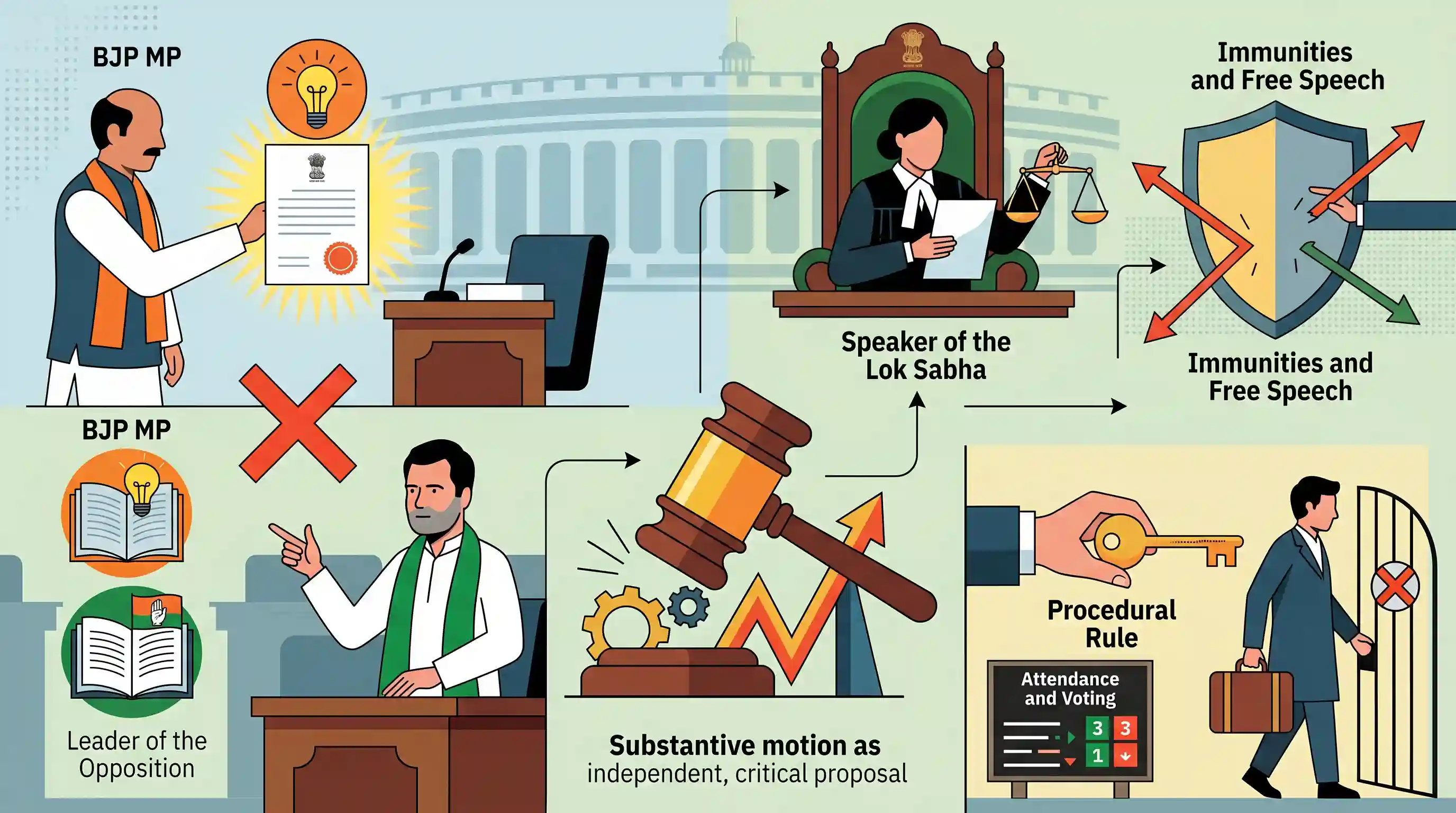
The article explores the concept of a 'substantive motion' in the Indian Parliament, triggered by a notice submitted by BJP MP Nishikant Dubey against Leader of the Opposition Rahul Gandhi. A substantive motion is an independent, self-contained proposal meant to elicit a specific decision from the House on matters of critical importance. The development highlights the procedural nuances of the Lok Sabha, the powers of the Speaker in admitting such motions, and the broader implications for parliamentary privileges, free speech, and the potential expulsion of a sitting Member of Parliament.
Key Points
- A 'substantive motion' is a self-contained, independent proposal submitted for the approval of the House, drafted in such a way as to be capable of expressing a decision of the House.
- Unlike substitute or subsidiary motions, a substantive motion deals with a subject of critical importance, such as the impeachment of high constitutional functionaries or serious disciplinary actions against Members of Parliament.
- The article discusses a specific instance where a substantive motion has been sought against the Leader of the Opposition, raising prospects of parliamentary disciplinary actions like suspension or expulsion.
- Admitting a substantive motion rests on the discretionary powers of the Speaker under the Rules of Procedure and Conduct of Business in the Lok Sabha, reflecting the procedural checks and balances within the Parliament.
Important Terms
Substantive Motion

A self-contained, independent proposal submitted for the House's approval, capable of expressing a specific decision on critical matters like the removal of high officials or censure.
UPSC context
GS Paper 2 (Polity); tests knowledge of parliamentary devices used to hold members or high authorities accountable.
Speaker of Lok Sabha
The presiding officer and guardian of the Lok Sabha's dignity, vested with the final authority to admit motions and interpret procedural rules under Article 93.
UPSC context
GS Paper 2 (Polity); tests the constitutional role and discretionary powers of presiding officers in legislative functioning.
Leader of the Opposition
Statutory head of the largest opposition party (minimum 10% House strength), serving as a counterbalance to the government and aiding in key statutory appointments.
UPSC context
GS Paper 2 (Polity); crucial for understanding parliamentary oversight, checks and balances, and the role of dissent.
Parliamentary Privileges
Special rights and immunities granted to MPs under Article 105 to ensure independent functioning, including freedom of speech and immunity from court proceedings for House actions.
UPSC context
GS Paper 2 (Polity); significant for topics on the powers and limitations of legislators and judicial-legislative relations.
Rules of Procedure and Conduct of Business in Lok Sabha
The framework of regulations formulated under Article 118, enabling the Speaker to manage House business and determine the admissibility of motions like Rule 186.
UPSC context
GS Paper 2 (Polity); tests understanding of the procedural mechanics that govern the daily functioning of Indian democracy.
Prelims Trap
"A substantive motion can be moved as an amendment to an ongoing parliamentary debate."
Substantive motions are strictly self-contained and independent. Motions depending on or modifying other pending business are subsidiary or substitute motions, never substantive.
Static Concepts Connected
What is the difference between Motions and Resolutions in Parliament?
- Nature of proposal: Every resolution is categorized as a substantive motion, whereas not all motions are substantive in nature.
- Voting requirement: All resolutions must invariably be put to a vote in the House, while only certain categories of motions require a formal vote.
What are the three principal categories of parliamentary motions?
- Substantive Motion: A self-contained, independent proposal dealing with highly critical subjects like the impeachment of the President or expulsion of members.
- Substitute Motion: A motion moved in substitution of an original motion to propose a complete alternative to the original text.
- Subsidiary Motion: A motion that depends on another motion or arises out of ongoing proceedings, such as a formal amendment.
Cross-Topic Patterns
Parliamentary Privileges vs RPA 1951
Expelling an MP via a substantive motion invokes Article 105 (Parliamentary Privileges). This is procedurally distinct from statutory disqualification under the Representation of the People Act (1951) or the Tenth Schedule.
Constitutional removals and substantive motions
The removal of Supreme Court judges, the CEC, and the CAG cannot be initiated casually; the process fundamentally requires moving a substantive motion before the special majority voting stage.

Expect a multi-statement Prelims question differentiating substantive, substitute, and subsidiary motions paired with Speaker powers.
Linked PYQs · 3
Linked PYQs · 3
- 2022PrelimsGS1
With reference to Deputy Speaker of Lok Sabha, consider the following statements: 1. As per the Rules of Procedure and Conduct of Business in Lok Sabha, the election of Deputy Speaker shall be held on such date as the Speaker may fix. 2. There is a mandatory provision that the election of a candidate as Deputy Speaker of Lok Sabha shall be from either the principal opposition party or the ruling party. 3. The Deputy Speaker has the same power as of the Speaker when presiding over the sitting of the House and no appeal lies against his rulings. 4. The well established parliamentary practice regarding the appointment of Deputy Speaker is that the motion is moved by the Speaker and duly seconded by the Prime Minister. Which of the statements given above are correct?
- 2018PrelimsGS1
Consider the following statements: 1. In the first Lok Sabha, the single largest party in the opposition was the Swatantra Party. 2. In the Lok Sabha, a "Leader of the Opposition" was recognised for the first time in 1969. 3. In the Lok Sabha, if a party does not have a minimum of 75 members, its leader cannot be recognised as the Leader of the Opposition. Which of the statements given above is/are correct?
- 2019MainsGS2
On what grounds a people's representative can be disqualified under the Representation of Peoples Act, 1951? Also mention the remedies available to such person against his disqualification.
