Paleoclimatic Hypothesis and Mechanics of Snowball Earth
Source:The Hindu ↗
Why It Matters
Understanding paleoclimatic extremes like Snowball Earth helps candidates grasp critical Earth system dynamics—such as the carbon cycle, the ice-albedo effect, and greenhouse gas regulation—which form the conceptual basis for studying contemporary climate change.
Summary
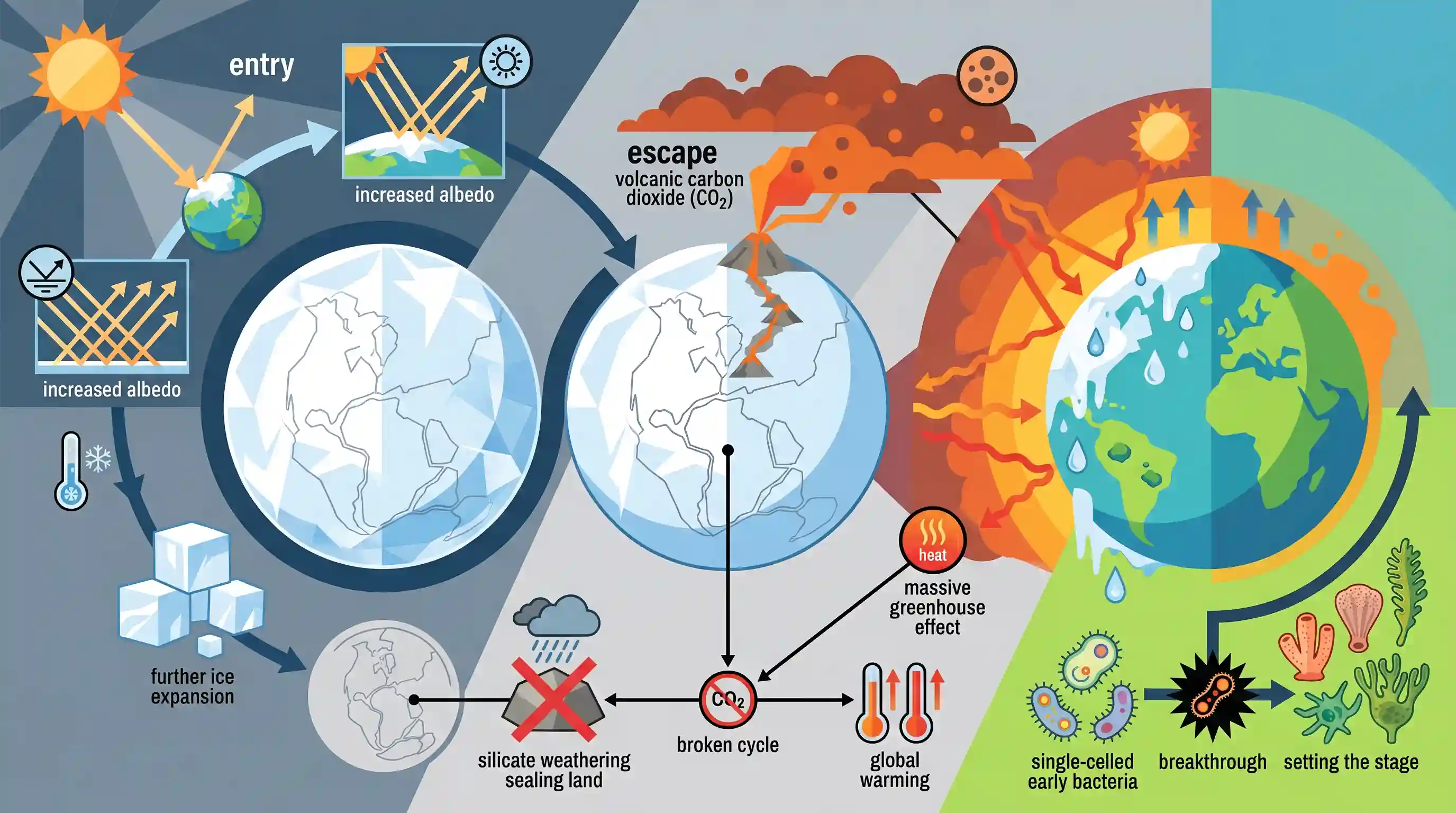
The article explores the 'Snowball Earth' hypothesis, a paleoclimatological concept suggesting that Earth experienced complete or near-complete glaciations millions of years ago. It explains the mechanics behind this extreme state, primarily the 'ice-albedo feedback' loop where expanding ice sheets reflect increasing amounts of sunlight, plunging the planet into a deep freeze. The escape mechanism highlights the Earth's natural carbon cycle: with landmasses sealed under ice, silicate weathering ceased, allowing volcanic carbon dioxide to accumulate and eventually trigger a massive greenhouse effect that melted the ice. This dramatic climate shift is closely linked to significant biological evolution, setting the stage for the emergence of complex multicellular organisms.
Key Points
- The 'Snowball Earth' hypothesis proposes that Earth's surface was entirely or almost entirely frozen during extreme glaciation events, primarily during the Cryogenian period (around 720 to 635 million years ago).
- The global freeze was driven by the 'ice-albedo feedback' loop: as ice sheets expanded from the poles, they reflected more solar radiation back into space, causing further cooling and more ice expansion.
- Earth escaped this frozen state through volcanic outgassing of carbon dioxide. Because the land was covered in ice, the chemical weathering of silicate rocks (which normally removes CO2 from the atmosphere) was halted, allowing greenhouse gases to build to extreme levels.
- The subsequent super-greenhouse effect caused rapid melting, leaving behind unique geological evidence such as 'cap carbonates' (thick layers of limestone over glacial deposits) and dropstones in paleo-equatorial latitudes.
- The intense environmental stress of Snowball Earth and the massive influx of nutrients into the oceans during the thaw are believed to have triggered major evolutionary leaps, leading to the rise of complex multicellular life.
Prelims Trap
Chemical weathering of silicate rocks released massive CO2, ending the Snowball Earth glaciation.
Silicate weathering actually removes CO2 from the atmosphere. It was the complete halting of this weathering (due to global ice cover) that allowed volcanic CO2 to accumulate.
Static Concepts Connected
What is the Albedo Effect and how does it drive climate feedback loops?
- Definition: The proportion of solar radiation reflected by a surface. Ice and snow have very high albedos (reflecting up to 80-90% of sunlight), while oceans have low albedos.
- Ice-Albedo Feedback: Cooling leads to ice expansion, which increases Earth's overall albedo, reflecting more sunlight and causing further cooling (a positive feedback loop).
What is the role of silicate weathering in the long-term Carbon Cycle?
- Mechanism: Atmospheric CO2 dissolves in rainwater to form weak carbonic acid, which chemically breaks down exposed silicate rocks on land.
- Geological Carbon Sink: The resulting ions wash into the ocean, where marine organisms use them to form calcium carbonate shells, locking carbon in rocks (limestone) for millions of years.
Cross-Topic Patterns
Paleoclimate and biological evolution
The massive nutrient runoff during the Snowball Earth thaw oxygenated oceans, acting as a geological catalyst for the Cambrian explosion of complex multicellular life.
Modern Arctic amplification
The same ice-albedo positive feedback loop that drove Snowball Earth's deep freeze is currently working in reverse, accelerating modern Arctic sea-ice loss and global warming.

Expect a paired statement question testing the 'ice-albedo feedback' alongside 'silicate weathering' as long-term climate regulators.
Linked PYQs · 5
Linked PYQs · 5
- 2022PrelimsGS1
Consider the following statements: 1. High clouds primarily reflect solar radiation and cool the surface of the Earth. 2. Low clouds have a high absorption of infrared radiation emanating from the Earth's surface and thus cause warming effect. Which of the statements given above is/are correct?
- 2021PrelimsGS1
In case of which one of the following biogeochemical cycles, the weathering of rocks is the main source of release of nutrient to enter the cycle?
- 2024PrelimsGS1
Consider the following statements: Statement-I: The atmosphere is heated more by incoming solar radiation than by terrestrial radiation. Statement-II: Carbon dioxide and other greenhouse gases in the atmosphere are good absorbers of long wave radiation. Which one of the following is correct in respect of the above statements?
- 2021MainsGS1
How do the melting of the Arctic ice and glaciers of the Antarctic differently affect the weather patterns and human activities on the Earth? Explain.
- 2022MainsGS3
Discuss global warming and mention its effects on the global climate. Explain the control measures to bring down the level of greenhouse gases which cause global warming, in the light of the Kyoto Protocol, 1997.
