Snowball Earth Hypothesis and Cryogenian Period Glaciation
Source:The Hindu ↗
Why It Matters
Understanding extreme paleoclimatic events like Snowball Earth helps contextualize the profound impacts of greenhouse gas concentrations, the carbon cycle, and feedback loops like the albedo effect. It provides crucial insights into how delicate Earth's climate system is and how extreme climatic shifts have historically shaped the evolution of the biosphere.
Summary
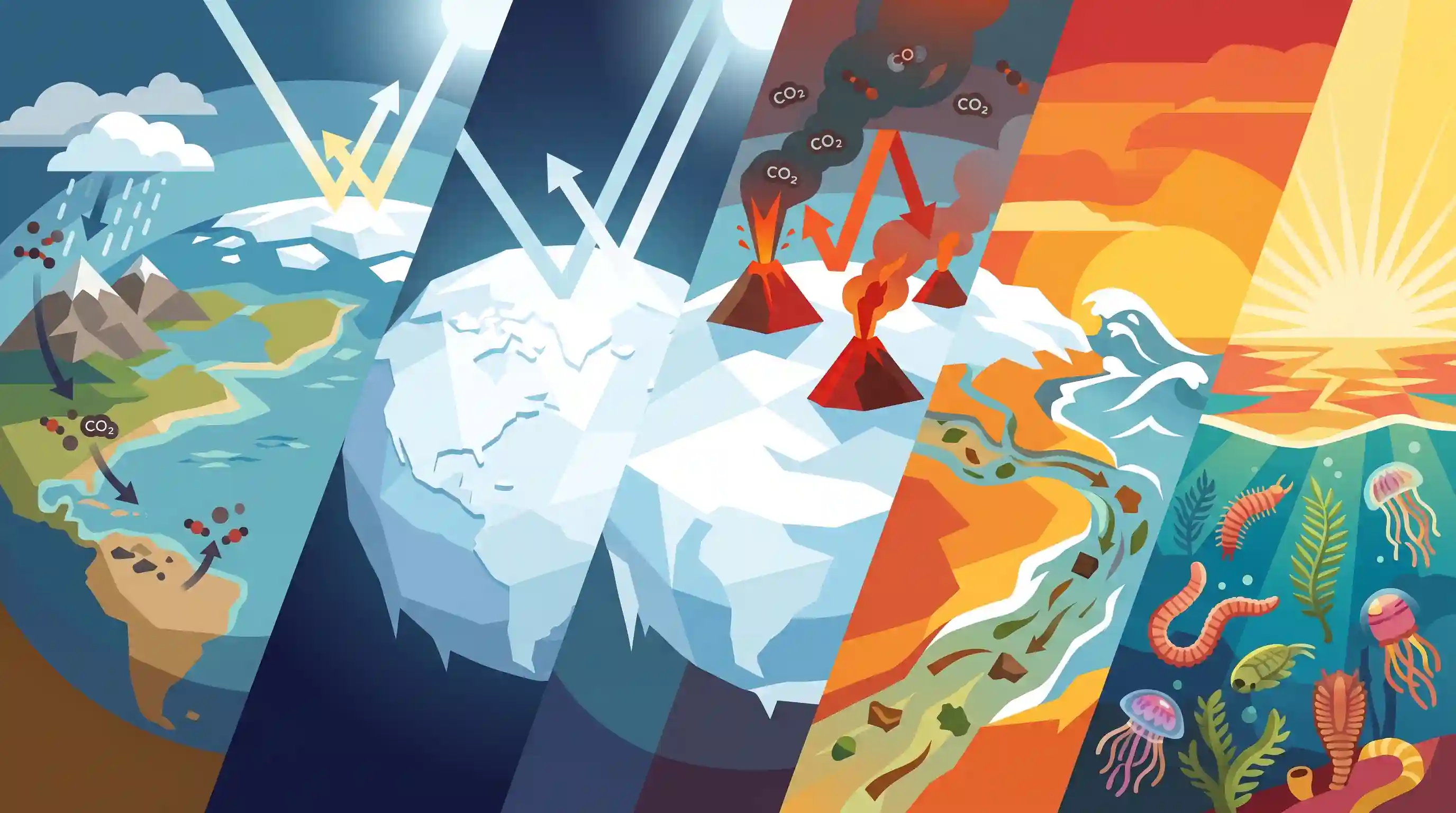
The 'Snowball Earth' hypothesis posits that Earth underwent extreme, global glaciations during the Cryogenian period (around 720 to 635 million years ago), where ice covered the planet from the poles to the equator. Driven by a runaway ice-albedo feedback mechanism and intense silicate weathering that depleted atmospheric carbon dioxide, the Earth turned into a frozen wasteland. This deep freeze was ultimately reversed by continuous volcanic eruptions that pumped greenhouse gases back into the atmosphere. Because the ice-covered surface prevented the carbon dioxide from being drawn down by rock weathering, the gases accumulated to create a massive greenhouse effect, rapidly melting the ice. The dramatic shift from a globally frozen world to a super-greenhouse environment flushed vast amounts of nutrients into the oceans, an event widely believed to have catalyzed the evolution of complex, multicellular life and paved the way for the Cambrian explosion.
Key Points
- The 'Snowball Earth' hypothesis proposes that Earth's surface was entirely or nearly entirely covered by ice during the Neoproterozoic era, specifically the Cryogenian period (approx. 720 to 635 million years ago).
- The extreme glaciation was driven by a runaway ice-albedo feedback loop, where expanding ice caps reflected more solar radiation, accelerating the cooling process, alongside carbon dioxide depletion from intensive silicate weathering.
- The frozen state was eventually broken by prolonged volcanic outgassing of carbon dioxide, which accumulated in the atmosphere due to the cessation of chemical weathering under the ice, creating a super-greenhouse effect.
- The rapid thawing of the planet flushed immense quantities of nutrients into the oceans, likely serving as a catalyst for the emergence and evolution of complex multicellular life, leading up to the Cambrian explosion.
Prelims Trap
"During the Snowball Earth phase, oceans acted as a massive carbon sink to absorb atmospheric CO2."
False. Global ice cover severed the ocean-atmosphere interface, temporarily halting the ocean's ability to absorb CO2. This inability to sequester carbon allowed volcanic greenhouse gases to accumulate.
Static Concepts Connected
What is the ice-albedo feedback mechanism?
- Positive feedback: A positive feedback loop where initial cooling causes ice growth, which increases the planet's albedo (reflectivity).
- Cooling acceleration: More reflected sunlight means less heat is absorbed by the surface, which accelerates further cooling and continuous ice expansion.
- Modern relevance: Currently operating in reverse; melting Arctic ice reduces planetary albedo, absorbing more solar radiation and accelerating global warming.
How does silicate weathering regulate Earth's long-term climate?
- Chemical weathering: Atmospheric CO2 dissolves in rainwater to form weak carbonic acid, which chemically weathers exposed silicate rocks on land.
- Carbon sequestration: The dissolved carbon ions wash into oceans and precipitate as carbonate rocks (like limestone), sequestering carbon for millions of years.
- Geological thermostat: Warmer climates increase weathering (cooling the Earth), while global freezing halts it, allowing volcanic CO2 to build up and warm the planet.
Cross-Topic Patterns
Geological Time Scale & Biological Evolution
UPSC often links geological eras with evolutionary milestones. The transition from the frozen Cryogenian period to the Cambrian Explosion exemplifies how extreme climate shifts can catalyze complex biological evolution.
Arctic Amplification vs. Ice-Albedo Feedback
The runaway ice-albedo feedback that caused Snowball Earth is the exact reverse of modern Arctic amplification, where melting sea ice exposes darker ocean surfaces, absorbing more heat and accelerating warming.

Expect a multi-statement question on the carbon cycle, linking silicate weathering's geological thermostat to modern climate feedback loops.
Linked PYQs · 4
Linked PYQs · 4
- 2025PrelimsGS1
Consider the following statements : I. Without the atmosphere, temperature would be well below freezing point everywhere on the Earth's surface. II. Heat absorbed and trapped by the atmosphere maintains our planet's average temperature. III. Atmosphere's gases, like carbon dioxide, are particularly good at absorbing and trapping radiation. Which of the statements given above are correct?
- 2022PrelimsGS1
Consider the following statements: 1. High clouds primarily reflect solar radiation and cool the surface of the Earth. 2. Low clouds have a high absorption of infrared radiation emanating from the Earth's surface and thus cause warming effect. Which of the statements given above is/are correct?
- 2022MainsGS3
Discuss global warming and mention its effects on the global climate. Explain the control measures to bring down the level of greenhouse gases which cause global warming, in the light of the Kyoto Protocol, 1997.
- 2025MainsGS1
Discuss how the changes in shape and sizes of continents and ocean basins of the planet take place due to tectonic movements of the crustal masses.
