Seva Teerth New PMO Complex and Central Vista Architectural Evolution
Source:The Hindu ↗
Why It Matters
The operationalization of Seva Teerth is an important milestone in the Central Vista redevelopment, shedding colonial legacies for indigenous architectural and philosophical models. It is highly relevant for GS1 (Art & Culture) due to the incorporation of Buddhist and Chalukyan architectural styles, GS2 (Governance) regarding the functional integration of apex executive bodies like the PMO and Cabinet Secretariat, and GS4 (Ethics) as an example of reorienting the administrative mindset towards public service.
Summary
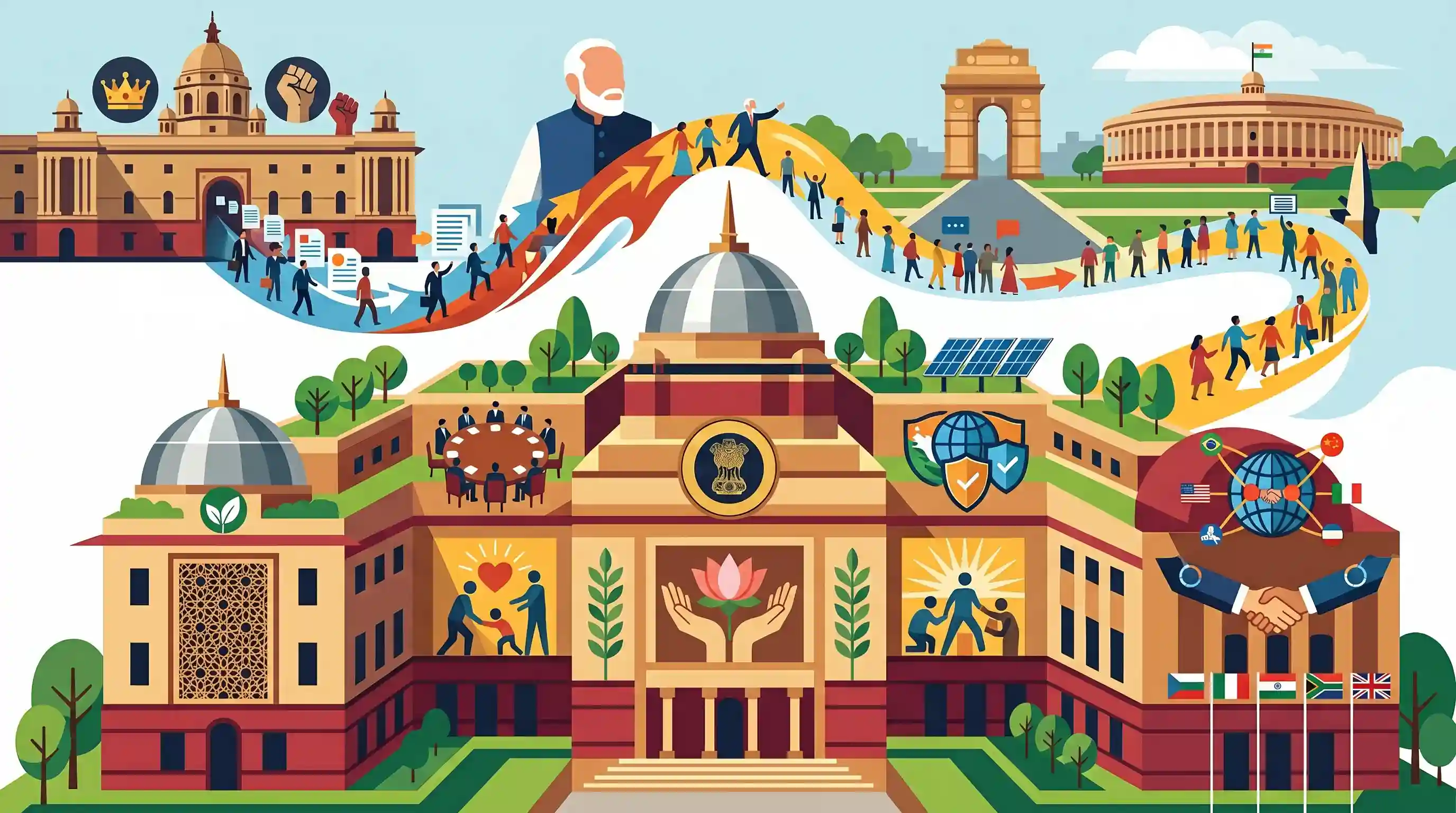
Prime Minister Narendra Modi has inaugurated and shifted to his new official workspace, 'Seva Teerth', part of the broader Central Vista Project. Replacing the colonial-legacy South Block, Seva Teerth consolidates the Prime Minister's Office (PMO), Cabinet Secretariat, and National Security Council into a single integrated hub. The building's name underscores a paradigm shift in Indian governance, moving from an ethos of power ('satta') to public service ('seva'). Its design integrates traditional Indian architecture—incorporating Buddhist stupa-style metal-clad domes and Chalukyan temple-inspired stone screen-work—with modern, 4-star green building standards. The complex also features 'India House' to host international diplomacy events, marking a significant upgrade in India's administrative and strategic infrastructure.
Key Points
- PM Narendra Modi has relocated his official workspace to 'Seva Teerth', replacing the colonial-era South Block.
- The new building serves as an integrated hub housing the PMO, Cabinet Secretariat, and the National Security Council.
- The nomenclature 'Seva Teerth' symbolizes a philosophical shift in governance from 'satta' (power) to 'seva' (service).
- Architecturally, it features a white and red sandstone facade with metal-clad domes inspired by Buddhist stupas and an entrance portal reflecting 11th-13th century Chalukyan temple stone screen-work.
- The complex includes 'India House' for hosting bilateral meetings and international summits, and boasts 4-star green building certifications with modern digital integration.
Important Terms
Central Vista Project

A redevelopment initiative to modernize New Delhi's central administrative area, replacing colonial-era structures with integrated, sustainable, and high-tech government facilities.
UPSC context
GS Papers 1 & 2. Tests urban planning, administrative decolonization, and infrastructure modernization.
Prime Minister’s Office (PMO)
The administrative agency providing secretarial, advisory, and managerial support to the Prime Minister. It acts as the nerve center for policy coordination and executive decision-making.
UPSC context
GS Paper 2 (Union Executive). Tests the role of extra-constitutional bodies in a parliamentary system.
Cabinet Secretariat
The administrative department facilitating inter-ministerial coordination and government business. Headed by the Cabinet Secretary, it ensures the smooth functioning of the Union Cabinet.
UPSC context
GS Paper 2 (Governance). Tests understanding of bureaucratic coordination and the Rules of Business.
National Security Council (NSC)
A three-tiered executive body advising the Prime Minister on strategic security, foreign policy, and internal/external threats, led by the National Security Advisor.
UPSC context
GS Paper 3 (Internal Security). Tests knowledge of India's strategic security and intelligence architecture.
Special Protection Group (SPG)
An elite armed force of the Union providing proximate security to the Prime Minister and immediate family residing at the official residence.
UPSC context
GS Paper 3 (Security Forces). Tests mandates of specialized agencies and the SPG Act.
Prelims Trap
"Seva Teerth integrates the PMO, Cabinet Secretariat, and the PM's official residence."
Seva Teerth is strictly the executive workspace hub. The Prime Minister's residential complex under the Central Vista project is a completely separate entity.
Static Concepts Connected
What are the key characteristics of Chalukyan (Vesara) architecture?
- Hybrid Style: Vesara emerged as a hybrid, combining the square plans and Vimanas of the Dravida style with the curvilinear shikhara of the Nagara style.
- Stellate Plans: Later Chalukyan temples frequently employed stellate (star-shaped) ground plans allowing for intricate, multi-faceted stone carvings.
- Prominent Sites: The style is heavily represented in Badami, Aihole, and Pattadakal (a UNESCO World Heritage site).
What is the structure of India's National Security Council (NSC)?
- Apex Body: Headed by the Prime Minister, it is the apex agency advising on political, economic, energy, and strategic security issues.
- Three-Tier Structure: It operates via the Strategic Policy Group (SPG), National Security Advisory Board (NSAB), and National Security Council Secretariat (NSCS).
- Role of NSA: The NSA acts as the primary advisor to the PM on security and chairs the Strategic Policy Group.
Cross-Topic Patterns
Decolonization of State Architecture
From the new Parliament's Sengol to Seva Teerth's Chalukyan screens, UPSC often explores how post-colonial India reclaims ancient heritage to signal indigenous governance models in GS1 Art & Culture.
Governance ethos: 'Satta' vs 'Seva'
The nomenclature shift from 'Satta' (power) to 'Seva' (service) embodies GS Paper 4 themes: the foundational values of civil services contrasting colonial authority with democratic public service.

Expect Prelims pair-matching: modern Central Vista structures (Seva Teerth, Parliament) linked to ancient architectural inspirations.
Linked PYQs · 4
Linked PYQs · 4
- 2023PrelimsGS1
With reference to ancient India, consider the following statements: 1. The concept of Stupa is Buddhist in origin. 2. Stupa was generally a repository of relics. 3. Stupa was a votive and commemorative structure in Buddhist tradition. How many of the statements given above are correct?
- 2016MainsGS1
Early Buddhist Stupa-art, while depicting folk motifs and narratives successfully expounds Buddhist ideals. Elucidate.
- 2014MainsGS2
The size of the cabinet should be as big as governmental work justifies and as big as the Prime Minister can manage as a team. How far is the efficacy of a government then inversely related to the size of the cabinet? Discuss.
- 2014MainsGS4
What does ethics seek to promote in human life? Why is it all the more important in public administration?
