Seva Teerth and Governance Infrastructure Transformation
Source:The Hindu ↗
Why It Matters
The new PMO represents significant developments in India's administrative infrastructure. For UPSC aspirants, it touches upon multiple syllabus areas: the philosophical underpinnings of public administration (GS2 and GS4), the application of e-governance and green infrastructure (GS2 and GS3), and the integration of ancient architectural elements like Chalukya temples and Stupas into modern state buildings (GS1 Art and Culture).
Summary
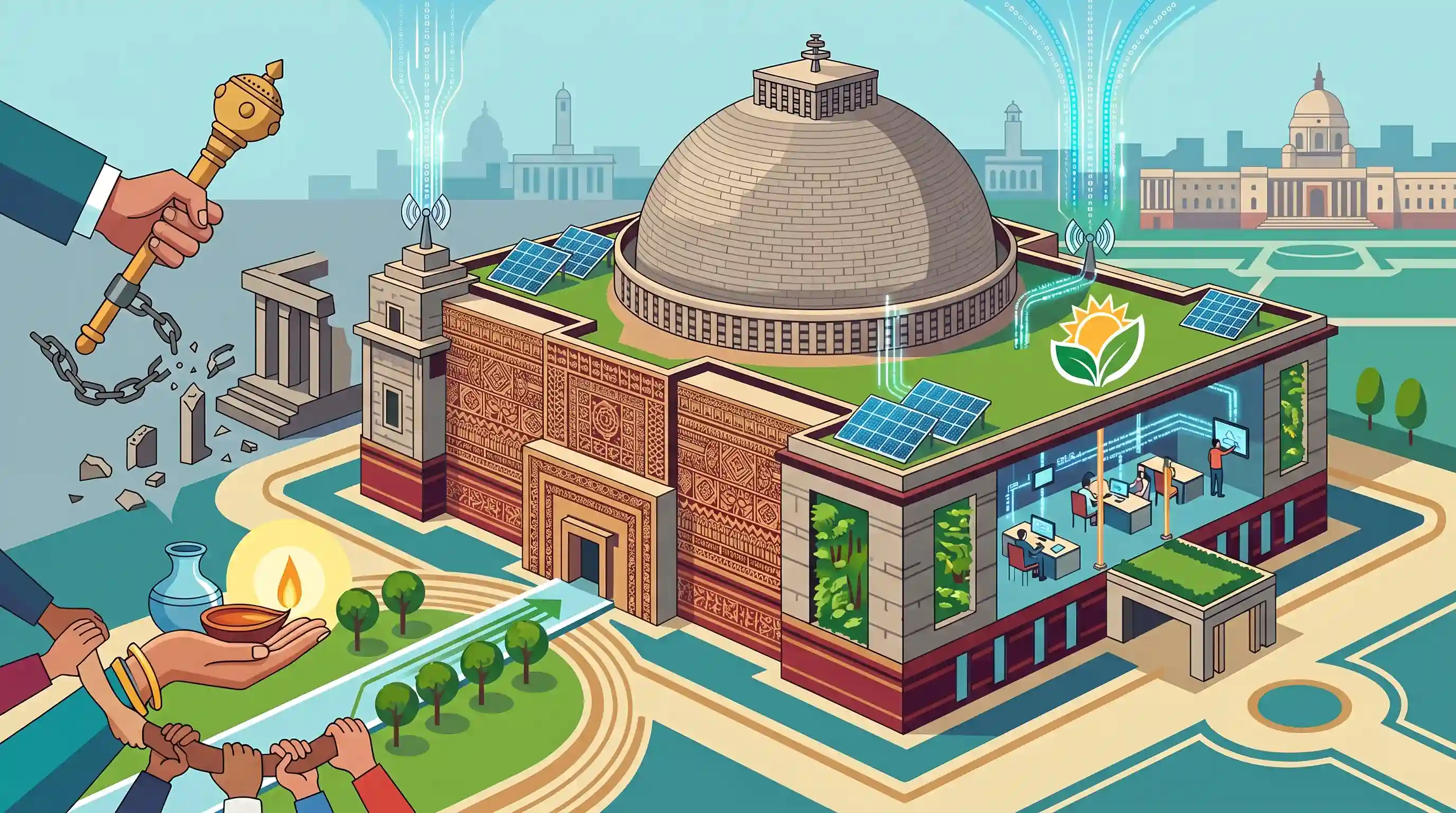
The newly constructed Prime Minister's Office (PMO) under the Central Vista Project has been named 'Seva Teerth', reflecting a philosophical shift from 'satta' (power) to 'seva' (service) in governance. Designed as a 4-star green building, it features a highly digitised, paperless administrative environment. Architecturally, the structure integrates elements of India's ancient heritage, prominently drawing from the intricate designs of Chalukya temples in Karnataka and the iconic domes of Buddhist Stupas, such as the one at Sanchi. This blend of modern sustainability and historical aesthetics exemplifies the evolving nature of public infrastructure in India.
Key Points
- The new Prime Minister's Office (PMO) building, part of the Central Vista Project, is named 'Seva Teerth', symbolising a shift in governance philosophy from 'satta' (power) to 'seva' (public service).
- The building's architecture draws inspiration from India's cultural heritage, notably blending elements from Karnataka's Chalukya temples and the dome structures of Buddhist Stupas in Sanchi.
- It aims to achieve high sustainability standards with a 4-star green building rating, reflecting India's commitment to eco-friendly public infrastructure.
- The new PMO embraces e-governance principles by functioning as a digitally integrated, paperless office with smart access control, improving both efficiency and security.
Important Terms
Central Vista Project

A comprehensive redevelopment initiative of New Delhi's central administrative area, featuring a new Parliament, Central Secretariat, and executive complexes to modernize governance infrastructure.
UPSC context
GS II (Executive/Governance) and GS III (Infrastructure); tests urban planning, administrative reform, and national symbols.
Seva Teerth
The newly inaugurated Prime Minister's Office (PMO) building (2026), symbolizing a philosophical shift from 'satta' (power) to 'seva' (service) in public administration.
UPSC context
GS II (Governance); relevant for symbolic shifts in political culture and the modernization of executive infrastructure.
Prime Minister's Office (PMO)
The staff agency providing secretarial, policy, and administrative assistance to the Prime Minister, serving as the central hub of India's executive decision-making.
UPSC context
GS II (Indian Constitution/Executive); key for understanding the functioning of the parliamentary system and centralized executive authority.
Kartavya Bhavan
The consolidated 'Common Central Secretariat' housing 51 ministries, designed to replace fragmented colonial-era offices and improve inter-ministerial coordination and digital efficiency.
UPSC context
GS II (Governance); important for topics related to administrative efficiency, transparency, and e-governance initiatives.
GRIHA (Green Rating for Integrated Habitat Assessment)
India's indigenous rating system for 'green buildings' that evaluates a structure's environmental performance and resource efficiency over its entire life cycle.
UPSC context
GS III (Environment); relevant for sustainable development goals (SDGs) and climate-resilient public infrastructure.
Chalukya Architecture
A distinctive 6th-12th century temple style (Vesara) from the Deccan, blending Nagara and Dravida elements, known for star-shaped plans and intricate carvings.
UPSC context
GS I (Art & Culture); tests knowledge of ancient Indian temple styles and their contemporary influence on state architecture.
Sanchi Stupa
A UNESCO World Heritage Buddhist monument in Madhya Pradesh, featuring a hemispherical dome and ornate gateways (toranas), representing early Indian stone architecture.
UPSC context
GS I (Art & Culture); essential for Buddhist history and the evolution of religious and structural architecture in India.
Prelims Trap
"Seva Teerth is the newly inaugurated Parliament building under the Central Vista Redevelopment Project."
Seva Teerth specifically designates the new Prime Minister's Office (PMO) building. It is distinct from the new Parliament building, though both are Central Vista components.
Static Concepts Connected
What are the defining characteristics of Chalukyan architecture?
- Vesara Style: It pioneered the hybrid Vesara style, seamlessly combining the northern Nagara (curvilinear shikhara) and southern Dravida (tiered vimana) architectural features.
- Stellate Plans: Structures frequently utilized intricate star-shaped (stellate) ground plans, which provided more surface area for elaborate sculptural decorations and structural complexity.
- Notable Examples: Prominent UNESCO recognized sites include the Virupaksha Temple at Pattadakal and the structural experimentation seen at Aihole and Badami.
How does the GRIHA rating system evaluate green buildings?
- Indigenous Standard: Jointly developed by TERI and the Ministry of New and Renewable Energy (MNRE), it serves as India's national rating system for sustainable habitats.
- Lifecycle Assessment: It evaluates resource efficiency, energy consumption, waste generation, and overall ecological impact across a building's pre-construction, building, and operation phases.
- Performance Rating: Buildings are awarded between 1 to 5 stars based on their compliance with a comprehensive set of environmental and energy metrics.
Cross-Topic Patterns
Decolonization of architectural aesthetics
The Central Vista deliberately embeds ancient Indian motifs (Chalukyan, Buddhist) into modern executive spaces to project civilizational continuity and decolonize aesthetics, similar to the thematic design of Bharat Mandapam.
Integration of green and e-governance
'Seva Teerth' showcases a dual transition in Indian public infrastructure, where digital administrative efficiency (paperless e-governance) is mandated alongside strict environmental sustainability (4-star green building compliance).

Expect a Prelims matching question linking modern public infrastructure (Seva Teerth, Bharat Mandapam) to ancient architectural inspirations.
Linked PYQs · 4
Linked PYQs · 4
- 2023PrelimsGS1
With reference to ancient India, consider the following statements: 1. The concept of Stupa is Buddhist in origin. 2. Stupa was generally a repository of relics. 3. Stupa was a votive and commemorative structure in Buddhist tradition. How many of the statements given above are correct?
- 2019PrelimsGS1
Building 'Kalyaana Mandapas' was a notable feature in the temple construction in the kingdom of
- 2024MainsGS2
The Doctrine of Democratic Governance makes it necessary that the public perception of the integrity and commitment of civil servants becomes absolutely positive. Discuss.
- 2024MainsGS2
e-governance is not just about the routine application of digital technology in service delivery process. It is as much about multifarious interactions for ensuring transparency and accountability. In this context evaluate the role of the 'Interactive Service Model' of e-governance.
