RBI Digital Currency and Local Currency Trade in BRICS
Source:The Hindu ↗
Why It Matters
Understanding alternative cross-border payment mechanisms and local currency trade is crucial for UPSC aspirants, as it connects digital economy advancements (UPI/CBDC) with shifting geopolitical realities (de-dollarisation and BRICS dynamics).
Summary
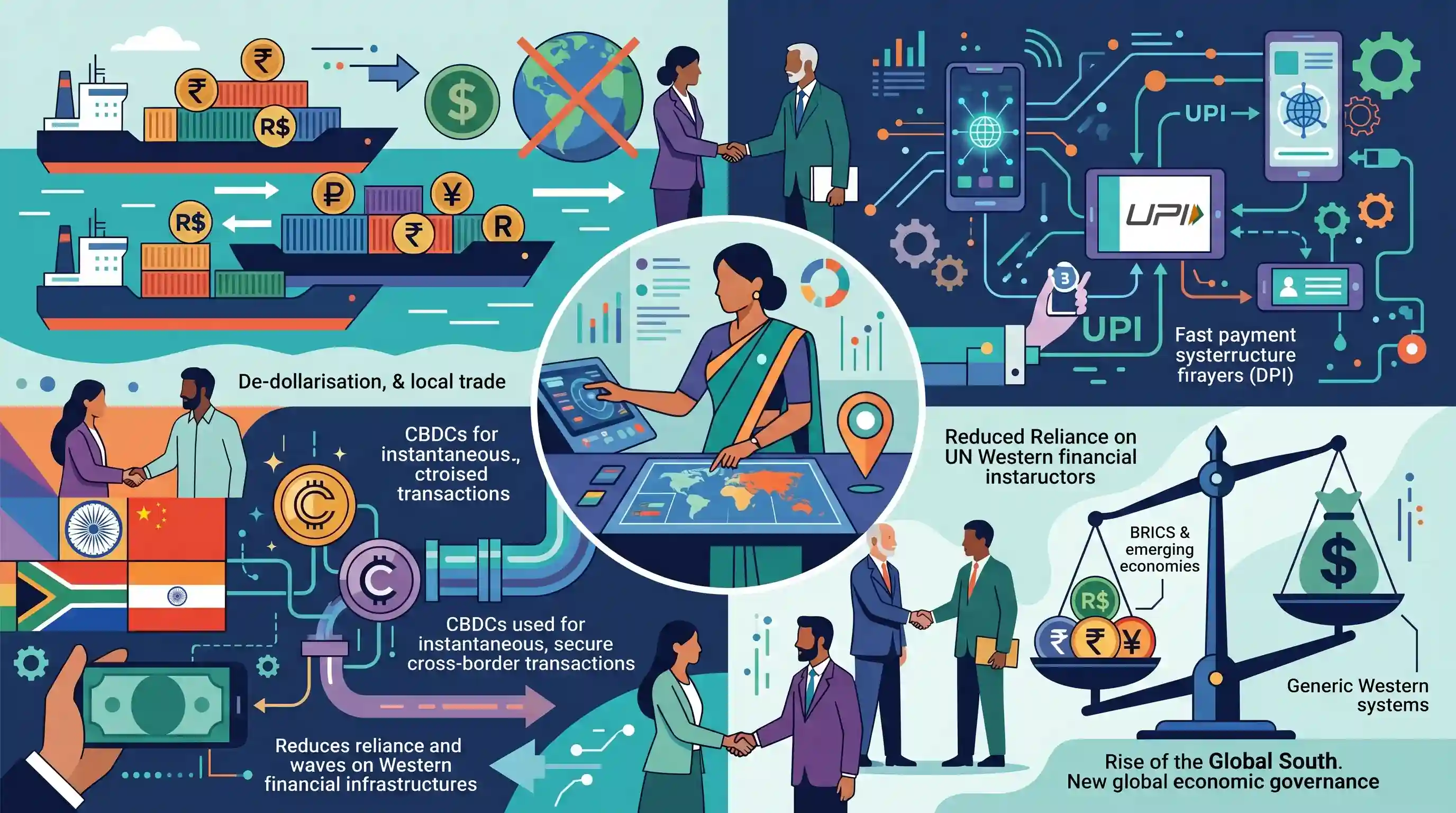
The Reserve Bank of India (RBI) is actively encouraging BRICS nations to integrate their fast payment systems and explore Central Bank Digital Currencies (CBDCs) to revolutionize cross-border transactions. By advocating for trade settlements in local currencies rather than a common BRICS currency, India aims to reduce reliance on the US Dollar and Western financial messaging infrastructures like SWIFT. This strategic nudge not only highlights India's leadership in Digital Public Infrastructure (DPI) through systems like UPI but also seeks to enhance macroeconomic stability, lower transaction costs, and foster deeper economic integration among the Global South.
Key Points
- The RBI is advocating for BRICS nations to link their domestic fast payment systems (similar to India's UPI) to enable seamless, low-cost cross-border transactions.
- There is a strong push to promote intra-BRICS trade settlement in local currencies, advancing the de-dollarisation agenda and insulating member economies from Western financial sanctions.
- The integration of Central Bank Digital Currencies (CBDCs) is highlighted as a viable alternative to bypass traditional, slower correspondent banking networks like SWIFT.
- India aims to leverage its successful Digital Public Infrastructure (DPI) model to lead the development of a secure, interoperable multilateral payment framework for emerging economies.
Important Terms
Unified Payments Interface (UPI)

An Indian real-time payment system developed by NPCI, enabling instant, mobile-based inter-bank transfers using a unique identifier. It is a cornerstone of India's Digital Public Infrastructure (DPI).
UPSC context
GS-3 (Economy/S&T); tests understanding of Digital Public Infrastructure (DPI), fintech innovation, and financial inclusion.
Central Bank Digital Currency (CBDC)
A digital form of sovereign currency issued and backed by a central bank (e.g., RBI's Digital Rupee). It acts as legal tender and a direct liability of the issuer.
UPSC context
GS-3 (Economy); relevant for digital currency, monetary policy, and innovations in cross-border settlements.
BRICS
An intergovernmental organization comprising Brazil, Russia, India, China, and South Africa, recently expanded to include members like Egypt and the UAE. It promotes South-South cooperation.
UPSC context
GS-2 (International Relations); tests knowledge of multilateral groupings and their role in global governance.
SWIFT
The Society for Worldwide Interbank Financial Telecommunication; a global messaging network used by financial institutions to securely transmit instructions for international transactions and settlements.
UPSC context
GS-2/GS-3; tests understanding of global financial infrastructure and the impact of geopolitical sanctions on trade.
New Development Bank (NDB)
A multilateral development bank established by BRICS nations in 2014 to finance infrastructure and sustainable development projects, serving as an alternative to the World Bank and IMF.
UPSC context
GS-2/GS-3; relevant for multilateral institutions, South-South cooperation, and alternative development financing.
Reserve Bank of India (RBI)
India's central bank and regulatory authority. It manages monetary policy, regulates the banking sector, and oversees the issuance of currency and national payment systems.
UPSC context
GS-3 (Economy); foundational for understanding monetary policy, banking regulation, and India's financial institutional framework.
Prelims Trap
"The RBI is actively pushing for a common BRICS currency to replace the US Dollar."
India explicitly opposes a single BRICS currency (like the Euro) due to macroeconomic disparities and sovereignty concerns, advocating instead for domestic/local currency settlement.
Static Concepts Connected
What is the SWIFT network and how does it function?
- Messaging vs Settlement: It is merely a messaging network that transmits secure instructions between banks; it does not hold funds or clear/settle transactions itself.
- Governance: It is a cooperative society established under Belgian law and overseen by G-10 central banks, making it susceptible to Western financial sanctions.
- Nostro/Vostro dependency: Banks use SWIFT messages to debit/credit balances in correspondent accounts (Nostro/Vostro) held with each other across borders.
How does a CBDC conceptually differ from UPI?
- Nature of Money: CBDC is a central bank liability (fiat sovereign money), while UPI transfers commercial bank money (bank deposits).
- Settlement Mechanism: CBDC settles directly and instantaneously between wallets. UPI is a front-end interface that requires delayed, batch-based inter-bank settlement at the backend.
- Anonymity: Retail CBDCs can be designed to offer cash-like anonymity for small transactions, whereas all UPI transactions leave a direct digital footprint with banks.
Cross-Topic Patterns
Vostro Accounts & Rupee Internationalisation
Linking BRICS local currency trade connects directly to the RBI's Special Rupee Vostro Account (SRVA) mechanism, previously tested with Russia and the UAE.
Tech-Diplomacy via India Stack
India leveraging its DPI (UPI/Aadhaar) at BRICS reflects a shift from traditional soft power to technology diplomacy, aiming to secure Global South leadership.

Expect a multi-statement question in 2026 comparing CBDC cross-border mechanics with SWIFT, linking DPI to Rupee internationalisation.
Linked PYQs · 5
Linked PYQs · 5
- 2025MainsGS3
What are the challenges before the Indian economy when the world is moving away from free trade and multilateralism to protectionism and bilateralism? How can these challenges be met?
- 2014MainsGS2
India has recently signed to become founding member of New Development Bank (NDB) and also the Asian Infrastructure Investment Bank (AIIB). How will the role of the two Banks be different ? Discuss the strategic significance of these two Banks for India.
- 2015PrelimsGS1
The 'Fortaleza Declaration', recently in the news, is related to the affairs of
- 2025PrelimsGS1
Consider the following statements with regard to BRICS : I. 16th BRICS Summit was held under the Chairship of Russia in Kazan. II. Indonesia has become a full member of BRICS. III. The theme of the 16th BRICS Summit was Strengthening Multiculturalism for Just Global Development and Security. Which of the statements given above is/are correct?
- 2023MainsGS3
What is the status of digitalization in the Indian economy? Examine the problems faced in this regard and suggest improvements.
