Quantum Entanglement Principles and Emerging Technology Applications
Source:The Hindu ↗
Why It Matters
Quantum technology is a critical frontier science with massive implications for cybersecurity, computing, and communications. The UPSC frequently tests foundational scientific concepts (e.g., qubits, artificial intelligence) in Prelims, while Mains questions evaluate the applications and strategic importance of such emerging technologies for India's development and security.
Summary
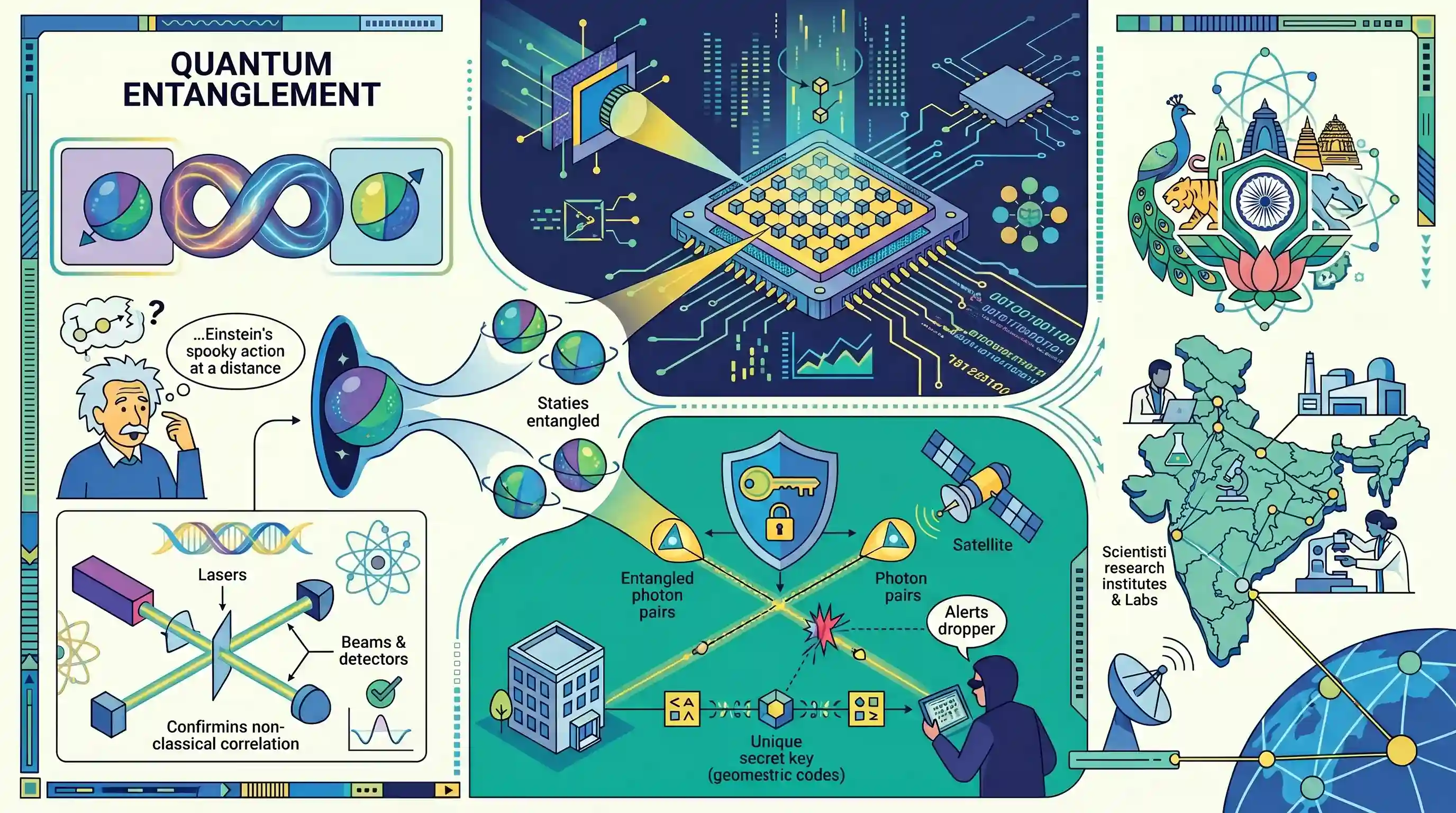
The article explains the concept of quantum entanglement, a fundamental principle of quantum mechanics where the properties of two or more particles become intimately linked. Even when separated by vast distances, a change in the state of one entangled particle instantaneously affects the other—a phenomenon Albert Einstein dubbed 'spooky action at a distance.' The piece outlines how this counterintuitive behavior, once a subject of theoretical debate and proven through Bell's theorem, has transitioned into a tangible technological resource. Today, quantum entanglement forms the bedrock of emerging frontier technologies, including quantum computing (utilizing interconnected qubits) and highly secure quantum communication networks (Quantum Key Distribution), which are a major focus for global research and India's National Quantum Mission.
Key Points
- Quantum entanglement is a foundational quantum mechanical phenomenon where particles become interconnected, such that the state of one particle instantaneously determines the state of another, regardless of the distance separating them.
- Albert Einstein famously referred to this phenomenon as 'spooky action at a distance' because it appeared to violate the classical physics principle of local realism and the speed of light limit.
- The phenomenon violates Bell's inequalities, proving that the universe at a quantum level does not operate on pre-existing 'hidden variables,' a discovery that earned the 2022 Nobel Prize in Physics.
- Entanglement is the critical resource driving quantum computing, allowing qubits to perform complex, parallel calculations exponentially faster than classical computer bits.
- It is practically applied in quantum cryptography, specifically Quantum Key Distribution (QKD), to create theoretically unhackable communication networks.
Important Terms
National Quantum Mission (NQM)

India's flagship mission (2023-2031) with a ₹6,003 crore outlay, aimed at developing indigenous quantum computing (50-1,000 qubits), communication, sensing, and materials via Department of Science and Technology thematic hubs.
UPSC context
GS Paper III: Science & Technology; tests awareness of government initiatives and technological self-reliance.
Quantum Entanglement
A quantum phenomenon where particles become interconnected such that the state of one instantaneously influences another, regardless of distance. Albert Einstein famously referred to this behavior as "spooky action at a distance."
UPSC context
GS Paper III: Science & Technology; fundamental for understanding frontier tech like quantum computers and cryptography.
Qubit (Quantum Bit)
The basic unit of quantum information. Unlike classical bits (0 or 1), qubits utilize superposition to represent multiple states simultaneously, providing the basis for exponential computational speedups in quantum computers.
UPSC context
GS Paper III: IT & Computers; specifically tested in Prelims (2022). Tests clarity on foundational units of emerging technologies.
Quantum Key Distribution (QKD)
A secure communication method leveraging quantum properties to distribute encryption keys. It ensures absolute security because any eavesdropping attempt disturbs the quantum state, alerting the legitimate users immediately.
UPSC context
GS Paper III: Security/IT; relevant for defense applications and indigenous achievements by agencies like DRDO and ISRO.
Bell's Theorem
A 1964 mathematical proof establishing that quantum mechanics is incompatible with "local realism," confirming that non-local links like entanglement are a fundamental reality rather than theoretical errors.
UPSC context
GS Paper III: Science & Technology; tests conceptual understanding of the theoretical shifts that enabled modern quantum technology.
Prelims Trap
Quantum entanglement allows for faster-than-light communication of data across long distances.
While an entangled particle's state change is instantaneous, it cannot be used to transmit classical data faster than light due to the no-communication theorem.
Static Concepts Connected
What distinguishes a Qubit from a classical computing Bit?
- Superposition: Classical bits are strictly 0 or 1. Qubits exist in a 'superposition' of both 0 and 1 simultaneously.
- Entanglement: Interconnected qubits use 'entanglement' to link their states, allowing exponential scaling of processing power.
- Processing Speed: These properties allow quantum computers to solve highly complex parallel problems exponentially faster than classical computers.
How does Quantum Key Distribution (QKD) prevent eavesdropping?
- Physics over Math: It uses the quantum states of particles (like photons) rather than mathematical complexity to distribute encryption keys.
- Observer Effect: Any attempt to intercept, measure, or read the entangled photons fundamentally and permanently alters their quantum state.
- Instant Alert: This inevitable alteration instantly notifies the communicating parties that the encryption key has been compromised.
Cross-Topic Patterns
QKD + GS3 Cybersecurity threats
The push for QKD aligns with GS3 Cybersecurity to counter 'Harvest now, decrypt later' threats, where adversaries steal encrypted data today to decrypt once quantum computers mature.
National Quantum Mission + Deep Tech Indigenization
NQM's target of a 2000 km QKD network by 2031 reflects India's broader GS3 strategic shift from software IT services to deep-tech hardware sovereignty.

Expect a multi-statement question contrasting Quantum Entanglement with Superposition, tied directly to National Quantum Mission targets.
Linked PYQs · 2
Linked PYQs · 2
- 2022PrelimsGS1
Which one of the following is the context in which the term "qubit" is mentioned ?
- 2024PrelimsGS1
Consider the following statements: I. It is expected that Majorana 1 chip will enable quantum computing. II. Majorana 1 chip has been introduced by Amazon Web Services (AWS). III. Deep learning is a subset of machine learning. Which of the statements given above are correct?
