Subscription Cancellation Rules and Dark Patterns Regulation in India
Source:The Hindu ↗
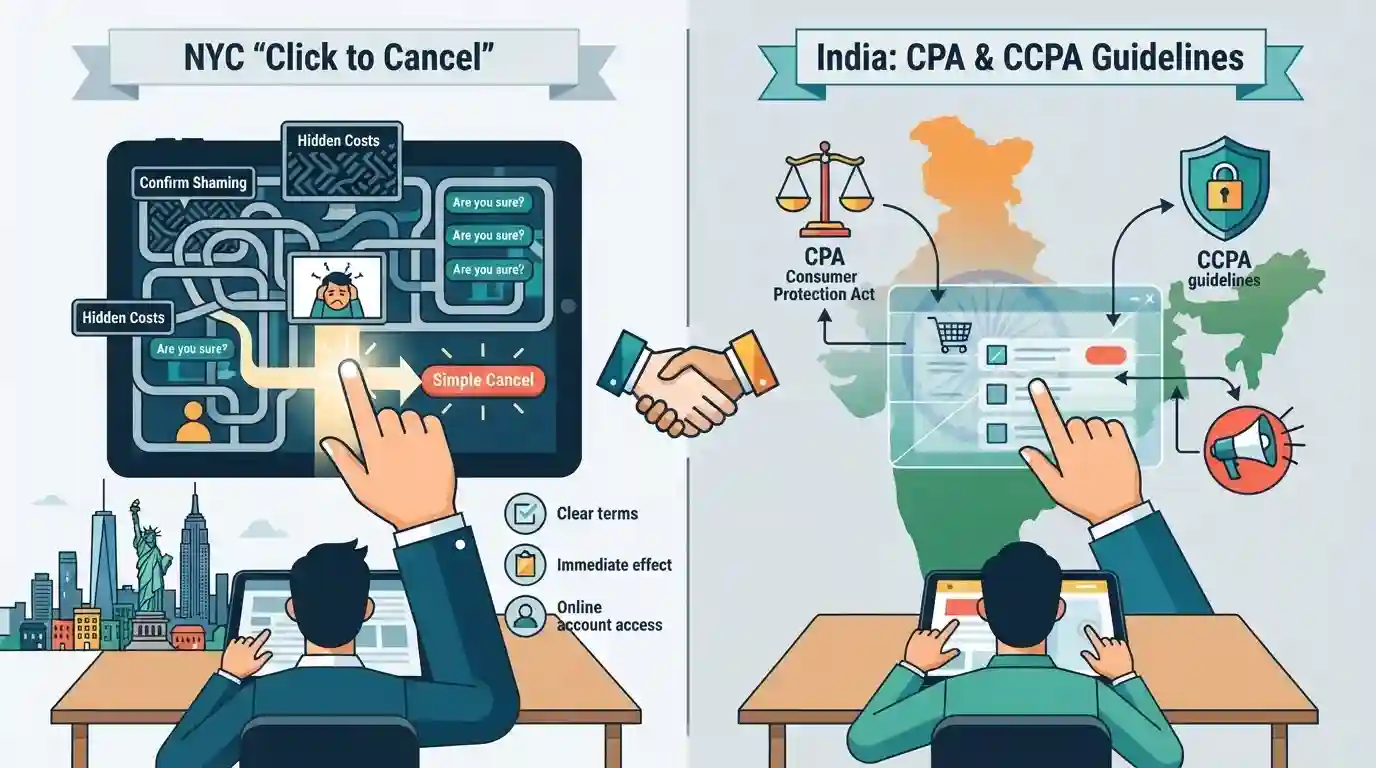
Why It Matters
Understanding global and domestic regulatory mechanisms against dark patterns and deceptive subscription traps is crucial for digital governance, consumer rights, and e-commerce policy in India.
Summary
An analysis of New York City's 'Click to Cancel' rule, which simplifies subscription cancellations and combats dark patterns, alongside a comparative look at India's regulatory framework under the Consumer Protection Act and CCPA guidelines against deceptive digital practices.
Key Points
- New York City introduced a 'Click to Cancel' rule requiring companies to make subscription cancellations as easy as signing up.
- The rule targets dark patterns such as forced continuity, complicated multi-step cancellation paths, and hidden information.
- In India, the Consumer Protection Act, 2019 and the Central Consumer Protection Authority (CCPA) guidelines on dark patterns (2023) prohibit deceptive subscription traps and forced continuity.
- However, unlike the specific mandated single-click or symmetrical cancellation process in NYC, India's regulatory framework relies on a broad prohibition of dark patterns rather than rigid technical UX mandates for subscriptions.
Important Terms
Click to Cancel Rule

A municipal regulation requiring businesses to make canceling a subscription as simple and accessible as signing up for one, effectively combating deceptive subscription traps.
UPSC context
Mains GS Paper II/III: Governance, consumer rights, and comparative global frameworks for digital consumer protection.
Consumer Protection Act, 2019
India's landmark legislation enacted to protect consumer interests, providing a framework for the establishment of consumer dispute redressal agencies and regulatory authorities like the CCPA.
UPSC context
Mains GS Paper II/III: Statutory frameworks, governance structures, and mechanisms for safeguarding consumer rights in India.
Guidelines for Prevention and Regulation of Dark Patterns, 2023
Regulatory guidelines issued by the CCPA to identify, prevent, and penalize deceptive user interface designs (dark patterns) that manipulate consumer choice on digital platforms.
UPSC context
Mains GS Paper III: E-commerce regulations, digital governance, and ethical concerns in online business practices.
Central Consumer Protection Authority (CCPA)
A regulatory body established under the Consumer Protection Act, 2019, tasked with promoting, protecting, and enforcing consumer rights as a class.
UPSC context
Mains GS Paper II: Important statutory bodies, their roles, powers, and effectiveness in enforcing consumer welfare.
Prelims Trap
India has enacted a strict 'Click to Cancel' technical rule identical to New York City's mandated single-click subscription cancellation process.
India's CCPA guidelines prohibit dark patterns, but unlike NYC's specific 'Click to Cancel' rule, they do not enforce a strict rigid technical single-click UX mandate for subscriptions.
Static Concepts Connected
What are the powers and functions of the Central Consumer Protection Authority (CCPA)?
- Statutory Body: Established under the Consumer Protection Act, 2019 to regulate matters relating to violation of consumer rights, unfair trade practices, and false advertisements.
- Powers & Mandate: Empowered to inquire suo motu, direct recall of goods, reimbursement of prices, and impose penalties for misleading advertisements and dark patterns.
Cross-Topic Patterns
Dark Patterns + RBI E-Mandates + CCPA
Digital governance and consumer laws intersect when regulatory bodies like the CCPA and RBI combine forces to regulate payment gateways and user interfaces.

CCPA Guidelines on Dark Patterns (2023) + RBI recurring payment norms will likely be tested via a multi-statement application question.
Linked PYQs · 1
Linked PYQs · 1
- 2026PrelimsGS1
Which one of the following best describes the key objective of India's 'Open Network for Digital Commerce' (ONDC) initiative ?
