National Honour Amendment Bill And Fundamental Duties
Source:The Hindu ↗
Why It Matters
Questions on the Flag Code of India and Fundamental Duties frequently appear in Prelims (e.g., 2023, 2017). For Mains (GS2), the interplay between statutory laws protecting national honour and the constitutional right to freedom of expression is a critical governance and polity theme.
Summary
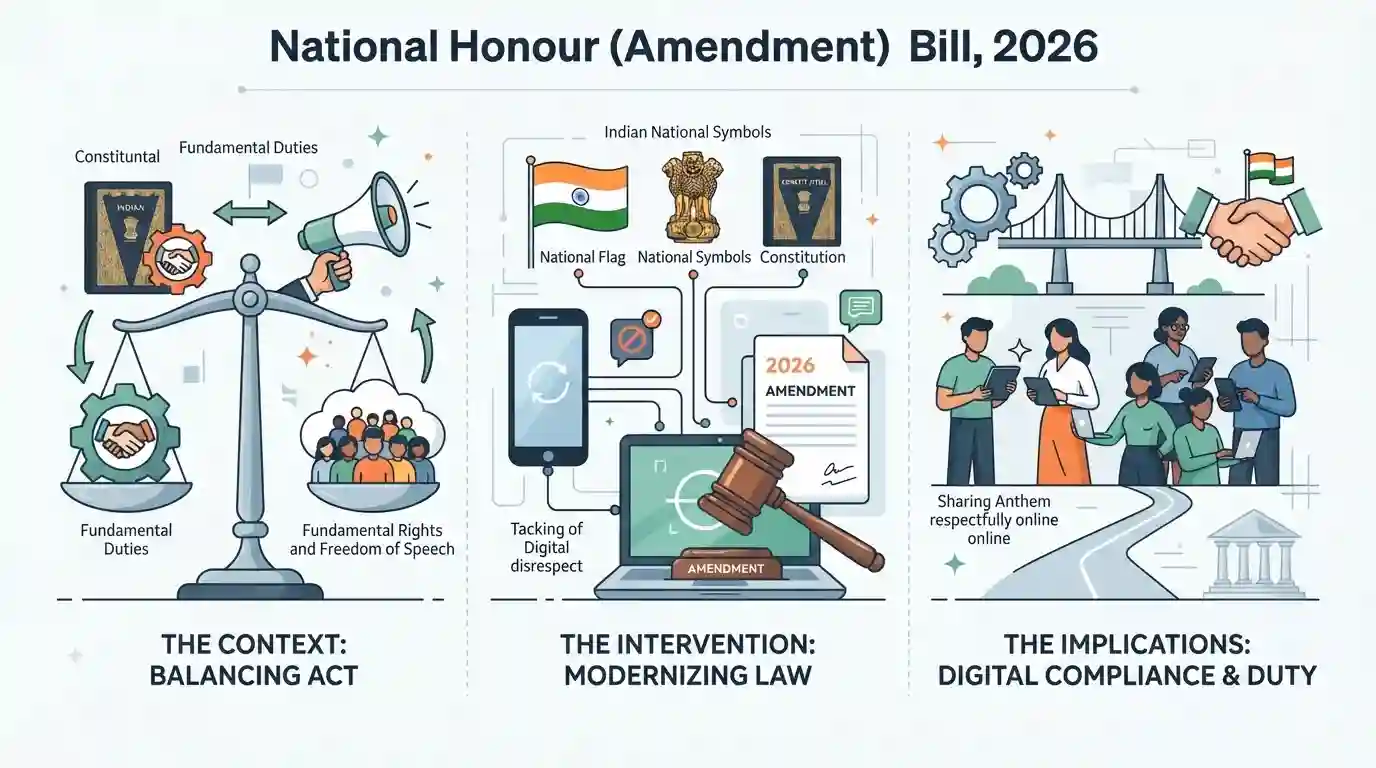
The article explains the provisions and implications of the National Honour (Amendment) Bill, 2026, which updates the Prevention of Insults to National Honour Act, 1971. The proposed amendments aim to tackle modern instances of disrespect towards national symbols like the National Flag, National Anthem, and the Constitution, especially in the digital space. The Bill bridges the gap between technological advancements and the legal enforcement of Fundamental Duties, while simultaneously navigating the boundaries of Freedom of Speech and Expression.
Key Points
- The National Honour (Amendment) Bill, 2026 seeks to amend the Prevention of Insults to National Honour Act, 1971 to address contemporary challenges, particularly digital and online forms of disrespect to national symbols.
- The original 1971 Act criminalizes insults to the Indian National Flag, the Constitution of India, and the National Anthem, prescribing imprisonment or fines.
- The amendment relates directly to Article 51A(a) of the Constitution, which lays down the Fundamental Duty of every citizen to respect the Constitution, the National Flag, and the National Anthem.
- Such legislative changes often ignite debates surrounding Article 19(1)(a) (Freedom of Speech and Expression) and the scope of reasonable restrictions under Article 19(2) concerning public order and national integrity.
Important Terms
Prevention of Insults to National Honour (Amendment) Bill, 2026

A proposed Indian law introduced in 2026 to amend Section 3 of the 1971 Act, extending statutory and penal protections to the National Song, Vande Mataram, on par with the National Anthem.
UPSC context
GS Paper II (Polity) — Tests understanding of bills on national symbols and the balance between fundamental duties and rights.
Prevention of Insults to National Honour Act, 1971
An Act of the Parliament of India that criminalizes insults to, or desecration of, the country's national symbols, including the National Flag, the Constitution of India, and the National Anthem.
UPSC context
GS Paper II (Polity) — Tests knowledge of the legal framework surrounding enforcement of respect for national symbols and constitutional values.
Flag Code of India, 2002
A comprehensive set of guidelines governing the display, hoisting, and respectful usage of the Indian National Flag by private, public, and government entities, combining previous laws and conventions.
UPSC context
GS Paper II (Polity) — Tests rules on national flag usage and amendments facilitating public display while maintaining dignity.
Constitution of India
The supreme law of India, establishing the political framework, fundamental rights, and fundamental duties (such as Article 51A) of citizens towards the state and its national symbols.
UPSC context
GS Paper II (Polity) — Foundational text for evaluating laws, civil liberties, and fundamental duties of Indian citizens.
Prelims Trap
The Fundamental Duties under Article 51A explicitly command citizens to respect the National Song (Vande Mataram) alongside the National Anthem.
While the 2026 Bill seeks to penalize insults to the National Song, Article 51A(a) of the Constitution explicitly mentions only the Constitution, National Flag, and National Anthem. It does not contain the term 'National Song' or 'Vande Mataram'.
Static Concepts Connected
What is the constitutional status and enforceability of Fundamental Duties?
- Constitutional Origin: Added by the 42nd Amendment in 1976 based on the Swaran Singh Committee's recommendations, with an 11th duty added in 2002.
- Non-Justiciability: They are non-justiciable, meaning courts cannot directly enforce them unless supported by specific statutory enactments.
- Justice Verma Committee: Identified statutory laws (like the 1971 Act) that already penalize conduct violating the spirit of Article 51A duties.
What is the legal status of the Right to Fly the National Flag?
- Naveen Jindal Case: Held that flying the flag with respect and dignity is a fundamental right under Article 19(1)(a), not just a static statutory privilege.
- Reasonable Restrictions: The right is subject to reasonable restrictions under Article 19(2) and is governed by the Flag Code of India, 2002.
Cross-Topic Patterns
Digital Speech vs. Sovereign Symbols
Explores the friction between Article 19(1)(a) and statutory curbs in the virtual realm, highlighting the jurisdictional challenges of policing online desecration of national symbols.
Executive Declarations vs. Constitutional Text
Illustrates the divide between political resolutions (e.g., Dr. Rajendra Prasad's 1950 statement on Vande Mataram) and constitutional text (Article 51A) in judicial interpretation.

2026 GS-2 may test statutory enforcement of Article 51A duties vs Article 19(1)(a) digital speech limitations.
Linked PYQs · 3
Linked PYQs · 3
- 2023PrelimsGS1
Consider the following statements in respect of the National Flag of India according to the Flag Code of India, 2002: Statement-I: One of the standard sizes of the National Flag of India is 600 mm x 400 mm. Statement-II: The ratio of the length to the height (width) of the Flag shall be 3:2. Which one of the following is correct in respect of the above statements?
- 2015PrelimsGS1
"To uphold and protect the Sovereignty, Unity and Integrity of India" is a provision made in the
- 2017PrelimsGS1
Which of the following statements is/are true of the Fundamental Duties of an Indian citizen? 1. A legislative process has been provided to enforce these duties. 2. They are correlative to legal duties. Select the correct answer using the code given below:
