Taxonomic Discoveries Expand Biodiversity and Conservation Mapping
Source:The Hindu ↗
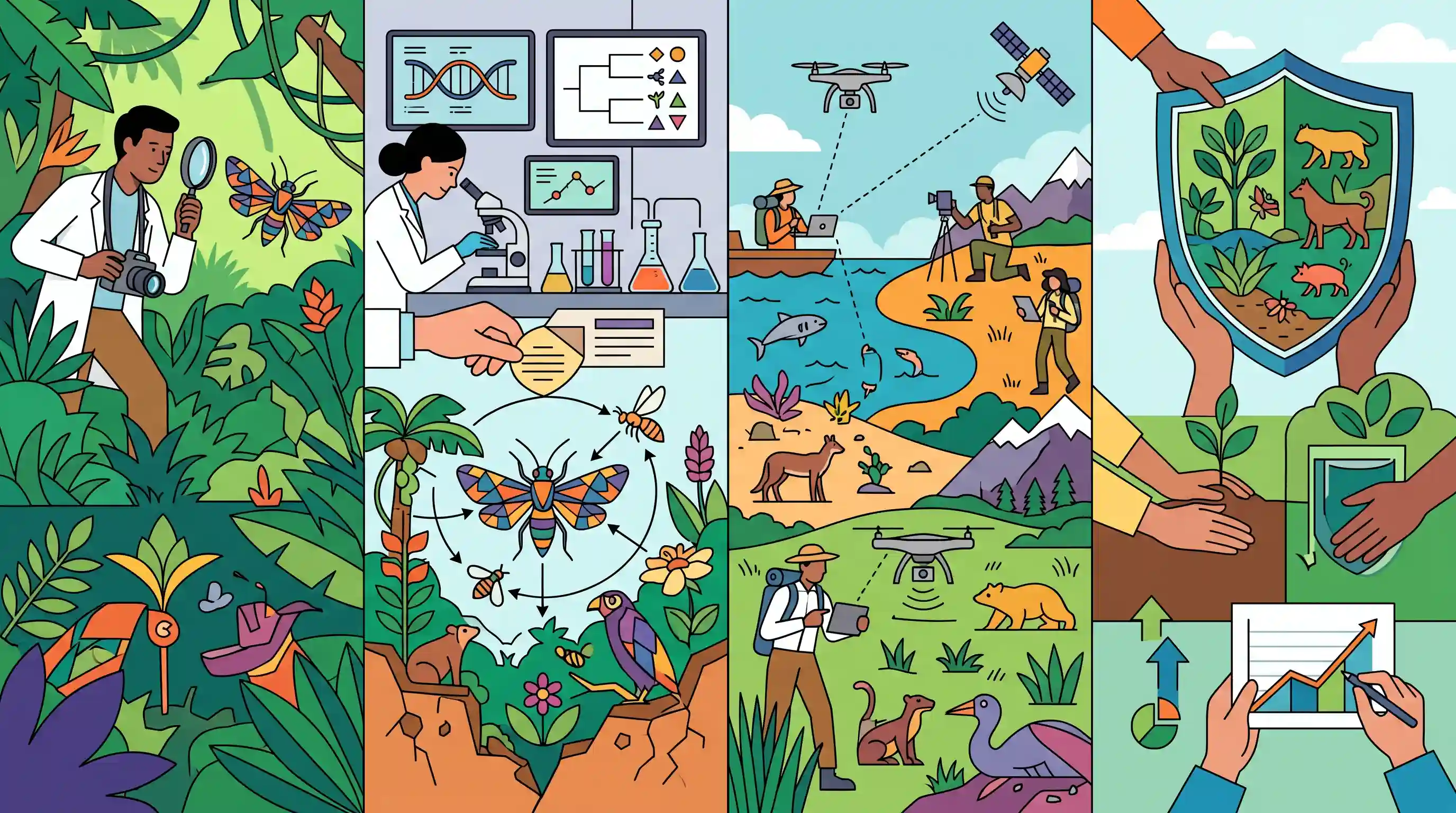
Why It Matters
UPSC Prelims frequently features questions on newly discovered species, their classifications (e.g., insects, fauna), and endemic biodiversity. For GS3, understanding taxonomy and species conservation is fundamental to the Environment syllabus.
Summary
The article highlights the discovery of Mosura fentoni, exploring its ecological significance and taxonomic classification. It underscores the broader importance of biological nomenclature and continuous biodiversity surveys in documenting unknown flora and fauna. Such discoveries are essential for understanding evolutionary relationships, assessing genetic diversity, and prioritizing conservation efforts in vulnerable ecosystems.
Key Points
- The article details the discovery and characteristics of Mosura fentoni, a recently identified species.
- The nomenclature reflects specific taxonomic conventions, potentially drawing connections to broader cultural or historical eponyms (like 'Mosura' and 'Fenton').
- Such discoveries underscore the vast, uncharted biological diversity remaining in ecological hotspots and the need for rigorous taxonomic surveys.
- Identifying new species is critical for understanding evolutionary biology, genetic diversity, and mapping ecosystem health before habitats are altered.
Important Terms
Mosura fentoni

A recently described extinct marine predator from the Cambrian Period (~506 million years ago). Nicknamed the "sea moth," this finger-sized radiodont possesses three eyes and specialized respiratory gills.
UPSC context
GS Paper III (Environment/S&T); relevant for "Species in News" and insights into early arthropod evolution.
Radiodonts
An extinct group of stem-group arthropods that were major marine predators during the Cambrian Period. They are distant evolutionary relatives of modern insects, spiders, and crustaceans.
UPSC context
GS Paper III (S&T); crucial for understanding the evolutionary history of the world's most diverse phylum, Arthropoda.
Burgess Shale
A world-renowned fossil field in the Canadian Rockies famous for its exceptional preservation of soft-bodied organisms from the Cambrian Period, providing a rare window into early animal life.
UPSC context
GS Paper I (Geography/S&T); significant as a global benchmark for paleontological discovery and geological history.
Zoological Survey of India (ZSI)
India's premier organization under the MoEFCC, established in 1916 for taxonomic research, survey, and documentation of the country's animal diversity and faunal wealth.
UPSC context
GS Paper III (Environment); vital for institutional framework, biodiversity conservation, and "Animal Discoveries" reports.
Biological Nomenclature
The formal system of naming species using two Latinized names (genus and species). This ensures universal scientific communication and eliminates confusion caused by local common names.
UPSC context
GS Paper III (Environment/S&T); tests basic scientific literacy and standards for global biodiversity documentation.
Taxonomy
The branch of science concerned with the naming, description, and classification of organisms. It is the foundation for monitoring biodiversity and prioritizing conservation efforts.
UPSC context
GS Paper III (Environment); fundamental for biodiversity management, identifying endemic species, and species-related current affairs.
Prelims Trap
Mosura fentoni is a newly discovered living marine species endemic to biodiversity hotspots.
It is actually an extinct marine fossil from the 506-million-year-old Burgess Shale in Canada, not a living organism.
Static Concepts Connected
What is the evolutionary significance of the Cambrian Explosion?
- Geological Timeframe: Occurred approximately 541 million years ago, marking the beginning of the Paleozoic Era.
- Rapid Diversification: A brief evolutionary period where most major animal phyla rapidly appeared in the fossil record for the first time.
- Fossil Preservation: Sites like Canada's Burgess Shale preserved soft-bodied organisms from this era, offering rare insights into early body segmentation.
How is Microsatellite DNA utilized in genetics and biology?
- Structural Definition: They are Short Tandem Repeats (STRs) of DNA sequences that exhibit high polymorphism (variation) across different individuals.
- Genetic Profiling: Heavily used in DNA fingerprinting, forensics, and kinship analysis due to their highly unique individual patterns (UPSC 2022).
- Evolutionary Tracking: Helps conservationists and biologists assess genetic diversity, trace evolutionary lineages, and study population bottlenecks.
Cross-Topic Patterns
Paleontology + Geological Time Scale
Discoveries of ancient stem-arthropods link directly to the Geological Time Scale, a static area where candidates must correctly sequence eras (Paleozoic, Mesozoic) and periods (Cambrian, Jurassic).
DNA Markers + Wildlife Conservation
Microsatellite DNA is not just for evolutionary history; it is actively used by institutions like WII to map tiger genetics, track poaching origins, and monitor inbreeding in reserves.

Expect questions on Microsatellite DNA (PYQ 2022) or the Geological Time Scale rather than the specific Canadian fossil itself.
Linked PYQs · 3
Linked PYQs · 3
- 2024PrelimsGS1
The organisms “Cicada, Froghopper and Pond skater" are:
- 2011PrelimsGS1
Three of the following criteria have contributed to the recognition of Western Ghats-Sri Lanka and Indo-Burma regions as hotspots of biodiversity: 1. Species richness 2. Vegetation density 3. Endemism 4. Ethno-botanical importance 5. Threat perception 6. Adaptation of flora and fauna to warm and humid conditions Which three of the above are correct criteria in this context?
- 2023PrelimsGS1
'Microsatellite DNA' is used in the case of which one of the following?
