Lunarcrete and ISRU for sustainable habitats on the Moon
Source:The Hindu ↗
Why It Matters
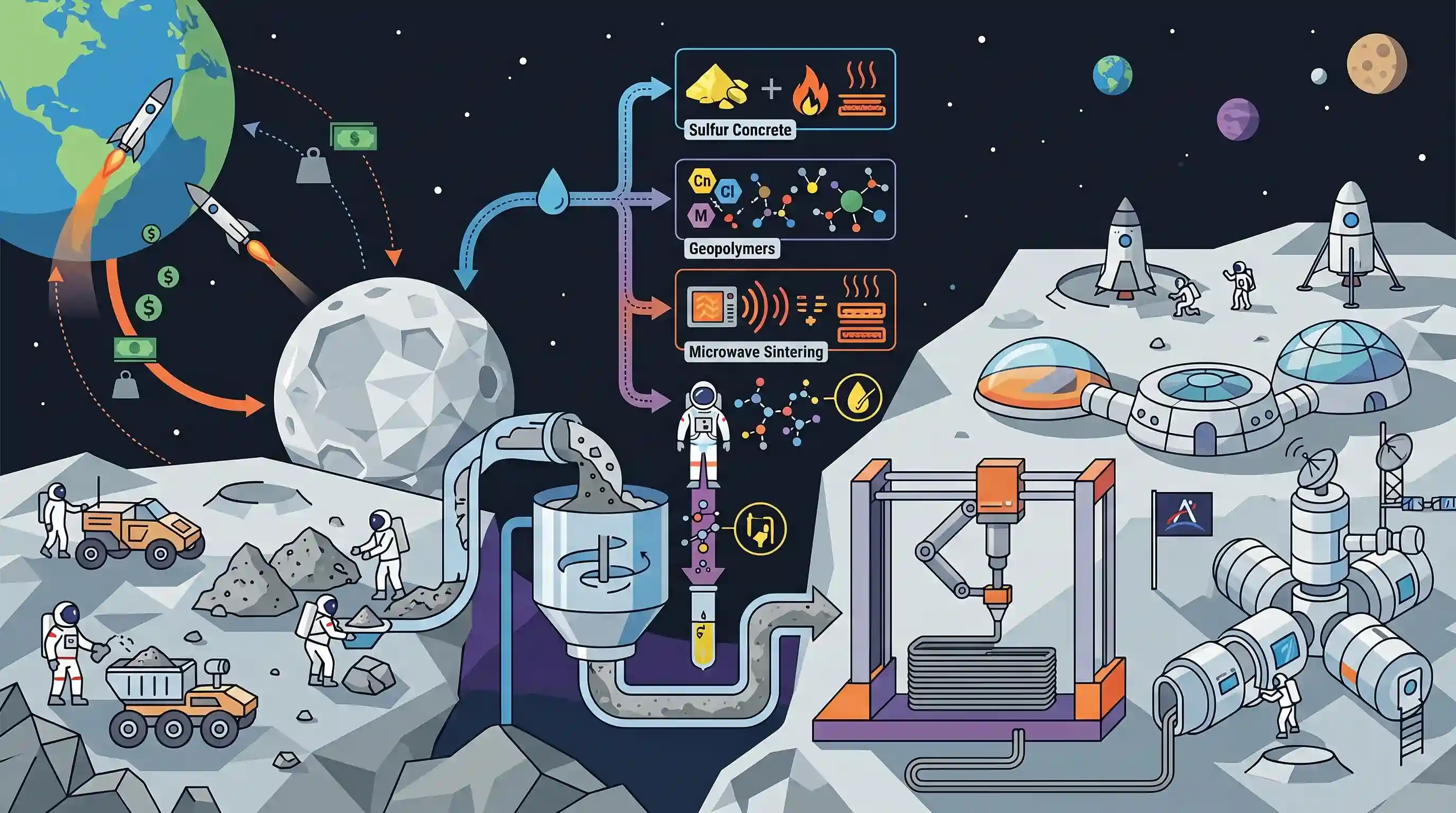
As global space agencies transition from brief lunar excursions to establishing permanent manned outposts, mastering In-Situ Resource Utilization (ISRU) through materials like lunarcrete is critical for overcoming extreme logistical hurdles and payload limitations.
Summary
The article delves into 'lunarcrete' (lunar concrete), a proposed construction material made predominantly from lunar regolith (moon dust and crushed rocks). It is designed to facilitate the building of habitats, research stations, and infrastructure on the Moon. Transporting building materials from Earth is prohibitively expensive and restricted by payload limits, making In-Situ Resource Utilization (ISRU) essential for sustainable space exploration. Overcoming the Moon's water scarcity is a primary challenge; hence, space agencies and researchers are developing waterless or low-water alternatives like sulfur concrete, geopolymers, and microwave sintering. Some innovative methods even propose using urea derived from astronauts' urine as a plasticizer to improve the material's workability before it sets. This technology is a critical stepping stone for planned long-term manned missions, such as NASA's Artemis program, and the eventual sustainable human presence on the lunar surface.
Key Points
- Definition: Lunarcrete is an extraterrestrial building material formed by combining lunar regolith with binding agents to create concrete for lunar structures.
- In-Situ Resource Utilization (ISRU): Using local lunar resources is a logistical necessity to bypass the exorbitant costs and payload constraints of launching heavy construction materials from Earth.
- Water Scarcity Solutions: Because traditional concrete requires abundant water, scientists are researching waterless alternatives (e.g., sulfur concrete, microwave sintering) and low-water geopolymers.
- Innovative Additives: Recent studies indicate that urea extracted from astronauts' urine can effectively act as a plasticizer, making the lunarcrete mixture more malleable and less prone to cracking.
- Strategic Importance: Mastering lunarcrete and 3D printing in space is critical for upcoming long-term human spaceflight programs, including NASA's Artemis and other planned lunar bases.
Important Terms
Artemis Program

A NASA-led mission to return humans to the Moon and establish a sustainable lunar presence as a springboard for future Mars missions.
UPSC context
GS Paper III; tests knowledge of international space collaboration and India's role in the Artemis Accords.
In-Situ Resource Utilization (ISRU)
The collection and processing of extraterrestrial resources (e.g., lunar soil) to produce supplies like water, oxygen, and construction materials on-site.
UPSC context
GS Paper III (Space Tech); vital for questions on sustainable exploration and reducing mission payload costs.
Lunar Regolith
The layer of loose, unconsolidated dust and fragmented rock covering the Moon's surface, used as raw material for lunar construction.
UPSC context
GS Paper III (Science); relevant for understanding extraterrestrial geology and its utility as an ISRU resource.
Lunarcrete
A proposed construction material for lunar habitats made by combining lunar regolith with specialized binders to withstand extreme space conditions.
UPSC context
GS Paper III; tests innovative material science and infrastructure development for long-term space settlements.
NASA
The U.S. federal agency responsible for civilian space exploration, aeronautics research, and international space leadership.
UPSC context
GS Paper II & III; key for bilateral space cooperation (NASA-ISRO) and global technological standards.
European Space Agency (ESA)
An intergovernmental space agency of 22 European nations that collaborates globally on missions like Artemis and the ISS.
UPSC context
GS Paper II; important for multilateral international cooperation and global space governance frameworks.
Prelims Trap
"Lunarcrete utilizes abundant subsurface lunar water ice to mix traditional Portland cement."
Lunarcrete specifically utilizes waterless or low-water alternatives (like geopolymers, sulfur, or sintering) because lunar water is too scarce and valuable to waste on building materials.
Static Concepts Connected
What is In-Situ Resource Utilization (ISRU) in space exploration?
- Core Concept: Harvesting local space resources (regolith, solar volatiles) instead of transporting materials from Earth.
- Logistical Need: Drastically reduces payload mass and launch costs, making deep-space human habitats economically viable.
- Key Applications: Creating lunarcrete for radiation-shielded shelters and extracting oxygen/hydrogen from lunar ice for rocket propellant.
How do Geopolymers differ from traditional Portland cement?
- Composition: Inorganic polymers synthesized from aluminosilicate materials (like industrial fly ash), unlike limestone-based Portland cement.
- Water Efficiency: Geopolymers require significantly less water to cure, making them ideal for arid lunar construction.
- Climate Impact: They produce substantially lower carbon emissions on Earth compared to traditional cement calcination processes.
Cross-Topic Patterns
ISRU + India's Space Policy
ISRU capabilities align directly with ISRO’s post-Chandrayaan vision and the Indian Space Policy 2023, which encourages advanced capabilities for a sustained human presence beyond Earth orbit.
Space Tech + Circular Economy
Utilizing astronaut urine (urea) as a plasticizer for lunarcrete extends Earth-based circular economy and waste-to-wealth principles directly into extraterrestrial habitat design.

Expect a 2026 Prelims multi-statement question combining lunar ISRU, space 3D printing, and Artemis Accords resource extraction rules.
Linked PYQs · 3
Linked PYQs · 3
- 2023MainsGS3
What is the main task of India's third moon mission which could not be achieved in its earlier mission? List the countries that have achieved this task. Introduce the subsystems in the spacecraft launched and explain the role of the Virtual Launch Control Centre' at the Vikram Sarabhai Space Centre which contributed to the successful launch from Sriharikota.
- 2017MainsGS3
India has achieved remarkable successes in unmanned space missions including the Chandrayaan and Mars Orbitter Mission, but has not ventured into manned space missions. What are the main obstacles to launching a manned space mission, both in terms of technology and logistics? Examine critically.
- 2013MainsGS3
How does the 3D printing technology work? List out the advantages and disadvantages of the technology.
