Low Emission Zones as Urban Air Quality Management Tool
Source:Indian Express ↗
Why It Matters
Urban air pollution is a persistent challenge in Indian metropolises. LEZs represent a targeted, policy-driven intervention to curb vehicular emissions. For UPSC aspirants, understanding LEZs is crucial for answering questions on environmental conservation (GS3), urban mass transport infrastructure (GS1), and the socio-economic challenges of transitioning to cleaner mobility.
Summary
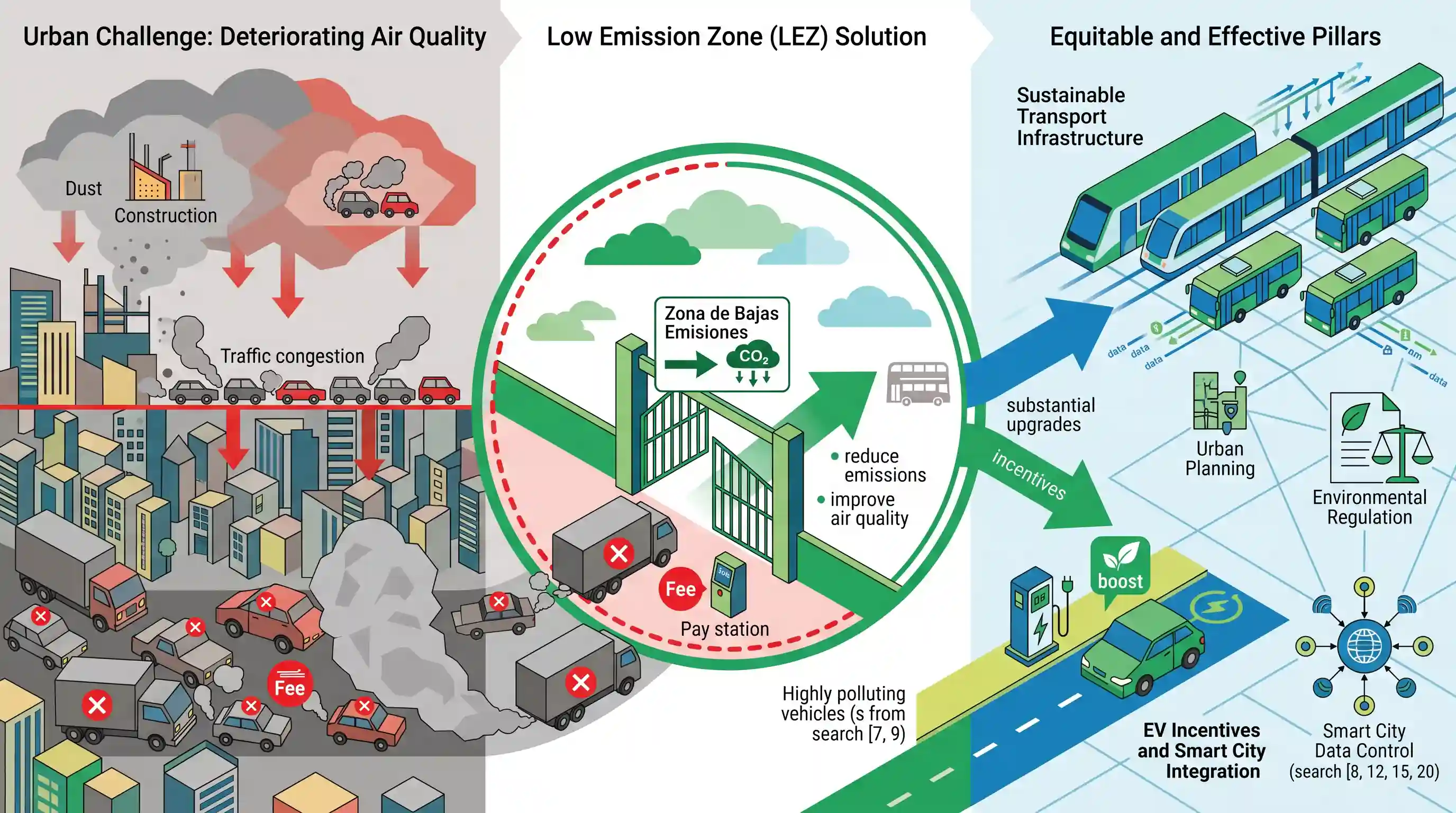
A Low Emission Zone (LEZ) is a defined urban area where highly polluting vehicles are restricted or charged a fee to enter, aiming to reduce vehicular emissions and improve local air quality. As Pune grapples with deteriorating air quality due to traffic congestion and construction, LEZ is being considered as a potential policy solution, drawing on models like London's Ultra Low Emission Zone (ULEZ). However, for an LEZ to be equitable and effective, it must be supported by substantial upgrades to public transport infrastructure and policies that incentivize Electric Vehicles (EVs). The initiative highlights the critical intersection of urban planning, environmental regulation, and sustainable mobility in fast-growing Indian metropolises.
Key Points
- A Low Emission Zone (LEZ) is an urban area where access by highly polluting vehicles is restricted or financially penalized to improve air quality.
- Pune is exploring LEZ models to combat its worsening Air Quality Index (AQI), which is exacerbated by heavy vehicular congestion, construction, and geographical factors.
- Successful LEZ implementation requires complementary infrastructure, particularly a robust, affordable, and widespread urban mass transit system to provide viable alternatives to private vehicle use.
- LEZs act as a catalyst for the adoption of Electric Vehicles (EVs) and Non-Motorized Transport (NMT) by increasing the cost of operating traditional internal combustion engine vehicles.
- Challenges include technological prerequisites (like ANPR cameras for enforcement), potential public resistance, and equity concerns for lower-income individuals who rely on older, more polluting vehicles.
Important Terms
Low Emission Zone (LEZ)

A designated urban area where access for highly polluting vehicles is restricted or charged, aiming to reduce vehicular emissions and improve local air quality.
UPSC context
Relevant for GS Paper III (Environment and Pollution) and urban planning strategies to combat deteriorating air quality.
National Clean Air Programme (NCAP)
Launched in 2019 by the Ministry of Environment, it is a national strategy aiming for a 40% reduction in particulate matter concentration by 2026.
UPSC context
Tests knowledge of government environmental initiatives and time-bound pollution targets in GS Paper III.
Central Pollution Control Board (CPCB)
A statutory body established in 1974 under the Water Act, responsible for air and water quality monitoring and advisory services for the Central Government.
UPSC context
Crucial for GS Paper II (Statutory Bodies) and GS III (Environmental Governance and enforcement).
Non-attainment Cities
Cities that consistently fail to meet the National Ambient Air Quality Standards (NAAQS) for particulate matter over a five-year period.
UPSC context
Significant for understanding target areas of NCAP and urban pollution challenges in GS III.
Ultra Low Emission Zone (ULEZ)
A stricter version of an LEZ, such as London’s model, requiring vehicles to meet even higher emission standards to avoid daily charges.
UPSC context
Evaluated as a global best-practice model for sustainable urban mobility in GS Paper III.
Bharat Stage (BS) Norms
Emission standards instituted by the Indian government to regulate the output of air pollutants from internal combustion engines and spark-ignition engines.
UPSC context
Key for understanding vehicle technology upgrades and environmental regulations in GS III.
Prelims Trap
Low Emission Zones (LEZs) are a mandatory central intervention under the National Clean Air Programme (NCAP) for all 131 non-attainment cities.
LEZ is a localized municipal-level policy tool. While it aligns with NCAP goals, NCAP mandates 'city-specific action plans', not a blanket implementation of LEZs across all 131 cities.
Static Concepts Connected
Which 8 pollutants are measured to calculate the National Air Quality Index (AQI)?
- Particulate Matter: PM10 and PM2.5, which are heavily emitted by vehicular exhaust and construction dust.
- Gases: Nitrogen Dioxide (NO2), Sulphur Dioxide (SO2), Carbon Monoxide (CO), and ground-level Ozone (O3). CO2 is notably absent.
- Others: Ammonia (NH3) and Lead (Pb) complete the eight parameters tracked for the index.
What defines a 'Non-Attainment City' under the National Clean Air Programme (NCAP)?
- Definition: Cities that consistently failed to meet the National Ambient Air Quality Standards (NAAQS) over a continuous five-year period.
- Updated Targets: NCAP mandates city-specific plans targeting a 40% reduction in PM10 and PM2.5 concentrations by 2025-26, using 2019 as the base year.
Cross-Topic Patterns
Urban Governance & Congestion Pricing
Implementing LEZs requires empowering Urban Local Bodies (74th CAA) to levy congestion taxes and strictly enforce traffic rules, highlighting the persistent issue of poor financial and administrative autonomy in Indian municipalities.
Climate Action vs. Spatial Equity
Penalizing older vehicles without first expanding affordable mass transit disproportionately burdens the urban poor, tightly linking GS3 environmental policies with GS1 urban social marginalization.

Expect a GS3 Mains question evaluating the socio-economic friction of urban climate interventions (like LEZs) against public transit deficits.
Linked PYQs · 4
Linked PYQs · 4
- 2016PrelimsGS1
In the cities of our country, which among the following atmospheric gases are normally considered in calculating the value of Air Quality Index? 1. Carbon dioxide 2. Carbon monoxide 3. Nitrogen dioxide 4. Sulfur dioxide 5. Methane Select the correct answer using the code given below.
- 2022PrelimsGS1
In the context of WHO Air Quality Guidelines, consider the following statements: 1. The 24-hour mean of PM2.5 should not exceed 15 µg/m³ and annual mean of PM2.5 should not exceed 5 µg/m³. 2. In a year, the highest levels of ozone pollution occur during the periods of inclement weather. 3. PM10 can penetrate the lung barrier and enter the bloodstream. 4. Excessive ozone in the air can trigger asthma. Which of the statements given above are correct?
- 2023MainsGS3
The adoption of electric vehicles is rapidly growing worldwide. How do electric vehicles contribute to reducing carbon emissions and what are the key benefits they offer compared to traditional combustion engine vehicles?
- 2019MainsGS1
How is efficient and affordable urban mass transport key to the rapid economic development of India?
