Uranium Enrichment Processes and Non-Proliferation Norms
Source:The Hindu ↗
Why It Matters
Crucial for understanding nuclear non-proliferation agreements (like the JCPOA and NPT), the functioning of the IAEA, and the volatile geopolitics of West Asia. These topics frequently appear in GS2 (International Relations) and GS3 (Science and Technology / Internal Security).
Summary
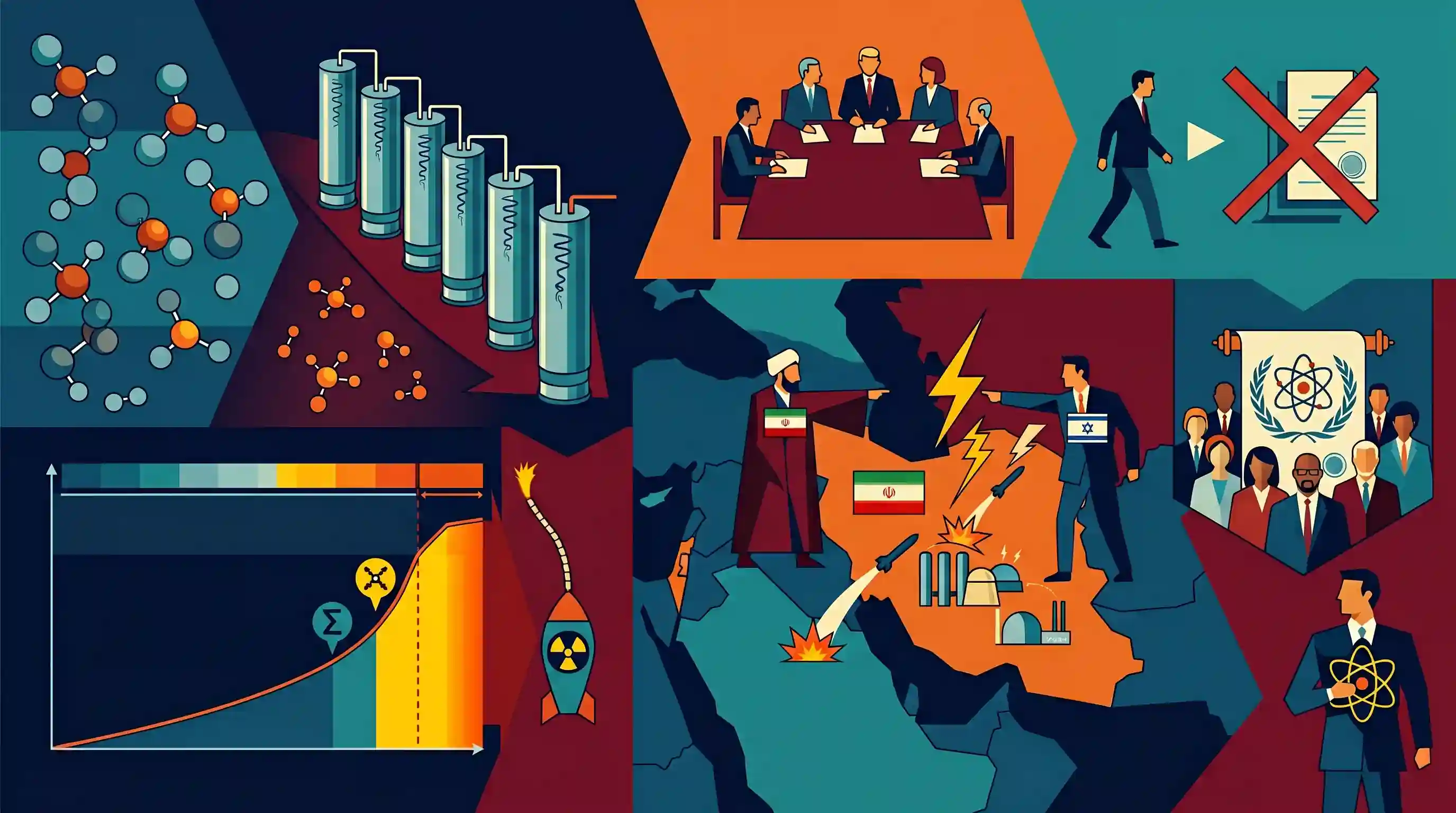
The article details the technical and geopolitical facets of Iran's nuclear programme, set against the backdrop of recent Israeli strikes on Iranian nuclear targets. It explains uranium enrichment—distinguishing between U-238 and U-235—and the role of centrifuges and Separative Work Units (SWU). Following the unilateral U.S. withdrawal from the 2015 Joint Comprehensive Plan of Action (JCPOA) in 2018, Iran escalated its enrichment to 60%, drastically shortening its 'breakout time' to assemble a nuclear weapon. The situation highlights deep-seated tensions in West Asia, aggravated by the fact that Israel, a presumed nuclear-weapon state, is not a signatory to the Non-Proliferation Treaty (NPT).
Key Points
- Israeli strikes on Iran's nuclear targets followed an IAEA resolution stating Iran breached a 1974 agreement.
- Natural uranium comprises mainly U-238 (99.3%) and U-235 (0.7%). Weapons-grade uranium requires enriching U-235 to 90% or higher.
- Uranium enrichment is achieved using centrifuges and measured in Separative Work Units (SWU).
- The 2015 JCPOA limited Iran's uranium enrichment to 3.67% and its stockpile to 300 kg, but the U.S. withdrawal in 2018 led Iran to enrich up to 60%.
- Iran is currently deemed a 'threshold' nuclear state, capable of assembling a nuclear warhead in a matter of months.
- Israel is widely believed to be a nuclear-armed state and is not a signatory to the 1968 Non-Proliferation Treaty (NPT).
Prelims Trap
"Like Israel and India, Iran is not a signatory to the Non-Proliferation Treaty (NPT)."
Iran is an NPT signatory; this is the legal basis for IAEA inspections. It was the 2015 JCPOA (Iran Nuclear Deal) that collapsed, not Iran's NPT membership.
Static Concepts Connected
What differentiates U-235 from U-238 in nuclear technology?
- Natural Abundance: U-238 constitutes ~99.3% of natural uranium, while U-235 makes up only ~0.7%.
- Fissile vs Fertile: U-235 is fissile (can sustain a chain reaction). U-238 is fertile (cannot sustain a chain reaction but can absorb a neutron to become Plutonium-239).
- Enrichment Levels: Civilian reactors use Low Enriched Uranium (3-5% U-235). Weapons-grade Highly Enriched Uranium (HEU) requires 90% or more U-235.
Which countries are non-signatories to the Non-Proliferation Treaty (NPT)?
- Never Signed: India, Pakistan, Israel, and South Sudan have never signed the 1968 treaty.
- Withdrawn: North Korea originally signed the treaty but announced its withdrawal in 2003.
- P5 Monopoly: The NPT only recognizes the P5 (US, Russia, UK, France, China) as legitimate nuclear-weapon states, which is why India refuses to sign it.
Cross-Topic Patterns
India's Non-NPT Status & Thorium
India’s three-stage nuclear programme (ultimately aiming at Thorium) was necessitated by its non-NPT status, which historically blocked global uranium trade until the 2008 NSG waiver.
Strait of Hormuz & Energy Transit
Any escalation regarding Iran's nuclear facilities immediately threatens the Strait of Hormuz, a critical chokepoint handling ~20% of global oil consumption, directly impacting India's import-dependent energy security.

Expect a composite Prelims question merging nuclear physics (U-235 vs U-238 enrichment) with IR, testing NPT status of Israel, Iran & India.
Linked PYQs · 3
Linked PYQs · 3
- 2018PrelimsGS1
In the Indian context, what is the implication of ratifying the 'Additional Protocol' with the 'International Atomic Energy Agency (IAEA)'?
- 2024PrelimsGS1
With reference to radioisotope thermoelectric generators (RTGs), consider the following statements: 1. RTGs are miniature fission reactors. 2. RTGs are used for powering the onboard systems of spacecrafts. 3. RTGs can use Plutonium-238, which is a by-product of weapons development. Which of the statements given above are correct?
- 2017MainsGS2
The question of India's Energy Security constitutes the most important part of India's economic progress. Analyze India's energy policy cooperation with West Asian countries.
