Replacing Saudi Kafala system and its impact on Indian workers
Source:Indian Express ↗
Why It Matters
The Indian diaspora in the Gulf is a critical source of remittances and a key pillar of India's soft power and relations with West Asia. Ensuring the welfare, safety, and labour rights of Indian workers is a central focus of India's consular services and foreign policy. Understanding the Kafala system and its exploitative nature is vital for addressing human rights and labour mobility issues globally.
Summary
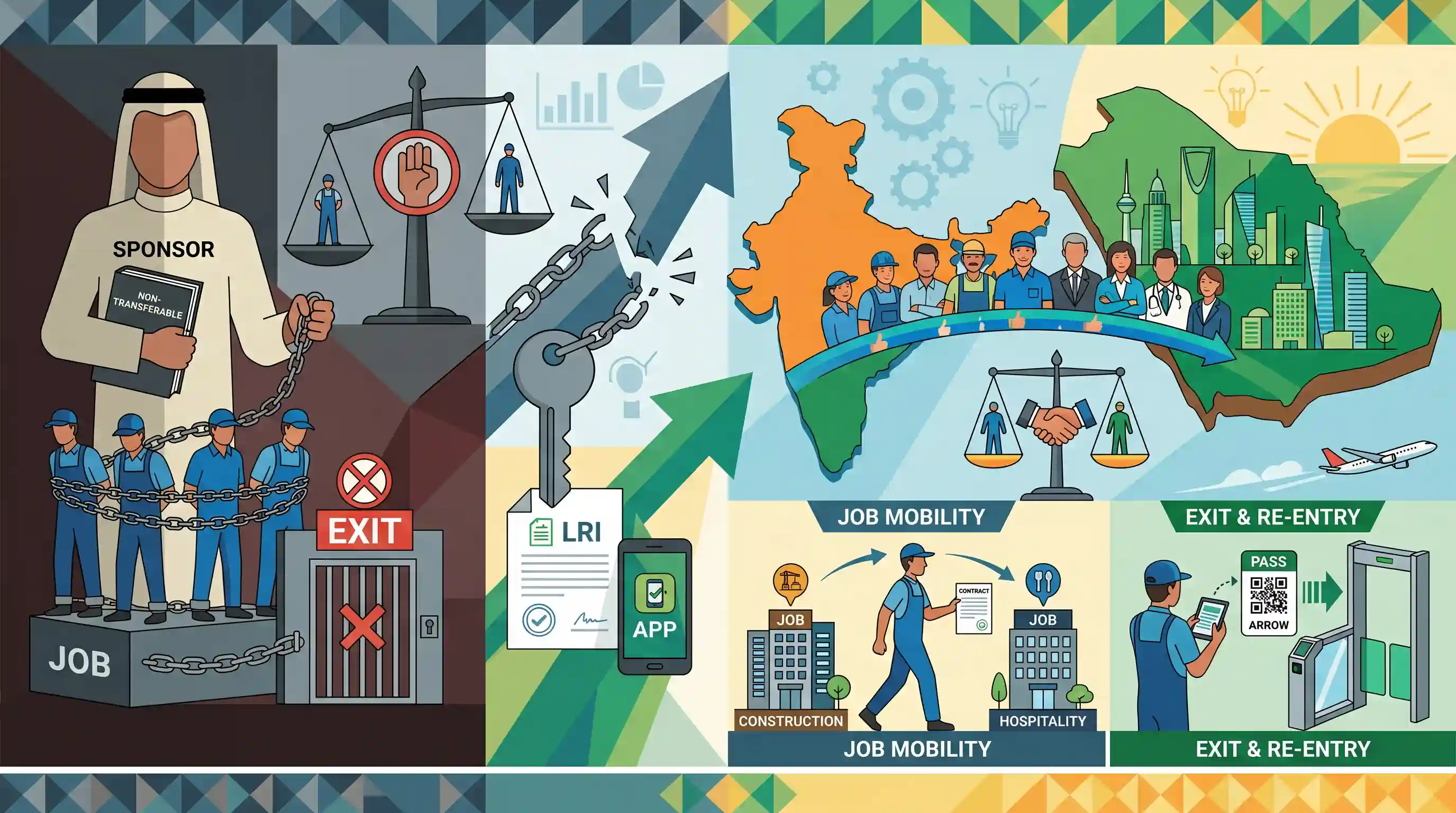
Saudi Arabia is implementing major labour market reforms by replacing the controversial 'Kafala' sponsorship system with a new contractual arrangement under the Labor Reform Initiative (LRI). Historically, the Kafala system bound migrant workers to their employers, leading to widespread exploitation and restricted movement. The new framework allows workers to change jobs after completing their contracts and provides electronic mechanisms to exit or re-enter the country without the sponsor's explicit approval. Aligned with Saudi Vision 2030, this move aims to attract global talent and modernize the economy. For India, this is a highly consequential development, as it promises improved working conditions, enhanced labour mobility, and better human rights protections for millions of Indian blue-collar migrant workers stationed in the region.
Key Points
- The traditional Kafala (sponsorship) system legally binds migrant workers to their domestic sponsors, severely restricting their freedom to change jobs or leave the country.
- Saudi Arabia has rolled out the Labor Reform Initiative (LRI) under Vision 2030 to replace the Kafala system with a contractual model, allowing enhanced labour mobility.
- Under the new rules, workers can transfer to a new employer upon contract completion and apply directly for exit and return visas without requiring the employer's prior consent.
- The reform will significantly benefit millions of Indian expatriates working in Saudi Arabia by safeguarding them against exploitation and human rights abuses often equated with modern-day slavery.
- While Bahrain abolished the system in 2009 and the UAE diluted it in 2015, the strict Kafala system remains prevalent in other Gulf Cooperation Council (GCC) countries like Kuwait, Qatar, and Oman.
Important Terms
Kafala System

A sponsorship system that legally binds a migrant worker's residency and employment status to a single employer (sponsor), often restricting the worker's ability to change jobs or leave the country.
UPSC context
GS Paper 2 (Indian Diaspora); critical for understanding human rights and labour challenges faced by Indian workers in West Asia.
Saudi Vision 2030
A comprehensive strategic framework launched in 2016 to diversify Saudi Arabia's economy beyond oil, focusing on social reforms, tourism, and infrastructure to modernize the Kingdom.
UPSC context
GS Paper 2 (Bilateral Relations); vital for analyzing the long-term economic and strategic transformation of India's key regional partner.
Labor Reform Initiative (LRI)
A program launched by the Saudi government to modernize the labour market by replacing the Kafala system with a contract-based relationship, allowing workers greater mobility and travel freedom.
UPSC context
GS Paper 2; significant for policies impacting the welfare and mobility of millions of Indian blue-collar migrants in Saudi Arabia.
International Labour Organisation (ILO)
A United Nations specialized agency that brings together governments, employers, and workers to set international labour standards, promote social justice, and advocate for decent work conditions globally.
UPSC context
GS Paper 2 (International Institutions); relevant for discussions on global labour rights, conventions, and international human rights frameworks.
Ministry of Human Resources and Social Development (MHRSD)
The primary Saudi Arabian government ministry responsible for regulating labor laws, social development, and overseeing the implementation of the Labor Reform Initiative (LRI).
UPSC context
GS Paper 2; the key regulatory authority for bilateral labour negotiations and worker protection protocols between India and Saudi Arabia.
Prelims Trap
"Saudi Arabia is the first GCC country to abolish the Kafala system."
Aspirants might assume Saudi Arabia is leading this change. Bahrain abolished it in 2009, and the UAE diluted it in 2015.
Static Concepts Connected
What governs Indian emigration for employment to the Gulf countries?
- Emigration Act 1983: Regulates emigration of Indian workers to safeguard against exploitation, establishing Emigration Clearance Required (ECR) passports for vulnerable workers.
- e-Migrate Portal: An online portal by the Ministry of External Affairs to register recruitment agents and track workers emigrating to ECR countries.
- PBBY Scheme: Provides insurance cover and financial assistance to emigrant workers in case of death, disability, or job loss.
What is the Gulf Cooperation Council (GCC)?
- Formation: A political and economic union of Arab states bordering the Persian Gulf, established in 1981.
- Membership: Comprises six nations: Bahrain, Kuwait, Oman, Qatar, Saudi Arabia, and the UAE. Yemen, Iran, and Iraq are not members.
- Headquarters: The secretariat is located in Riyadh, Saudi Arabia.
Cross-Topic Patterns
Gulf labour reforms & Remittances
India is the world's top remittance recipient, heavily driven by the GCC. Improved labor frameworks ensure wage security and sustained inward remittances, bolstering India's Balance of Payments.
Evolution of India's 'Think West' policy
Beyond diaspora and energy security, India-Saudi relations are transitioning into strategic tech, defense, and connectivity partnerships (like IMEC), aligning closely with Saudi Vision 2030.

Expect a Prelims match-the-pair on labour systems (Kafala) and regions, or a Mains GS-2 question on GCC reforms and the Indian diaspora.
Linked PYQs · 4
Linked PYQs · 4
- 2023MainsGS2
Indian diaspora has scaled new heights in the West. Describe its economic and political benefits for India.
- 2025MainsGS2
"Energy security constitutes the dominant kingpin of India's foreign policy, and is linked with India's overarching influence in Middle Eastern countries.” How would you integrate energy security with India's foreign policy trajectories in the coming years?
- 2017MainsGS2
Indian diaspora has an important role to play in South-East Asian countries' economy and society. Appraise the role of Indian diaspora in South-East Asia in this context.
- 2024MainsGS3
Discuss the merits and demerits of the four 'Labour Codes' in the context of labour market reforms in India. What has been the progress so far in this regard?
