IceCube Neutrino Observatory and Fundamental Astroparticle Physics
Source:The Hindu ↗
কেন এটি গুরুত্বপূর্ণ
Understanding major global scientific facilities like IceCube enhances awareness of cutting-edge research in astroparticle physics, cosmic rays, and fundamental constituents of matter, which frequently feature in civil services general science and technology questions.
সারসংক্ষেপ
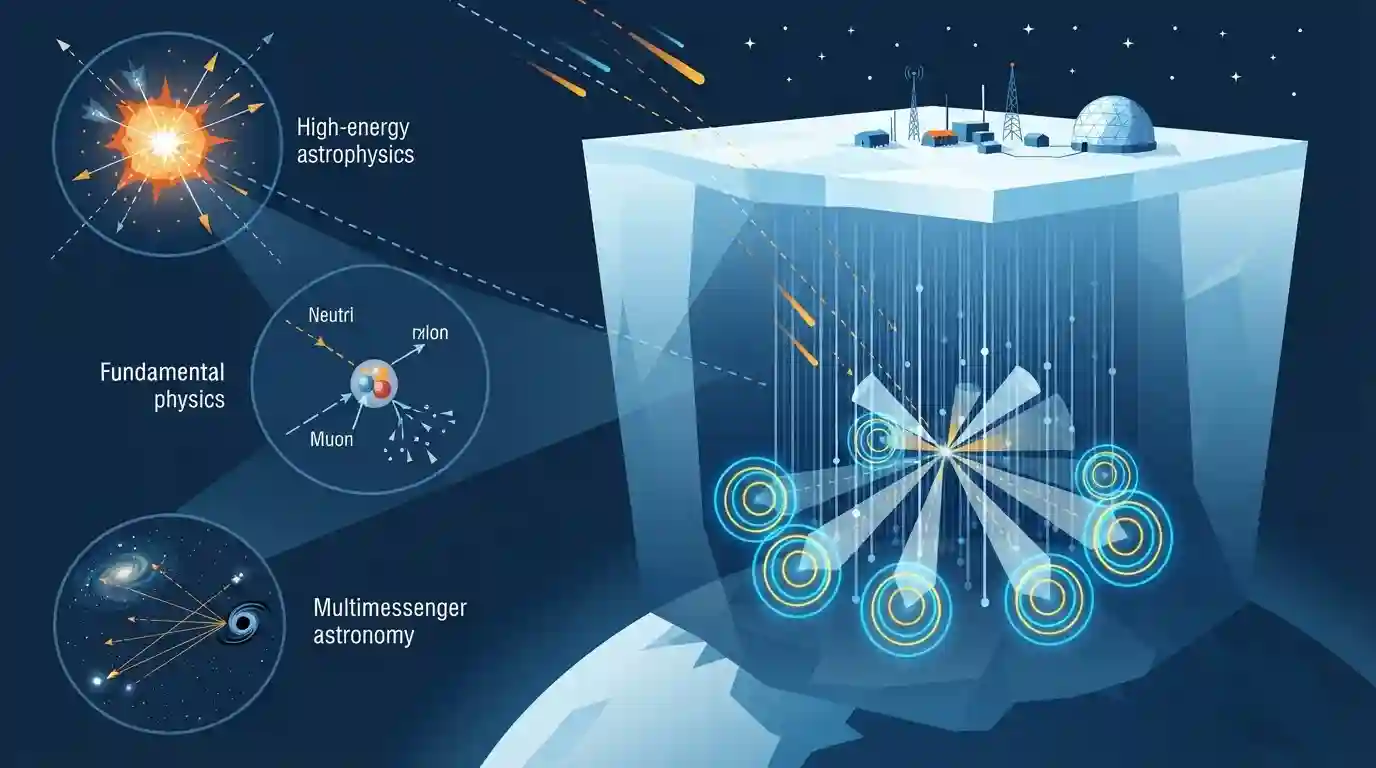
The article explains the IceCube Neutrino Observatory located at the South Pole, its working principles involving the detection of faint Cherenkov light produced by neutrino interactions in deep Antarctic ice, and its significance in astrophysics and particle physics.
মূল বিষয়
- Neutrinos are subatomic particles with virtually no mass and no charge that rarely interact with matter, making them difficult to detect.
- The IceCube Neutrino Observatory, located deep in the ice at the South Pole, uses a cubic kilometre of ultra-clear ice equipped with digital optical modules (photomultiplier tubes) to detect Cherenkov radiation emitted when neutrinos interact with ice.
- IceCube helps scientists study high-energy astrophysical events, cosmic rays, and fundamental particle physics by tracking neutrino trajectories back to their cosmic sources.
গুরুত্বপূর্ণ শব্দ
IceCube Neutrino Observatory

A massive particle detector embedded deep within the Antarctic ice sheet at the South Pole, designed to detect high-energy cosmic neutrinos by capturing faint Cherenkov light produced during particle interactions.
UPSC context
GS Paper III (Science and Technology - Space & Scientific Research); tests knowledge of premier international research facilities and fundamental physics discoveries.
University of Wisconsin-Madison
The lead institution that developed and manages the IceCube Neutrino Observatory through the Wisconsin IceCube Particle Astrophysics Center (WIPAC).
UPSC context
GS Paper III (Science and Technology); relevant for understanding global institutional collaborations in cutting-edge astrophysical and particle physics experiments.
সংযুক্ত স্থির ধারণা
What are neutrinos and how do neutrino observatories detect them?
- Ghost Particles:: Subatomic particles with almost zero mass and neutral charge, interacting extremely weakly with matter.
- Cherenkov Light:: Faint blue optical radiation emitted when charged particles move faster than the speed of light in a medium (like ultra-clear ice or water).
- Deep-Site Shielding:: Deep underground or underwater placement (ice, mines, seas) shields detectors from cosmic ray noise to isolate rare neutrino signals.
আন্তঃবিষয় প্যাটার্ন
Global Mega-Science Projects and India's Role
India participates in global mega-science projects like LIGO-India and SKA. UPSC frequently tests the governance and funding models of such international research facilities.

IceCube's unique detection mechanism (Cherenkov radiation in ice) makes it a prime candidate for a technical Prelims match-the-column.
সংযুক্ত PYQ · 1
সংযুক্ত PYQ · 1
- 2023PrelimsGS1
Consider the following pairs: Objects in space Description 1. Cepheids: Giant clouds of dust and gas in space 2. Nebulae: Stars which brighten and dim periodically 3. Pulsars: Neutron stars that are formed when massive stars run out of fuel and collapse How many of the above pairs are correctly matched?
