Judicial Interpretation of Industry Definition under Labour Law
Source:The Hindu ↗
ఇది ఎందుకు ముఖ్యం
The judgment addresses the critical constitutional dividing line between 'sovereign functions' of the state and 'industrial activity'. It directly affects the labor rights, collective bargaining privileges, and grievance redressal mechanisms of millions of workers employed in government schemes, public utilities, and social welfare projects.
సారాంశం
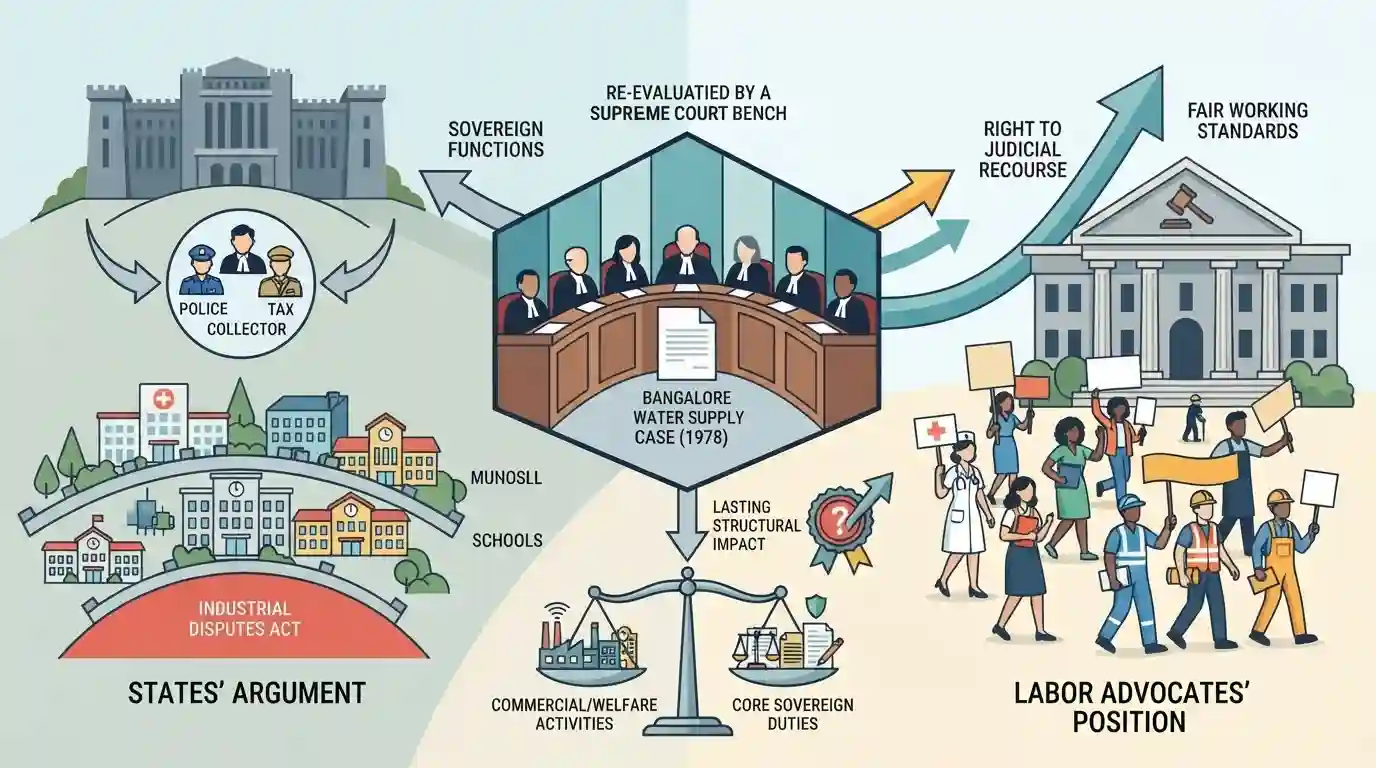
The Supreme Court’s nine-judge Bench is set to pronounce its verdict on the exact legal definition and scope of the term 'industry' under Section 2(j) of the repealed Industrial Disputes Act, 1947. This review revisits the 1978 Bangalore Water Supply case, which expansively defined 'industry' to include municipalities, hospitals, and educational institutions, excluding only core sovereign functions. While states seek to exclude social welfare programs and state enterprises from this definition, labor advocates argue that this categorization is fundamental to workers' constitutional right to judicial recourse and fair working standards. Despite the enactment of the new Industrial Relations Code, the ruling will carry lasting structural impact on the division between the state's sovereign and commercial/welfare functions.
ముఖ్య అంశాలు
- A nine-judge Supreme Court Bench, headed by Chief Justice of India Surya Kant, is reviewing the definition and legal ambit of the term 'industry' under Section 2(j) of the repealed Industrial Disputes Act, 1947.
- The primary reference is the landmark 1978 seven-judge Bench ruling in Bangalore Water Supply and Sewerage Board v. A. Rajappa, authored by Justice V.R. Krishna Iyer, which provided an expansive definition of 'industry' based on a 'triple test'.
- Under the 1978 ruling, only core sovereign functions (defence, judiciary, law and order) were exempted, bringing hospitals, educational institutions, and municipalities under the ambit of 'industry' to protect workers' rights.
- States like Uttar Pradesh, Maharashtra, and Punjab have urged a relook, arguing that social welfare schemes, developmental activities, and state-run enterprises should not be classified as industrial activities.
- While worker representatives argue that classification as an 'industry' is vital for ensuring access to judicial grievance redressal and collective bargaining, the Attorney-General argued that sovereign functions must remain open-ended to adapt to the evolving role of the state.
- Although the new Industrial Relations Code has replaced the old labor laws, an authoritative clarification on the distinction between 'sovereign functions' and 'industrial activities' remains legally and constitutionally essential.
ముఖ్యమైన పదాలు
Bangalore Water Supply and Sewerage Board

A landmark 1978 Supreme Court case that formulated the "triple test" to expansively define "industry," bringing hospitals, educational institutions, and welfare departments under the ambit of labor protection.
UPSC context
GS Paper II: Judgments & Judicial Review; tests understanding of labor welfare jurisprudence and the separation of sovereign and commercial functions.
Industrial Disputes Act, 1947
A historical piece of legislation that provided a legal framework for investigating and settling industrial disputes, safeguarding workers against unfair labor practices and arbitrary dismissals.
UPSC context
GS Paper III: Industrial Growth & Labour Reforms; tests comprehension of historical labor laws and evolution of industrial dispute mechanisms.
Industrial Relations Code
A consolidated central code that simplifies and replaces three major labor laws to streamline trade union recognition, employment terms, and industrial dispute resolution.
UPSC context
GS Paper III: Indian Economy and Mobilization of Resources; tests understanding of labor market reforms, ease of doing business, and worker welfare.
Trade Unions Act, 1926
A pre-independence law that granted legal recognition to trade unions, protected registered union office-bearers from civil and criminal liabilities during collective bargaining, and regulated industrial relations.
UPSC context
GS Paper I: Modern Indian History (Labour Movements) & GS II: Polity; tests historical development of worker unions and statutory bargaining rights.
Industrial Employment (Standing Orders) Act, 1946
An act requiring employers in industrial establishments to formally define and certify uniform terms of employment, working conditions, and disciplinary procedures to ensure workplace transparency.
UPSC context
GS Paper III: Labour Reforms & Governance; tests knowledge of pre-reform statutory worker protections and workplace standardization mechanisms.
ప్రిలిమ్స్ ఉచ్చు
The Bangalore Water Supply case's Triple Test requires a profit-making motive for an enterprise to be classified as an industry.
The Bangalore Water Supply 'Triple Test' explicitly rules out profit-making or philanthropic objectives as deciding factors; systematic employer-employee cooperation is the core test.
అనుసంధానమైన స్థిర భావనలు
What is the 'Triple Test' defining 'industry' under Indian labour jurisprudence?
- Systematic Activity: Requires structured, organized, and continuous operations rather than casual, personal, or sporadic transactions.
- Cooperative Relationship: Relies on functional, structured cooperation between the employer and employees to yield the desired output.
- Wants Satisfaction: Aimed at producing or distributing goods and services to satisfy material human wants, regardless of any profit motive.
How does Indian law differentiate the state's sovereign and non-sovereign functions?
- Sovereign Functions: Inalienable, primary state duties like defence, law enforcement, foreign affairs, and justice administration that cannot be delegated to private entities.
- Non-Sovereign Welfare: Commercial, industrial, or welfare activities undertaken by the State, which are subject to regular civil and labour law liabilities.
- Article 300 Nexus: Governs the suability of the State; Indian courts increasingly restrict sovereign immunity to expand citizens' and workers' constitutional rights.
అంతర-అంశ నమూనాలు
Sovereign immunity and Welfare State
The clash between state immunity and social security highlights the transition from a colonial-era police state to a modern welfare administration under Part IV of the Constitution.
Judicial review vs statutory codes
Examines how judicial interpretations of repealed acts (like ID Act 1947) continue to shape and influence the execution of the new Industrial Relations Code, 2020.

SC's definition of 'sovereign functions' vs. welfare activities likely to feature as a conceptual GS-2 separation of powers question.
అనుసంధాన PYQలు · 2
అనుసంధాన PYQలు · 2
- 2024MainsGS3
Discuss the merits and demerits of the four 'Labour Codes' in the context of labour market reforms in India. What has been the progress so far in this regard?
- 2017PrelimsGS1
The Trade Disputes Act of 1929 provided for
