Rare Earth Elements Reserves and Production Bottlenecks in India
Source:Indian Express ↗
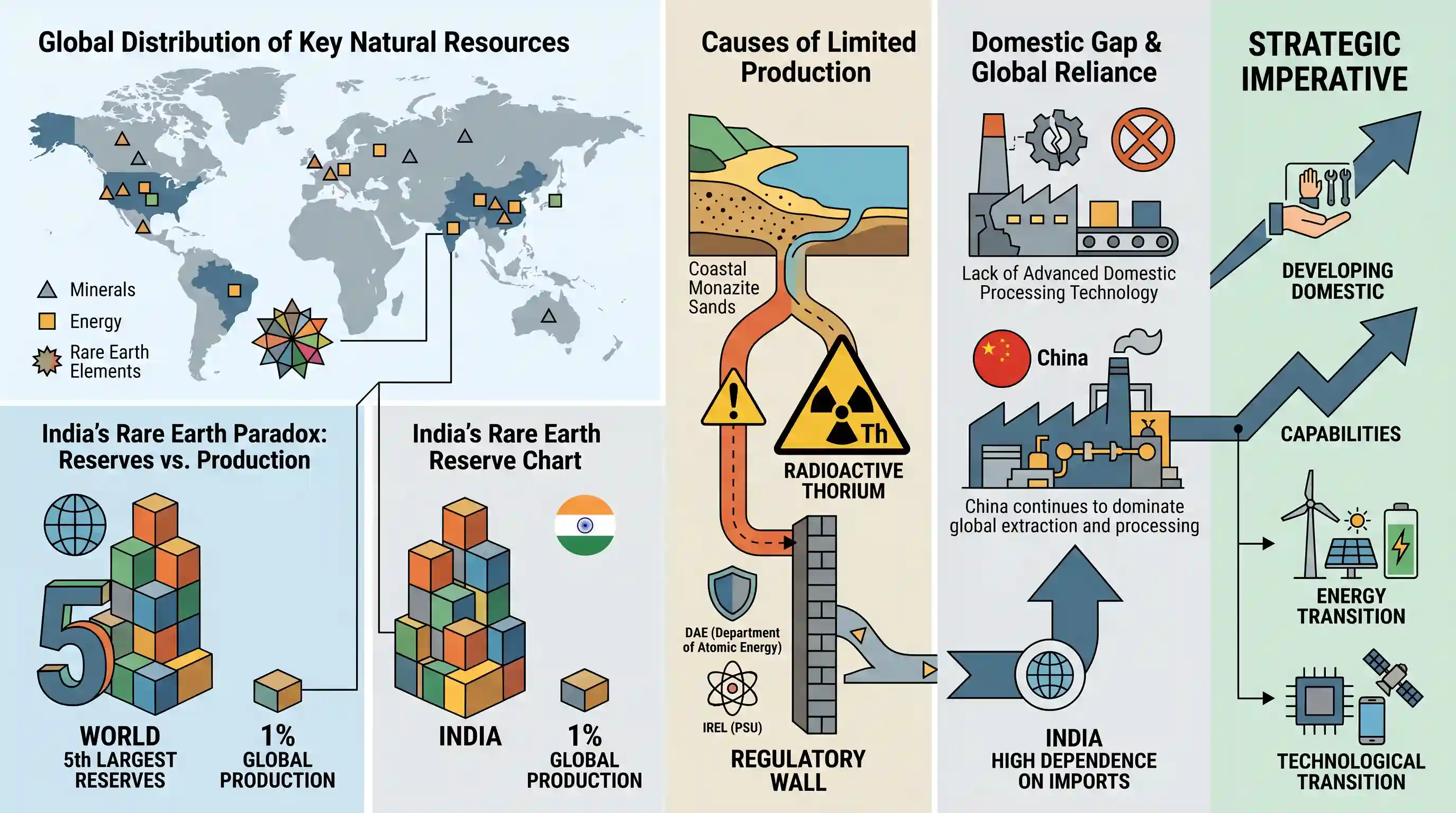
Why It Matters
REEs are vital 'critical minerals' essential for India's transition to green energy and self-reliance in high-tech manufacturing. Understanding their geographical distribution, the bottleneck in Indian production (monazite regulation), and geopolitical supply chain vulnerabilities (China's dominance) is frequently tested in both Prelims (Geography) and Mains (Geography & Economy/Tech).
Summary
The article examines India's position in the global landscape of Rare Earth Elements (REEs), a crucial group of 17 minerals powering modern technologies like clean energy and advanced electronics. Despite having the world's 5th largest reserves, primarily found in coastal monazite sands, India accounts for only 1% of global production. The disparity is attributed to the fact that monazite contains radioactive thorium, placing REE mining under stringent regulations of the Department of Atomic Energy and limiting it to PSUs like IREL. Combined with a lack of advanced domestic processing technology, this leaves India highly dependent on imports, while China continues to dominate global extraction and processing. Developing domestic capabilities in this sector is seen as strategically imperative for India's technological and energy transitions.
Key Points
- Rare Earth Elements (REEs) comprise 17 chemically similar elements (15 lanthanides, scandium, and yttrium) that are indispensable for high-tech applications including electric vehicles, wind turbines, and defense electronics.
- India possesses the world's 5th largest REE reserves (accounting for ~6% of global reserves) but contributes only about 1% to global production.
- China has a near-monopoly on the sector, controlling over 60% of global mining production and roughly 85% of downstream processing and refining capabilities.
- In India, REEs are predominantly derived from monazite sand deposits found along the coasts of Kerala, Tamil Nadu, and Odisha.
- Because monazite contains radioactive thorium, its mining and extraction are tightly regulated under the Department of Atomic Energy, with processing restricted mainly to the state-owned Indian Rare Earths Limited (IREL).
- Scaling up India's REE production is hindered by strict atomic energy regulations, environmental concerns related to mining, and a lack of advanced downstream processing technology.
Important Terms
Rare Earth Elements (REEs)

A group of 17 metallic elements (15 lanthanides plus scandium and yttrium) essential for high-tech applications like permanent magnets, EV motors, and defense systems.
UPSC context
GS Paper 1 (Resources) and Paper 3 (Economy/Tech); tests knowledge of strategic global resources and energy transition.
Monazite
A phosphate mineral found in Indian coastal sands; it is the primary source of both rare earths and radioactive thorium.
UPSC context
GS Paper 1 (Distribution of resources) and Paper 3 (Energy); focuses on India's unique mineral wealth and nuclear fuel cycle.
Atomic Energy Act, 1962
Legislation governing India's nuclear program that classifies monazite as a 'prescribed substance,' restricting its mining and processing exclusively to government-controlled entities.
UPSC context
GS Paper 2 (Laws) and Paper 3 (Security/Energy); examines regulatory barriers to domestic industrial growth in strategic sectors.
Mines and Minerals (Development and Regulation) Amendment Act, 2023
A 2023 legislative update that reclassified several atomic minerals as 'critical minerals' to permit private sector mining and introduced new exploration licenses.
UPSC context
GS Paper 3 (Economic Development/Resources); relevant for understanding recent policy shifts toward mineral self-reliance (Atmanirbhar Bharat).
IREL (India) Limited
A Mini Ratna Public Sector Undertaking under the DAE, authorized as the sole agency for processing and exporting monazite-derived rare earths in India.
UPSC context
GS Paper 3 (Economy); concerns the role of PSUs in managing strategic resources and infrastructure.
Department of Atomic Energy (DAE)
The nodal agency under the Prime Minister's Office that oversees India's nuclear power technology and regulates atomic minerals like monazite.
UPSC context
GS Paper 2 (Governance) and Paper 3 (Science/Energy); tests understanding of the institutional framework for strategic materials.
Critical Minerals
Minerals vital for economic development and national security whose supply is at risk; India has identified 30 such minerals, including REEs and lithium.
UPSC context
GS Paper 3 (Economic Security/Tech); crucial for topics on global supply chains and the Minerals Security Partnership (MSP).
Prelims Trap
Rare Earth Elements are extremely scarce and rarely found in the Earth's crust.
The term 'rare' is a historical misnomer. REEs are actually relatively abundant in the Earth's crust, but they rarely occur in concentrated, economically extractable ore deposits.
Static Concepts Connected
What is Monazite and how is it regulated in India?
- Composition: A reddish-brown phosphate mineral that serves as a primary ore for rare earth elements and contains radioactive thorium.
- Distribution: Found abundantly as placer deposits (beach sands) along the coastal tracts of Kerala, Tamil Nadu, and Odisha.
- Regulation: Due to its radioactive thorium content, its mining is strictly regulated by the Department of Atomic Energy and restricted to PSUs like IREL.
Which elements constitute the Rare Earth Elements (REEs) group?
- 17 Elements: It comprises 17 metallic elements: 15 lanthanides (atomic numbers 57-71) along with Scandium and Yttrium, which share similar chemical properties.
- Unique Properties: They exhibit unique magnetic, luminescent, and electrochemical properties making them irreplaceable in advanced electronics, permanent magnets, and defense systems.
Cross-Topic Patterns
Clean Energy vs. Mineral Security
India's Panchamrit climate goals (500GW non-fossil capacity by 2030) directly collide with its heavy import dependency for REEs, which are vital for wind turbine generators and electric vehicle motors.
Minerals Security Partnership (MSP) and Quad
To bypass China's 85% processing monopoly, India joined the US-led Minerals Security Partnership (MSP) and is utilizing Quad frameworks to secure critical mineral supply chains globally.

Expect a 2026 prelims question linking coastal Monazite distribution, Thorium radioactivity, and DAE regulations on REE mining.
Linked PYQs · 4
Linked PYQs · 4
- 2022PrelimsGS1
With reference to India, consider the following statements: 1. Monazite is a source of rare earths. 2. Monazite contains thorium. 3. Monazite occurs naturally in the entire Indian coastal sands in India. 4. In India, Government bodies only can process or export monazite. Which of the statements given above are correct?
- 2023PrelimsGS1
Ilmenite and rutile, abundantly available in certain coastal tracts of India, are rich sources of which one of the following?
- 2020PrelimsGS1
The term 'West Texas Intermediate', sometimes found in news, refers to a grade of
- 2025MainsGS3
Mineral resources are fundamental to the country's economy and these are exploited by mining. Why is mining considered an environmental hazard? Explain the remedial measures required to reduce the environmental hazard due to mining.
