India First Orbital Data Centre Satellite and Edge Computing
Source:The Hindu ↗
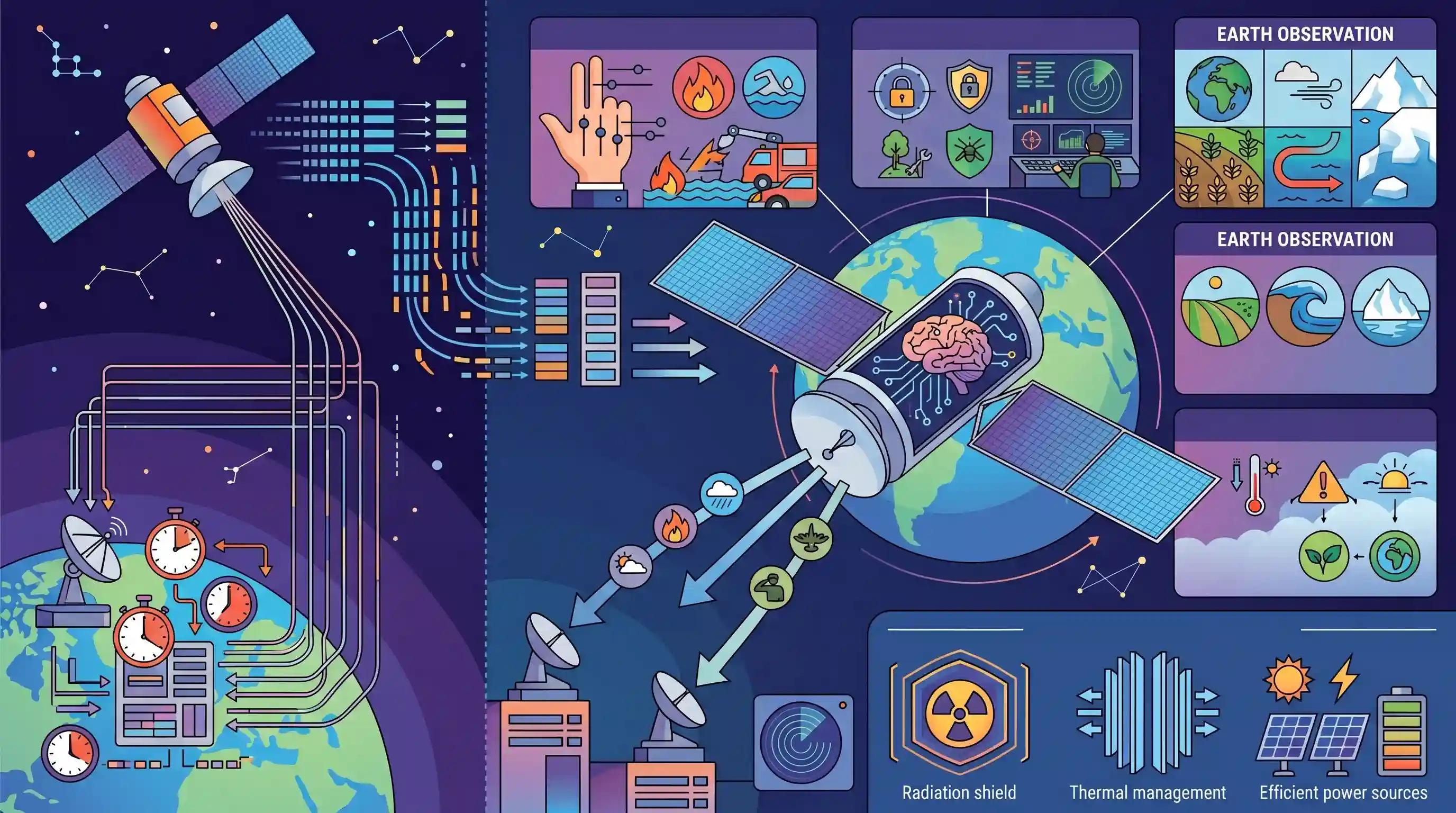
Why It Matters
The integration of edge computing and AI into satellites marks a paradigm shift in space technology, directly relevant to GS-3 (Science & Technology). It demonstrates how emerging technologies are being applied to improve disaster response, internal security, and resource management.
Summary
The article discusses the emergence of India's first orbital data centre satellite, a major advancement that integrates high-performance computing and Artificial Intelligence directly into space assets. Traditionally, satellites collect vast amounts of raw data and transmit it to ground stations for processing, which consumes significant bandwidth and introduces latency. Orbital data centres overcome this by employing "edge computing in space"—processing the data in orbit and downlinking only the necessary, actionable insights. This capability is critical for real-time decision-making in areas like disaster response, defence, and climate monitoring. However, realizing this technology requires solving complex engineering challenges related to space radiation, thermal management, and power efficiency.
Key Points
- Orbital data centres bring edge computing to space, enabling satellites to process information onboard using AI rather than just acting as data-gathering relays.
- By analysing raw Earth Observation data in orbit and transmitting only actionable insights, these satellites drastically reduce downlink bandwidth requirements and data latency.
- Real-time processing is highly beneficial for time-critical applications such as disaster management, maritime domain awareness, and border surveillance.
- Building orbital data centres presents unique engineering challenges, including radiation hardening, thermal management (heat dissipation), and strict power constraints in the space environment.
- The development marks a significant step in India's space capabilities, highlighting a shift towards intelligent satellite architectures and increased commercial viability.
Important Terms
Pathfinder Satellite

A 200-kg class satellite by Pixxel and Sarvam AI, designed as India's first orbital data centre to perform AI processing directly in space.
UPSC context
GS Paper III: Space technology; illustrative of private sector milestones and 'NewSpace' initiatives in India.
Orbital Data Centre (ODC)
A space-based infrastructure that stores and processes data in orbit, utilizing solar energy and radiative cooling to overcome terrestrial energy and land constraints.
UPSC context
GS Paper III: IT and Space; tests understanding of emerging computing paradigms and sustainable technology.
Edge Computing in Space
The practice of processing data locally on a satellite rather than transmitting raw data to ground stations, reducing latency and bandwidth usage.
UPSC context
GS Paper III: Science & Tech; critical for real-time disaster management and strategic defense applications.
IN-SPACe
An autonomous nodal agency under the Department of Space that regulates and promotes private sector participation in India's space industry.
UPSC context
GS Paper III: Space; central to questions on space reforms and ease of doing business in high-tech sectors.
Hyperspectral Imaging
Imaging technology that captures data across hundreds of narrow spectral bands, enabling precise identification of materials and chemical compositions from space.
UPSC context
GS Paper III: Earth Observation; vital for precision agriculture, environmental monitoring, and mineral exploration.
Sovereign AI
AI infrastructure and models developed and controlled within a nation to ensure data security, privacy, and strategic autonomy from foreign tech providers.
UPSC context
GS Paper III: Internal Security and IT; relates to data localization and national technological independence.
Prelims Trap
"Orbital data centres act as massive cloud servers to store and transmit vast amounts of raw satellite data globally."
They utilize edge computing, not massive cloud storage. The goal is to process data locally on the satellite and transmit only actionable insights, drastically reducing raw data transmission.
Static Concepts Connected
How does Edge Computing differ from Cloud Computing?
- Location: Edge computing processes data locally (e.g., on a satellite), whereas cloud computing relies on centralized, distant data centers.
- Latency: Edge provides ultra-low latency ideal for real-time decisions, while cloud computing involves transmission delays.
- Bandwidth: Edge computing saves bandwidth by transmitting only processed insights; cloud computing requires sending bulky raw data.
What are the key engineering challenges for electronics in Low Earth Orbit?
- Radiation Hardening: Cosmic rays and solar radiation can cause Single Event Upsets (SEUs) that corrupt memory or permanently damage commercial hardware.
- Thermal Management: Dissipating heat is highly complex in the vacuum of space where convection is impossible, requiring specialized conduction systems.
- Power Constraints: Satellites rely on limited solar panels and batteries, demanding AI hardware with extremely high power-efficiency.
Cross-Topic Patterns
Orbital Edge & Border Surveillance
Real-time, AI-processed orbital imagery bridges Space Tech and Internal Security, directly enhancing maritime domain awareness (MDA) and border anomaly detection by eliminating ground-processing delays.
Private Sector Space Innovations (IN-SPACe)
Collaborations like Pixxel and Sarvam AI highlight the shift from an ISRO-monopolized space sector to private deep-tech startups driving payload innovations under IN-SPACe.

Expect a prelims question pairing "Edge Computing" applications with "Orbital Data Centres", focusing on latency and bandwidth reduction.
Linked PYQs · 3
Linked PYQs · 3
- 2018PrelimsGS1
With reference to India's satellite launch vehicles, consider the following statements: 1. PSLVs launch the satellites useful for Earth resources monitoring whereas GSLVs are designed mainly to launch communication satellites. 2. Satellites launched by PSLV appear to remain permanently fixed in the same position in the sky, as viewed from a particular location on Earth. 3. GSLV Mk III is a four-staged launch vehicle with the first and third stages using solid rocket motors; and the second and fourth stages using liquid rocket engines. Which of the statements given above is/are correct?
- 2016MainsGS3
Discuss India's achievements in the field of Space Science and Technology. How the application of this technology has helped India in its socio-economic development?
- 2023MainsGS3
Introduce the concept of Artificial Intelligence (AI). How does Al help clinical diagnosis? Do you perceive any threat to privacy of the individual in the use of Al in healthcare?
