Hantavirus Transmission Dynamics and Public Health Risks
Source:Indian Express ↗
Why It Matters
The emergence of zoonotic diseases and their link to climate change are critical topics for GS3. Understanding the vectors, transmission mechanisms, and environmental triggers for diseases like Hantavirus is essential for disaster preparedness, public health policy, and environmental management.
Summary
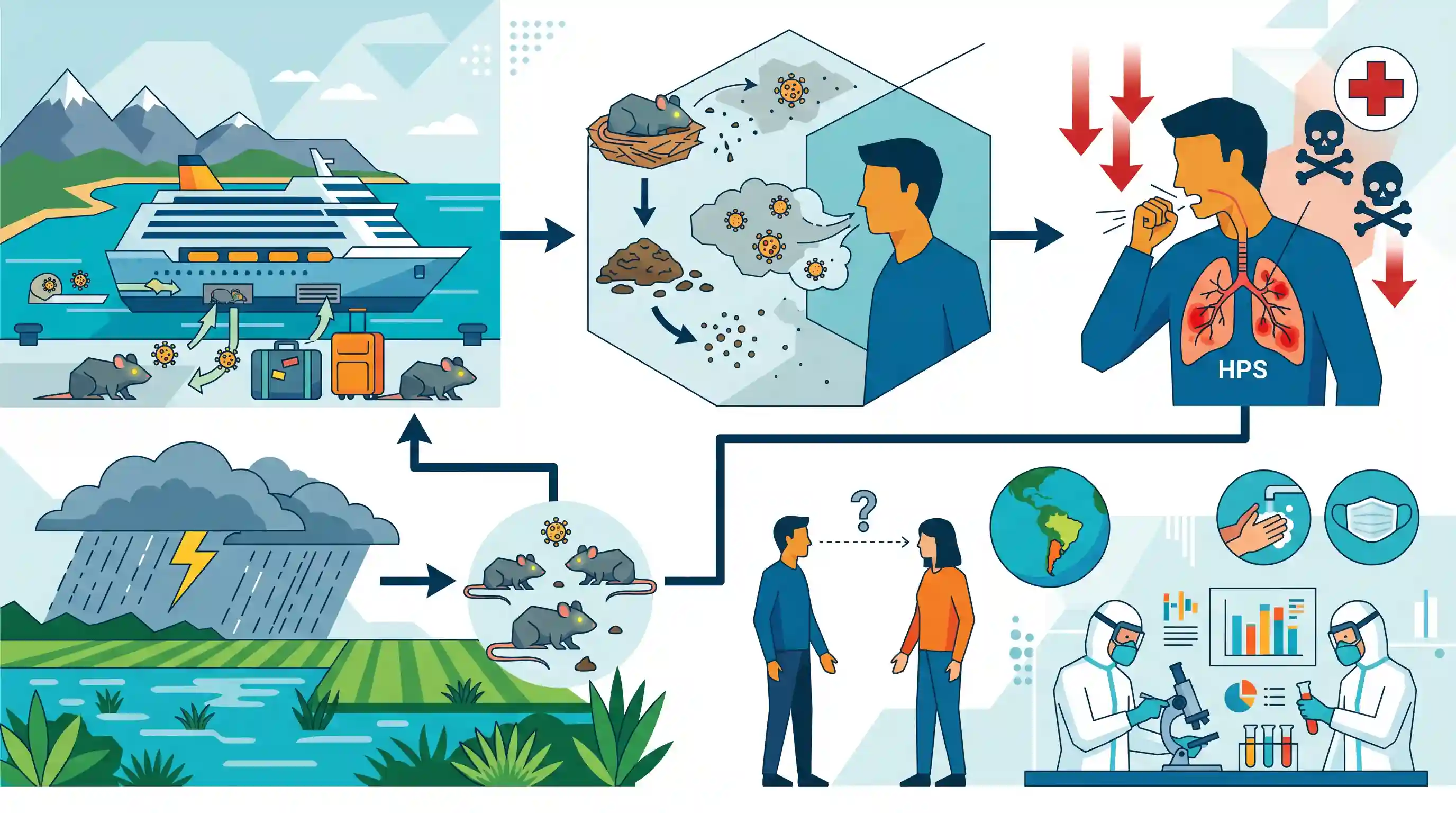
An outbreak of Hantavirus on a cruise ship in Argentina has drawn attention to this severe, rodent-borne viral disease. Hantavirus causes Hantavirus Pulmonary Syndrome (HPS), a severe respiratory illness with a high mortality rate, primarily contracted by inhaling aerosolized virus from infected rodent droppings. Although human-to-human transmission is exceptionally rare, it has occurred with specific strains in South America. The article highlights the role of climate change in exacerbating outbreaks, as increased rainfall can lead to larger rodent populations, thereby increasing the risk of zoonotic disease spillover.
Key Points
- Hantavirus is a zoonotic viral disease spread by rodents through contact with their urine, feces, or saliva.
- Inhalation of aerosolized virus from rodent droppings is the primary mode of transmission to humans, leading to Hantavirus Pulmonary Syndrome (HPS).
- HPS presents with flu-like symptoms that can rapidly progress to severe respiratory distress, carrying a high fatality rate of 38%.
- While human-to-human transmission is rare, it has been documented with the Andes virus strain in South America.
- Climate change, specifically increased rainfall in regions like Argentina, boosts vegetation and subsequently rodent populations, elevating the risk of zoonotic spillover.
- India has recorded sporadic cases of Hantavirus in the past, including among the Irula tribe and recently in Palghar, Maharashtra.
Important Terms
Hantavirus

A family of rodent-borne viruses causing severe respiratory or renal diseases. Humans are typically infected through contact with or inhalation of infected rodent excreta.
UPSC context
GS Paper III (S&T); tests knowledge of disease vectors, zoonoses, and emerging public health threats.
Hantavirus Pulmonary Syndrome (HPS)
A severe respiratory illness caused by New World hantaviruses (e.g., Andes virus). It is characterized by high mortality and rapid progression to respiratory distress.
UPSC context
GS Paper III (S&T); specific clinical knowledge required for Prelims, including symptoms and transmission.
Zoonotic Disease
Infectious diseases naturally transmissible from vertebrate animals to humans. They constitute roughly 75% of emerging infectious diseases globally.
UPSC context
GS Paper II & III; crucial for pandemic preparedness and understanding human-animal-environmental linkages.
One Health approach
An integrated framework recognizing the interdependence of human, animal, and environmental health. India manages this via the National One Health Mission.
UPSC context
GS Paper II (Health Governance); central to discussions on pandemic prevention and multisectoral coordination.
Zoonotic Spillover
The process where a pathogen jumps from an animal reservoir to humans, often triggered by climate change, deforestation, or human encroachment into habitats.
UPSC context
GS Paper III (Environment/Health); tests understanding of how ecological disruptions lead to new viral outbreaks.
Aerosolization
The conversion of liquid or solid particles (like dried rodent droppings) into fine airborne dust that can be inhaled into the lungs.
UPSC context
GS Paper III (S&T); essential for understanding pathogen transmission routes and biosafety measures.
Andes virus
A specific Hantavirus strain found in South America. It is uniquely capable of person-to-person transmission, unlike most other hantavirus strains.
UPSC context
GS Paper III (S&T); tests awareness of unique disease traits and international health emergencies.
Prelims Trap
"Hantavirus is a highly contagious respiratory illness that primarily spreads through human-to-human contact."
Human-to-human transmission is exceptionally rare. The primary infection route is environmental: inhaling aerosolized virus particles from infected rodent droppings or urine.
Static Concepts Connected
What distinguishes RNA viruses from DNA viruses in the context of human diseases?
- Genetic Material: RNA viruses (like Hantavirus, Coronavirus) use RNA; DNA viruses (like Adenovirus, Herpes) use double-stranded DNA.
- Mutation Rate: RNA viruses typically mutate faster and more unpredictably due to the lack of proofreading mechanisms during viral replication.
How does the 'One Health' concept address zoonotic spillovers like Hantavirus?
- Interconnected Health: An integrated approach recognizing that human health is intrinsically linked to animal health and shared ecosystems.
- Ecological Triggers: Addresses how environmental shifts (e.g., rodent population booms driven by increased rainfall) directly drive human disease emergence.
Cross-Topic Patterns
Climate Change & Zoonotic Spillover
Unseasonal rainfall boosts vegetation and rodent populations. This links environmental ecology directly to epidemiology, a recurring theme in recent UPSC questions on climate impact.
Tribal Occupations & Disease Vulnerability
Sporadic cases among India's Irula tribe—traditional rat catchers—highlight the specific occupational health hazards faced by indigenous communities, linking health with tribal anthropology.

Zoonotic transmission modes (aerosol vs vector) paired with climate-driven habitat changes are ripe for a 2026 multi-statement question.
Linked PYQs · 5
Linked PYQs · 5
- 2023PrelimsGS1
'Wolbachia method' is sometimes talked about with reference to which one of the following?
- 2017MainsGS3
'Climate change' is a global problem. How India will be affected by climate change? How Himalayan and coastal states of India will be affected by climate change?
- 2022MainsGS3
Discuss global warming and mention its effects on the global climate. Explain the control measures to bring down the level of greenhouse gases which cause global warming, in the light of the Kyoto Protocol, 1997.
- 2025PrelimsGS1
With reference to monoclonal antibodies, often mentioned in news, consider the following statements : I. They are man-made proteins. II. They stimulate immunological function due to their ability to bind to specific antigens. III. They are used in treating viral infections like that of Nipah virus. Which of the statements given above are correct?
- 2019PrelimsGS1
Which one of the following statements is not correct?
