Structural Drivers and Climate Impacts of Rural Distress in India
Source:Indian Express ↗
Why It Matters
Rural distress is a perennial and critical theme for UPSC, intersecting agriculture, economy, and social justice. Understanding its root causes (from MSP to climate change and wage stagnation) is vital for GS Paper 3 (Agriculture and Economy) and formulating balanced policy answers in Mains.
Summary
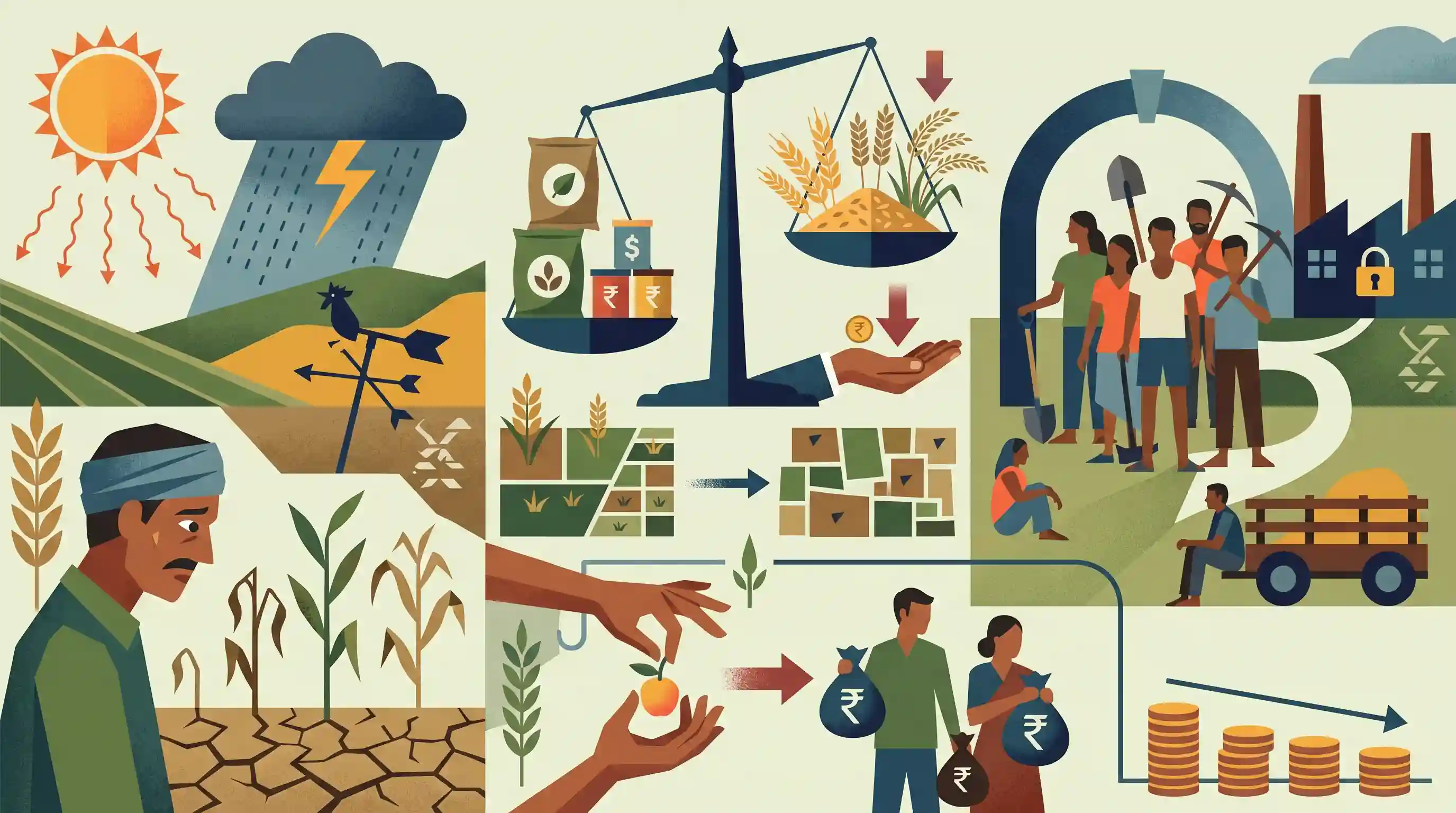
The article analyzes the multifaceted drivers of rural distress in India, emphasizing the interplay of structural agricultural challenges, economic pressures, and climate vulnerabilities. Rural areas are grappling with stagnant real wages, a lack of non-farm employment, and an over-reliance on safety-net schemes like MGNREGA. Agricultural viability is fundamentally undermined by rising input costs, unremunerative crop prices, and continuous land fragmentation. Furthermore, the increasing frequency of extreme weather events due to climate change exacerbates crop losses, pushing marginalized farmers deeper into debt. Resolving these issues requires a multi-pronged approach that includes better price realization mechanisms, targeted promotion of rural industrialization, and the widespread adoption of climate-resilient farming practices to stabilize the rural economy.
Key Points
- Stagnant rural incomes and falling real wages significantly contribute to rural distress, reflecting a severe lack of non-farm employment opportunities.
- Rising input costs (seeds, fertilizers, diesel) combined with volatile crop prices and inadequate MSP realization have squeezed farmers' profit margins.
- Structural bottlenecks, notably the continuous fragmentation of landholdings and insufficient irrigation infrastructure, structurally limit agricultural productivity.
- Increased demand for MGNREGA work underscores the scarcity of alternative livelihoods and over-dependence on agriculture for sustenance.
- Climate vulnerabilities, including erratic monsoons and extreme weather events, lead to frequent crop failures, further entrenching rural debt.
Important Terms
MGNREGA

A 2005 legislative guarantee providing 100 days of unskilled manual work per financial year to rural households, ensuring a "right to work" and social safety net.
UPSC context
GS-II: Welfare Schemes; GS-III: Employment. Tests knowledge of rural safety nets and their role in mitigating economic distress.
Minimum Support Price (MSP)
A guaranteed floor price set by the Union Government for 22 mandated crops to protect farmers against sharp falls in market prices and ensure remunerative returns.
UPSC context
GS-III: Agricultural Pricing. Crucial for understanding farm subsidies, procurement efficiency, and the "Swaminathan Commission" recommendations.
PM-KISAN
A Central Sector scheme providing direct income support of ₹6,000 annually to landholding farmer families via three equal installments to supplement agricultural input costs.
UPSC context
GS-III: Inclusive Growth. Tests understanding of Direct Benefit Transfer (DBT) effectiveness in supporting small and marginal farmers.
Pradhan Mantri Fasal Bima Yojana (PMFBY)
A government-subsidized crop insurance scheme protecting farmers against yield losses from natural calamities, pests, and diseases, aimed at stabilizing farm incomes.
UPSC context
GS-III: Agriculture/Climate Change. Tests risk-mitigation strategies for weather-dependent agriculture and the role of technology in claim settlements.
NABARD
India’s apex development financial institution for the rural sector, overseeing policy and credit planning for agriculture, cottage industries, and rural infrastructure.
UPSC context
GS-III: Economic Development. Central to questions on institutional credit, rural banking (RRBs), and the Rural Infrastructure Development Fund (RIDF).
Commission for Agricultural Costs and Prices (CACP)
An advisory body that recommends MSP for notified crops by analyzing production costs (A2+FL, C2), market trends, and consumer interests.
UPSC context
GS-III: Agriculture. Important for understanding the methodology behind farm price determination and government policy-making processes.
Prelims Trap
Rising demand for MGNREGA work reflects robust rural economic growth and employment generation.
Surging MGNREGA demand is a distress indicator, not a growth metric. It signals a severe lack of alternative, better-paying non-farm livelihoods and contracting rural wages.
Static Concepts Connected
What is the impact of land fragmentation on Indian agriculture?
- Diseconomies of scale: Small operational holdings (average 1.08 hectares) prevent economies of scale and make large-scale mechanization economically unviable.
- Credit access barriers: Marginal farmers lack sufficient collateral, forcing them to rely on informal, high-interest moneylenders rather than institutional credit.
- Input inefficiency: Per-hectare costs for inputs like seeds, fertilizers, and irrigation are proportionally higher for fragmented plots.
How is rural distress measured through wage data?
- Nominal wages: The actual monetary cash amount paid to rural workers, which may show an upward trend over time.
- Real wages: Wages adjusted for inflation using the Consumer Price Index for Agricultural Labourers (CPI-AL).
- Purchasing power erosion: If rural inflation outpaces nominal wage hikes, real wages stagnate or fall, reducing purchasing power and driving distress.
Cross-Topic Patterns
Climate risks inflating rural NPAs
Erratic monsoons and extreme weather cause frequent crop failures, pushing marginalized farmers into debt traps and raising NPA risks for rural cooperative banks and RRBs.
Domestic MSP demands vs. WTO Peace Clause
Domestic pressure to make MSP a statutory right directly clashes with the WTO's Aggregate Measurement of Support (AMS) limits, keeping India reliant on the 'Peace Clause'.

Expect a 2026 prelims question linking surging MGNREGA demand, stagnant rural real wages (CPI-AL), and structural land fragmentation.
Linked PYQs · 5
Linked PYQs · 5
- 2018MainsGS3
What do you mean by Minimum Support Price (MSP)? How will MSP rescue the farmers from the low income trap?
- 2017MainsGS3
How do subsidies affect the cropping pattern, crop diversity and economy of farmers? What is the significance of crop insurance, minimum support price and food processing for small and marginal farmers?
- 2023MainsGS3
Most of the unemployment in India is structural in nature. Examine the methodology adopted to compute unemployment in the country and suggest improvements.
- 2015MainsGS3
Livestock rearing has a big potential for providing non-farm employment and income in rural areas. Discuss suggesting suitable measures to promote this sector in India.
- 2016PrelimsGS1
With reference to 'Pradhan Mantri Fasal Bima Yojana', consider the following statements: 1. Under this scheme, farmers will have to pay a uniform premium of two percent for any crop they cultivate in any season of the year. 2. This scheme covers post-harvest losses arising out of cyclones and unseasonal rains. Which of the statements given above is/are correct?
