खगोल भौतिकी में सुपरकिलोनोवा विलय और भारी तत्वों का संश्लेषण
स्रोत:द हिंदू ↗
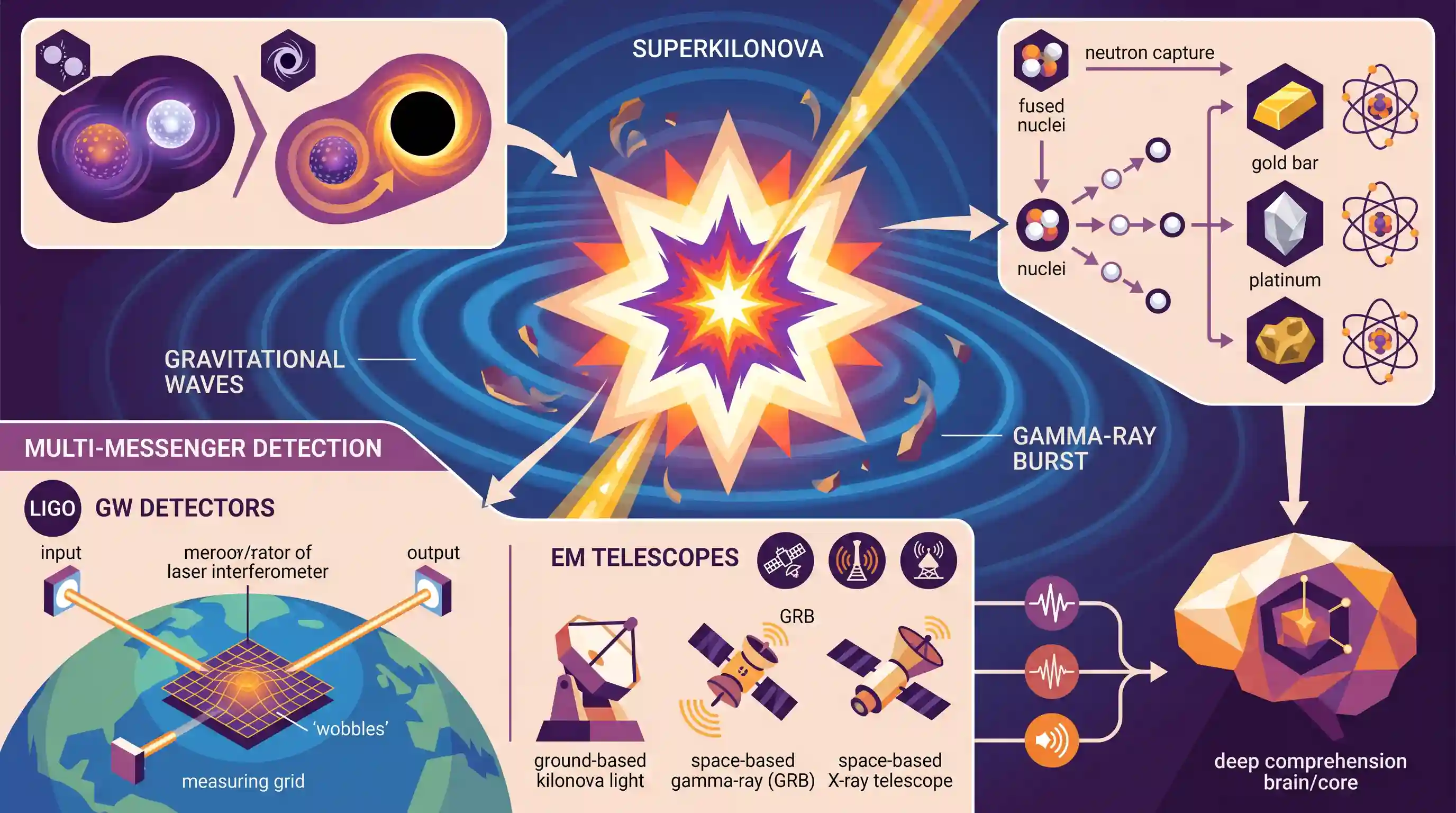
क्यों मायने रखता है
Questions on the life cycle of stars, black holes, neutron stars, and gravitational waves are frequent in UPSC Prelims. Understanding advanced astronomical phenomena like superkilonovas helps candidates tackle questions on the origins of the universe, the synthesis of heavy elements, and the significance of modern observatories (e.g., LIGO, LISA).
सारांश
The article explains the phenomenon of a "superkilonova," a highly energetic astronomical event resulting from the merger of dense compact objects such as neutron stars or a neutron star and a black hole. Far brighter than a standard kilonova, a superkilonova acts as a crucial cosmic foundry, facilitating rapid neutron-capture (the r-process) to synthesize heavy elements like gold, platinum, and uranium in the universe. These massive collisions also unleash powerful gravitational waves and gamma-ray bursts. The study of superkilonovas is a cornerstone of multi-messenger astronomy, combining data from gravitational wave detectors like LIGO with traditional electromagnetic telescopes to deepen our understanding of astrophysics and the origins of matter.
मुख्य बिंदु
- Superkilonovas are extraordinarily energetic astronomical explosions resulting from the merger of two neutron stars or a neutron star and a black hole.
- ये ब्रह्मांडीय ढलाईघरों (cosmic foundries) के रूप में कार्य करते हैं, जो रैपिड न्यूट्रॉन-कैप्चर (r-process) न्यूक्लियोसिंथेसिस (nucleosynthesis) को सुगम बनाते हैं, जिससे सोना, प्लैटिनम और यूरेनियम जैसे भारी तत्वों का निर्माण होता है।
- These events emit intense gravitational waves alongside electromagnetic radiation, typically observed as prolonged gamma-ray bursts (GRBs).
- Studying superkilonovas advances 'multi-messenger astronomy', relying on collaborative data from gravitational wave observatories (like LIGO) and traditional electromagnetic telescopes.
महत्वपूर्ण शब्द
सुपरकिलोनोवा

न्यूट्रॉन सितारों के विलय से होने वाला एक दुर्लभ, उच्च-ऊर्जा वाला ब्रह्मांडीय विस्फोट, जो फ़ॉलबैक हीटिंग (fallback heating) जैसे अतिरिक्त ऊर्जा स्रोतों के कारण किलोनोवा की तुलना में काफी अधिक चमकीला और लंबे समय तक रहने वाला होता है।
UPSC context
GS Paper 3 (Science & Tech); tests understanding of new astronomical phenomena and stellar evolution.
r-process
The rapid neutron-capture process occurring in extreme environments (e.g., neutron star mergers) that synthesizes heavy elements like gold, platinum, and uranium.
UPSC context
GS Paper 3 (Science & Tech); relevant for nuclear nucleosynthesis and the origin of elements in the universe.
मल्टी-मेसेंजर एस्ट्रोनॉमी
An astronomical approach combining different cosmic signals—gravitational waves, electromagnetic radiation, and neutrinos—to provide a comprehensive understanding of celestial events.
UPSC context
GS पेपर 3; आधुनिक अवलोकन तकनीकों और AstroSat जैसे मिशनों के माध्यम से भारत की भूमिका के लिए महत्वपूर्ण।
LIGO (Laser Interferometer Gravitational-Wave Observatory)
A US-based observatory that uses laser interferometry to detect gravitational waves, providing direct evidence for Einstein's General Theory of Relativity.
UPSC context
GS Paper 3; core topic regarding gravitational wave detection and global scientific collaborations.
Virgo
A large interferometer located in Italy that collaborates with LIGO to detect and localize the sources of gravitational waves in the universe.
UPSC context
GS Paper 3; important for the global network of detectors and source triangulation in space research.
ESA (यूरोपियन स्पेस एजेंसी)
An intergovernmental organization for space exploration; its collaboration with ISRO on missions like Proba-3 and data-sharing is vital for India.
UPSC context
GS Paper 2 & 3; relevant for international relations and bilateral space cooperation.
LIGO-India
A planned advanced gravitational-wave detector in Maharashtra, India, serving as the fifth node in the global LIGO network to enhance detection precision.
UPSC context
GS Paper 3; high-priority "Mega-Science" project frequently tested in Prelims and Mains.
प्रारंभिक ट्रैप
Heavy elements like gold and platinum are formed through normal nuclear fusion in stellar cores.
Elements heavier than iron cannot form via normal core fusion, which is endothermic. They require extreme explosive events like superkilonovas for rapid neutron-capture.
संबंधित अवधारणाएँ
What are the key components of Multi-messenger Astronomy?
- Photons: संपूर्ण स्पेक्ट्रम में प्रकाश का पता चला, उच्च-ऊर्जा वाली गामा किरणों से लेकर रेडियो तरंगों तक।
- Gravitational waves: LIGO/Virgo द्वारा खोजी गई अदृश्य तरंगें, जो आपस में विलीन होते न्यूट्रॉन सितारों जैसे त्वरित विशाल पिंडों से उत्पन्न होती हैं।
- Cosmic particles: High-energy particles like neutrinos that provide unique information about the core physical processes of cosmic events.
How are elements heavier than iron formed in the universe?
- r-process (rapid): खगोल भौतिकी (astrophysics) में परमाणु प्रतिक्रियाओं का एक समूह, जो लोहे (iron) से भारी लगभग आधे परमाणु नाभिकों के निर्माण के लिए जिम्मेदार है।
- Neutron-capture: The process requires a massive flux of neutrons, typically found only in extreme environments like superkilonovas or supernovas.
- ऊष्माशोषी अवरोध: चूँकि भारी तत्वों का संलयन ऊष्माशोषी (ऊर्जा अवशोषित करने वाला) होता है, इसलिए सामान्य तारकीय न्यूक्लियोसिंथेसिस लोहे पर रुक जाता है।
अंतर-विषय पैटर्न
LIGO-India & Global Astrophysics
सुपरकिलोनोवा (Superkilonova) अध्ययन वैश्विक वेधशाला नेटवर्क के महत्व को रेखांकित करते हैं। महाराष्ट्र में आगामी LIGO-India परियोजना ऐसे विशाल गुरुत्वाकर्षण तरंग स्रोतों के सटीक स्थानीयकरण (precise localization) के लिए महत्वपूर्ण होगी।
Cosmic Origins of Strategic Minerals
Understanding the r-process connects astrophysics to geography. The gold, platinum, and uranium driving Earth's geopolitics and nuclear energy were originally synthesized in ancient neutron star mergers.

Expect a multi-statement Prelims question combining the cosmic r-process of heavy element synthesis (gold/uranium) with LIGO detections.
संबद्ध PYQ · 3
संबद्ध PYQ · 3
- 2019PrelimsGS1
Recently, scientists observed the merger of giant 'blackholes' billions of light-years away from the Earth. What is the significance of this observation?
- 2023PrelimsGS1
Consider the following pairs: Objects in space Description 1. Cepheids: Giant clouds of dust and gas in space 2. Nebulae: Stars which brighten and dim periodically 3. Pulsars: Neutron stars that are formed when massive stars run out of fuel and collapse How many of the above pairs are correctly matched?
- 2020PrelimsGS1
"The experiment will employ a trio of spacecraft flying in formation in the shape of an equilateral triangle that has sides one million kilometres long, with lasers shining between the craft." The experiment in question refers to
