Superkilonova Mergers And Heavy Element Synthesis In Astrophysics
Source:The Hindu ↗
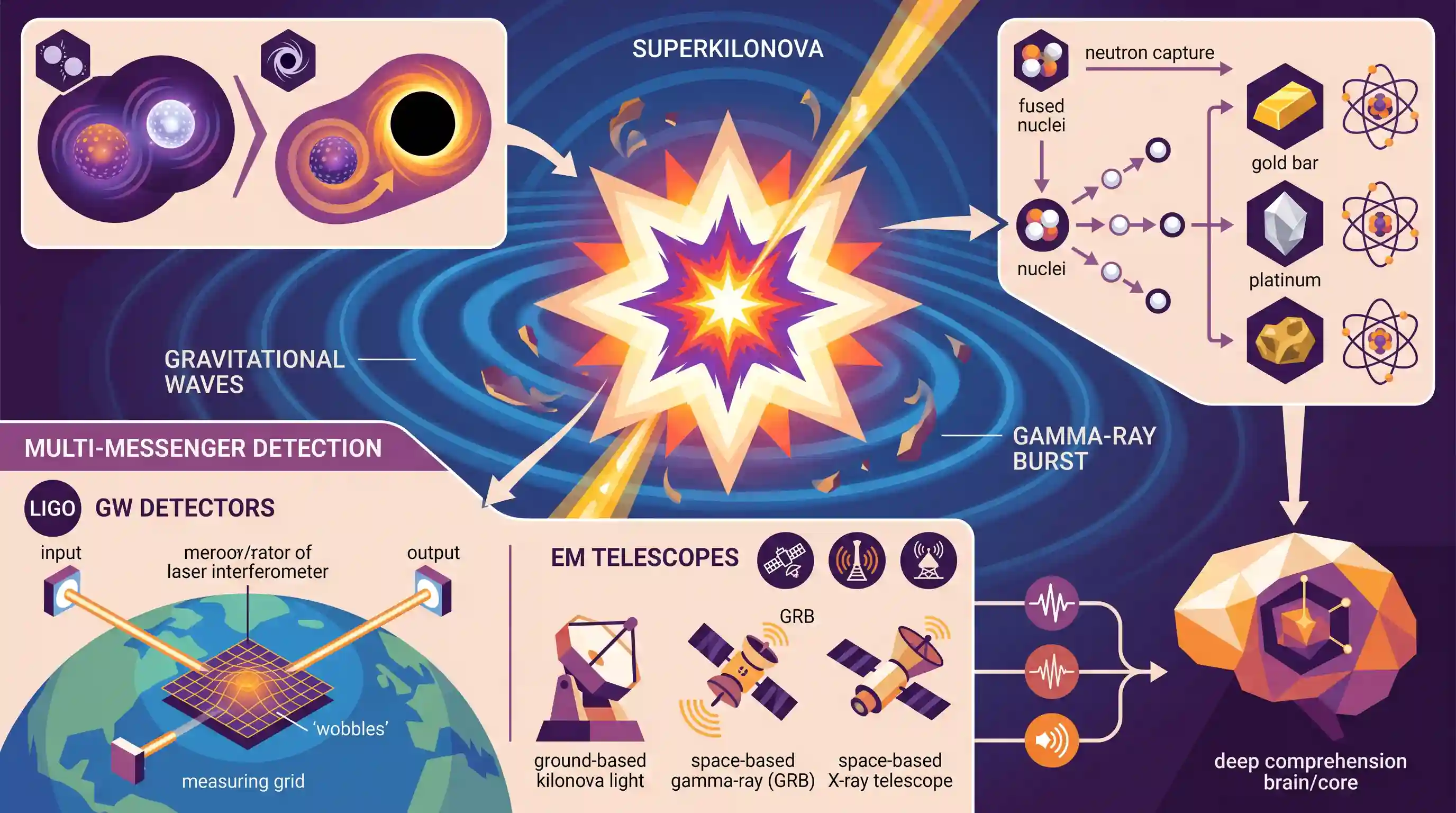
Why It Matters
Questions on the life cycle of stars, black holes, neutron stars, and gravitational waves are frequent in UPSC Prelims. Understanding advanced astronomical phenomena like superkilonovas helps candidates tackle questions on the origins of the universe, the synthesis of heavy elements, and the significance of modern observatories (e.g., LIGO, LISA).
Summary
The article explains the phenomenon of a "superkilonova," a highly energetic astronomical event resulting from the merger of dense compact objects such as neutron stars or a neutron star and a black hole. Far brighter than a standard kilonova, a superkilonova acts as a crucial cosmic foundry, facilitating rapid neutron-capture (the r-process) to synthesize heavy elements like gold, platinum, and uranium in the universe. These massive collisions also unleash powerful gravitational waves and gamma-ray bursts. The study of superkilonovas is a cornerstone of multi-messenger astronomy, combining data from gravitational wave detectors like LIGO with traditional electromagnetic telescopes to deepen our understanding of astrophysics and the origins of matter.
Key Points
- Superkilonovas are extraordinarily energetic astronomical explosions resulting from the merger of two neutron stars or a neutron star and a black hole.
- They serve as cosmic foundries, facilitating rapid neutron-capture (r-process) nucleosynthesis which creates heavy elements like gold, platinum, and uranium.
- These events emit intense gravitational waves alongside electromagnetic radiation, typically observed as prolonged gamma-ray bursts (GRBs).
- Studying superkilonovas advances 'multi-messenger astronomy', relying on collaborative data from gravitational wave observatories (like LIGO) and traditional electromagnetic telescopes.
Important Terms
Superkilonova

A rare, high-energy cosmic explosion from merging neutron stars, significantly brighter and longer-lasting than a kilonova due to extra energy sources like fallback heating.
UPSC context
GS Paper 3 (Science & Tech); tests understanding of new astronomical phenomena and stellar evolution.
r-process
The rapid neutron-capture process occurring in extreme environments (e.g., neutron star mergers) that synthesizes heavy elements like gold, platinum, and uranium.
UPSC context
GS Paper 3 (Science & Tech); relevant for nuclear nucleosynthesis and the origin of elements in the universe.
Multi-messenger Astronomy
An astronomical approach combining different cosmic signals—gravitational waves, electromagnetic radiation, and neutrinos—to provide a comprehensive understanding of celestial events.
UPSC context
GS Paper 3; significant for modern observational techniques and India's role via missions like AstroSat.
LIGO (Laser Interferometer Gravitational-Wave Observatory)
A US-based observatory that uses laser interferometry to detect gravitational waves, providing direct evidence for Einstein's General Theory of Relativity.
UPSC context
GS Paper 3; core topic regarding gravitational wave detection and global scientific collaborations.
Virgo
A large interferometer located in Italy that collaborates with LIGO to detect and localize the sources of gravitational waves in the universe.
UPSC context
GS Paper 3; important for the global network of detectors and source triangulation in space research.
ESA (European Space Agency)
An intergovernmental organization for space exploration; its collaboration with ISRO on missions like Proba-3 and data-sharing is vital for India.
UPSC context
GS Paper 2 & 3; relevant for international relations and bilateral space cooperation.
LIGO-India
A planned advanced gravitational-wave detector in Maharashtra, India, serving as the fifth node in the global LIGO network to enhance detection precision.
UPSC context
GS Paper 3; high-priority "Mega-Science" project frequently tested in Prelims and Mains.
Prelims Trap
Heavy elements like gold and platinum are formed through normal nuclear fusion in stellar cores.
Elements heavier than iron cannot form via normal core fusion, which is endothermic. They require extreme explosive events like superkilonovas for rapid neutron-capture.
Static Concepts Connected
What are the key components of Multi-messenger Astronomy?
- Photons: Light detected across the entire spectrum, from high-energy gamma rays to radio waves.
- Gravitational waves: Invisible ripples detected by LIGO/Virgo, originating from accelerating massive bodies like merging neutron stars.
- Cosmic particles: High-energy particles like neutrinos that provide unique information about the core physical processes of cosmic events.
How are elements heavier than iron formed in the universe?
- r-process (rapid): A set of nuclear reactions in astrophysics responsible for creating roughly half the atomic nuclei heavier than iron.
- Neutron-capture: The process requires a massive flux of neutrons, typically found only in extreme environments like superkilonovas or supernovas.
- Endothermic barrier: Because heavy element fusion is endothermic (absorbs energy), normal stellar nucleosynthesis stops at iron.
Cross-Topic Patterns
LIGO-India & Global Astrophysics
Superkilonova studies highlight the importance of global observatory networks. The upcoming LIGO-India project in Maharashtra will be crucial for the precise localization of such massive gravitational wave sources.
Cosmic Origins of Strategic Minerals
Understanding the r-process connects astrophysics to geography. The gold, platinum, and uranium driving Earth's geopolitics and nuclear energy were originally synthesized in ancient neutron star mergers.

Expect a multi-statement Prelims question combining the cosmic r-process of heavy element synthesis (gold/uranium) with LIGO detections.
Linked PYQs · 3
Linked PYQs · 3
- 2019PrelimsGS1
Recently, scientists observed the merger of giant 'blackholes' billions of light-years away from the Earth. What is the significance of this observation?
- 2023PrelimsGS1
Consider the following pairs: Objects in space Description 1. Cepheids: Giant clouds of dust and gas in space 2. Nebulae: Stars which brighten and dim periodically 3. Pulsars: Neutron stars that are formed when massive stars run out of fuel and collapse How many of the above pairs are correctly matched?
- 2020PrelimsGS1
"The experiment will employ a trio of spacecraft flying in formation in the shape of an equilateral triangle that has sides one million kilometres long, with lasers shining between the craft." The experiment in question refers to
