India US Trade Deal Agricultural Concessions and Soybean Impact
Source:Indian Express ↗
Why It Matters
Provides a concrete example of how macro-level bilateral trade agreements create sector-specific winners and losers in agriculture, a core theme for GS3 (Agricultural Trade/Economics) and GS2 (International Relations).
Summary
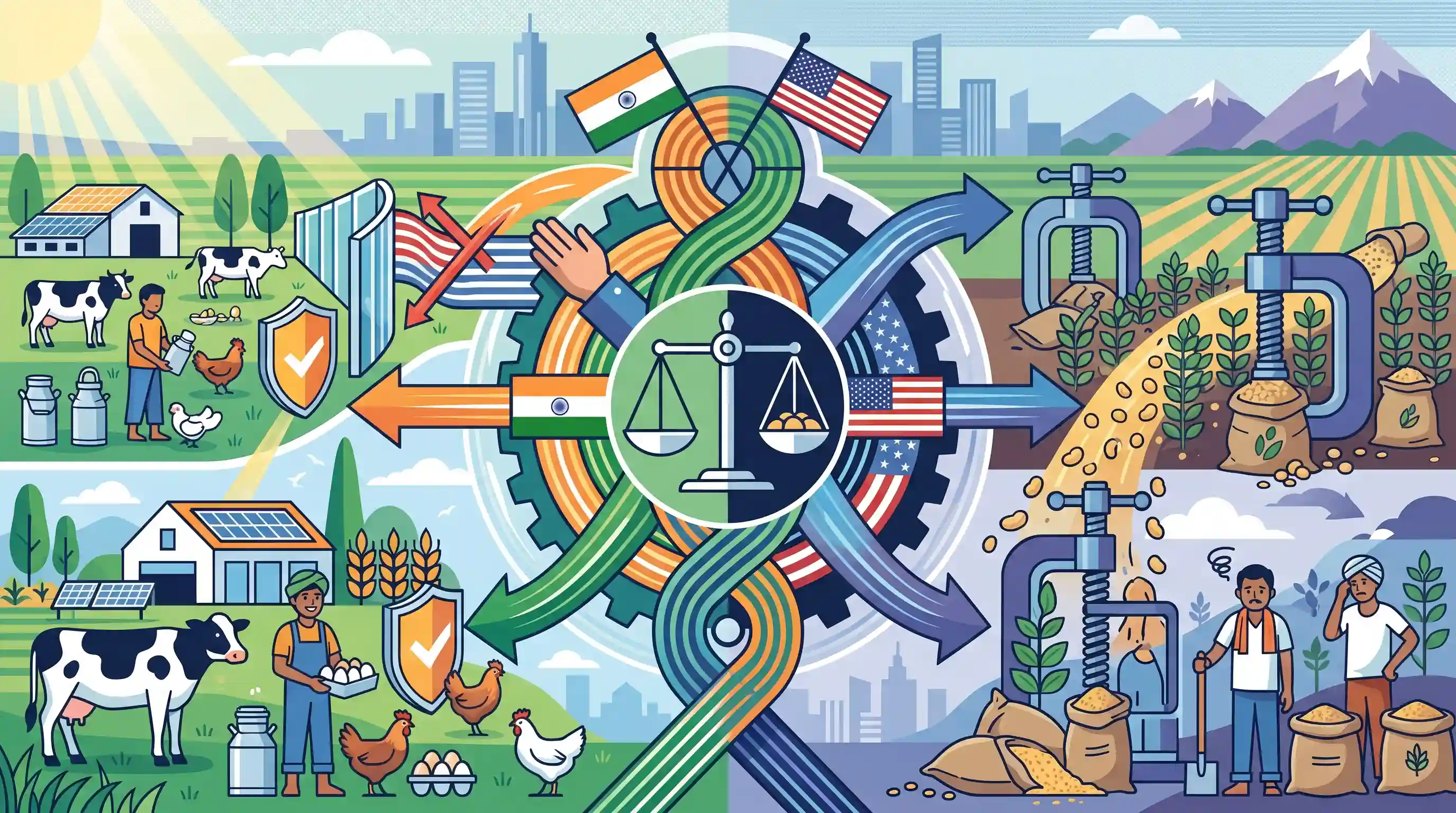
The article analyzes the agricultural implications of the India-US trade deal, noting its divergent impact on different farming sectors. While India successfully shielded its politically sensitive dairy and poultry sectors from US imports—thereby protecting domestic farmers—it appears to have made concessions that negatively impact soybean growers. This 'squeeze' on soybean farmers underscores the complex trade-offs inherent in bilateral trade negotiations. Protecting domestic food security and the livelihoods of specific farming communities often necessitates compromising on other commodities, reflecting the broader challenges India faces in balancing domestic agricultural interests with international trade expectations and market access demands.
Key Points
- India recently negotiated trade adjustments with the United States regarding agricultural products and market access.
- The agreement reflects a strategic choice to protect sensitive sectors like poultry and dairy from American imports, safeguarding local farmers' livelihoods.
- Conversely, soybean growers are facing downward price pressures or a 'squeeze', likely due to import concessions or tariff reductions on competing US soy products.
- The dynamics highlight the complexities of bilateral trade negotiations, where securing market access or resolving disputes requires trade-offs that unevenly impact different segments of the domestic agricultural economy.
Important Terms
India-US Trade Policy Forum (TPF)

The premier bilateral mechanism for trade between India and the US, co-chaired by India's Commerce Minister and the US Trade Representative (USTR).
UPSC context
Relevant for GS Paper II (International Relations) and Paper III (Economy); tests bilateral mechanisms and trade diplomacy.
Sanitary and Phytosanitary (SPS) Measures
International regulations under the WTO ensuring food safety and animal/plant health, often used as non-tariff barriers in agricultural trade.
UPSC context
GS Paper III (Economy/Agriculture); focuses on trade barriers, food safety standards, and international compliance.
WTO Poultry Dispute
A long-standing WTO conflict resolved in 2023-24, where India initially banned US poultry over avian flu concerns, eventually leading to reduced tariffs on specific products.
UPSC context
GS Paper II (Global Institutions) and Paper III (Agriculture); tests dispute resolution mechanisms and trade impact on domestic farmers.
Genetically Modified (GM) Crops
Plants whose DNA has been modified via genetic engineering. These are a major point of contention in trade, as India restricts GM soy and corn imports.
UPSC context
GS Paper III (Science & Tech/Agriculture); tests regulatory frameworks (GEAC) and biodiversity concerns in international trade.
Distiller's Dried Grains with Solubles (DDGS)
A nutrient-rich byproduct of ethanol production used as animal feed; India recently granted tariff concessions for US DDGS imports, impacting domestic soybean meal producers.
UPSC context
GS Paper III (Agriculture/Economy); relates to the "squeeze" on domestic oilseed farmers and value-added agricultural imports.
Non-Tariff Barriers (NTBs)
Trade restrictions like quotas, licensing, or technical standards that restrict imports without using taxes (tariffs).
UPSC context
GS Paper III (Economy); critical for understanding modern protectionism and market access challenges beyond simple duties.
Prelims Trap
India permitted the import of Genetically Modified (GM) soybean and corn under the new trade pact.
While India lowered duties on soybean oil and DDGS, it explicitly retained its ban on GM food crops citing domestic biosafety laws. Do not conflate processed soy with raw GM seeds.
Static Concepts Connected
What is the principle of 'non-reciprocity' in WTO?
- Special & Differential Treatment: A principle allowing developing and least-developed countries (LDCs) to take on fewer tariff-reduction commitments than developed nations.
- Protection of Vulnerable Sectors: It ensures vulnerable sectors, such as subsistence agriculture in India, are not decimated by heavily subsidized imports from developed markets.
- GATT Part IV: Enshrined in Part IV of the GATT, formalizing the idea that trade agreements shouldn't demand equal concessions from unequal economies.
What are SPS measures under the WTO?
- Health Protection Rules: Sanitary and Phytosanitary (SPS) measures are rules to protect human, animal, or plant health from imported pests, diseases, or toxins.
- Science-Based Requirement: They must be based on scientific principles (like Codex standards) and cannot be used as disguised protectionist trade barriers.
- Poultry Dispute Context: India's previous restriction on US poultry imports over Avian Influenza concerns was heavily litigated under the SPS agreement.
Cross-Topic Patterns
Edible Oil Mission vs Trade Commitments
The tariff reduction on US soybean oil contradicts India's domestic push for self-reliance in oilseeds under the National Mission on Edible Oils (NMEO-Oilseeds), highlighting the classic consumer vs. producer trade-off.
Ethanol Blending Byproducts & Animal Feed
Importing US DDGS (a corn ethanol byproduct) lowers domestic animal feed costs. This directly links to India's own Ethanol Blended Petrol program, which also aims to produce domestic DDGS for cattle feed.

Expect a 2026 Prelims question mapping specific WTO clauses (S&DT, SPS measures) against bilateral trade exceptions and GM crop policies.
Linked PYQs · 5
Linked PYQs · 5
- 2019MainsGS2
‘What introduces friction into the ties between India and the United States is that Washington is still unable to find for India a position in its global strategy, which would satisfy India's national self-esteem and ambitions.’ Explain with suitable examples.
- 2023MainsGS3
What are the direct and indirect subsidies provided to farm sector in India? Discuss the issues raised by the World Trade Organization (WTO) in relation to agricultural subsidies.
- 2024PrelimsGS1
Consider the following plants : 1. Groundnut 2. Horse-gram 3. Soybean How many of the above belong to the pea family?
- 2025PrelimsGS1
Consider the following statements : Statement I: In India, income from allied agricultural activities like poultry farming and wool rearing in rural areas is exempted from any tax. Statement II: In India, rural agricultural land is not considered a capital asset under the provisions of the Income-tax Act, 1961. Which one of the following is correct in respect of the above statements?
- 2016MainsGS2
The broader aims and objectives of WTO are to manage and promote international trade in the era of globalization. But the Doha round of negotiations seem doomed due to differences between the developed and the developing countries." Discuss in the Indian perspective.
