Global Mental Health Crisis and WHO Policy Guidelines
Source:The Hindu ↗
Why It Matters
Mental health remains a highly neglected component of public health in India. Understanding WHO guidelines is crucial for evaluating India's Mental Healthcare Act, identifying systemic gaps in public health infrastructure (GS2), and understanding the role of societal empathy and ethics (GS4) in overcoming stigma.
Summary
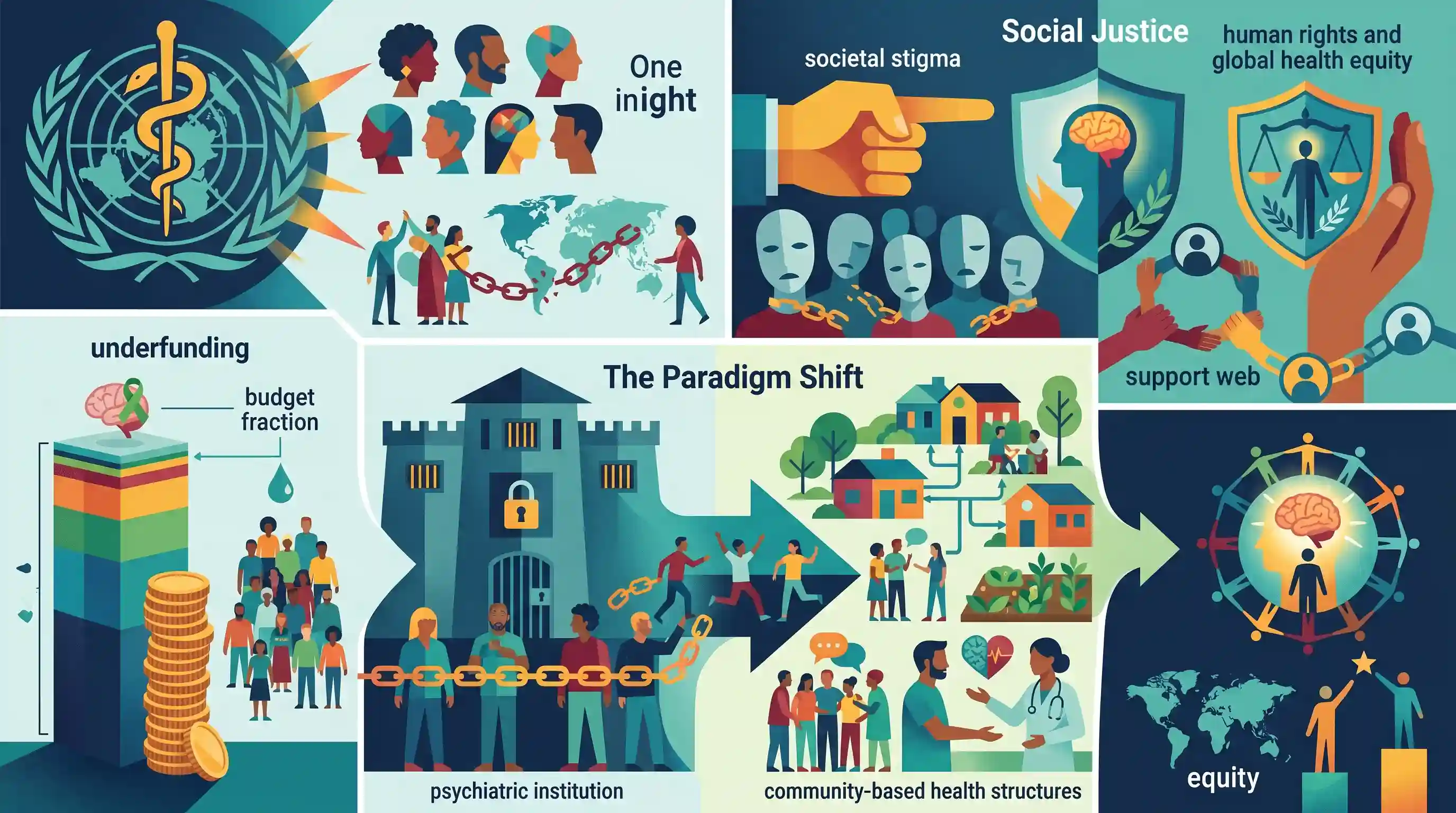
The article explores the World Health Organization's (WHO) recent observations on the global mental health crisis. It highlights the massive burden of mental health disorders worldwide, emphasizing that nearly one in eight people is affected. The WHO warns of a severe 'treatment gap' and chronic underfunding, noting that mental health receives only a fraction of national health budgets. To address these systemic flaws, the WHO recommends a paradigm shift from institutional psychiatric care toward community-based health structures. Additionally, tackling pervasive societal stigma and protecting the human rights of patients are identified as critical priorities for global health equity.
Key Points
- Over 1 billion people globally live with a mental health condition, with a massive spike in anxiety and depression post-COVID-19.
- Mental health suffers from severe global underfunding, with countries allocating an average of merely 2% of their health budgets to it.
- A glaring 'treatment gap' exists, especially in low and middle-income countries, where the vast majority of sufferers receive no psychiatric care.
- The WHO strongly advocates transitioning from institutionalized mental health facilities to integrated, community-based care networks.
- Eradicating social stigma, discrimination, and human rights violations against people with mental health conditions remains a core public health challenge.
Important Terms
Comprehensive Mental Health Action Plan 2013-2030

A WHO global roadmap (2013-2030) aiming to improve mental health through effective leadership, community-based care, prevention strategies, and strengthened information systems.
UPSC context
GS Paper II (Social Justice/Health); tests knowledge of international health frameworks and India’s commitment to global health standards.
Mental Healthcare Act 2017
Indian legislation providing a rights-based framework for mental healthcare, guaranteeing access to services, protecting patient dignity, and decriminalizing attempted suicide in India.
UPSC context
GS Paper II (Social Sector/Health); critical for questions on social legislation, fundamental rights, and healthcare policy.
Tele-MANAS
India's 24/7 toll-free helpline launched in 2022 to provide accessible mental health counseling and specialist referrals, leveraging technology to bridge the urban-rural care divide.
UPSC context
GS Paper II (Health) and GS Paper III (Digital Infrastructure); relevant for technology in governance and public health.
Treatment Gap
The disparity between the number of people needing mental health care and those receiving it; in India, this gap is estimated at approximately 83-85%.
UPSC context
GS Paper II (Health/Social Justice); a key metric for analyzing health infrastructure deficits and policy effectiveness.
World Health Organization (WHO)
The specialized UN agency for international public health that sets global mental health standards and facilitates the 'QualityRights' initiative.
UPSC context
GS Paper II (International Organizations); tests understanding of global governance bodies and their impact on domestic health policy.
Prelims Trap
The Mental Healthcare Act 2017 completely repealed Section 309 of the Indian Penal Code to decriminalize suicide attempts.
The Act did not repeal Section 309 IPC. It only created a legal presumption of 'severe stress' for anyone attempting suicide, exempting them from trial and punishment under that section.
Static Concepts Connected
What are the core provisions of the Mental Healthcare Act 2017?
- Rights-based care: Guarantees the right to mental healthcare and treatment from state-funded public health services.
- Advance Directives: Allows individuals to specify in advance how they wish to be treated (or not treated) for a mental illness.
- Decriminalizes suicide: Presumes individuals attempting suicide are under severe stress, protecting them from prosecution under Section 309 of the IPC.
- Regulates treatments: Restricts electro-convulsive therapy (ECT) without anesthesia and bans it entirely for minors.
What is the Tele-MANAS initiative launched by the Government of India?
- Core Objective: To provide universal access to equitable, affordable, and quality 24/7 tele-mental health care services across India.
- Two-tier Structure: Functions as a two-tier system: Tier 1 comprises state Tele-MANAS cells (counsellors), and Tier 2 includes specialists via e-Sanjeevani.
Cross-Topic Patterns
Mental Health & Demographic Dividend
The massive 70-92% treatment gap directly threatens India's working-age population. This transforms mental health from a purely medical issue into a macroeconomic challenge impacting labor productivity and the demographic dividend.
Digital Public Health & Tele-medicine
The Tele-MANAS scheme connects mental health with digital governance, reflecting a broader UPSC theme of leveraging digital public infrastructure (like eSanjeevani) to bridge the rural-urban healthcare divide.

Advance Directives under the Mental Healthcare Act 2017 + Tele-MANAS architecture are prime targets for a mixed-statement Prelims Q in 2026.
Linked PYQs · 4
Linked PYQs · 4
- 2021MainsGS2
“Besides being a moral imperative of a Welfare State, primary health structure is a necessary precondition for sustainable development.” Analyze.
- 2024MainsGS2
In a crucial domain like the public healthcare system the Indian State should play a vital role to contain the adverse impact of marketisation of the system. Suggest some measures through which the State can enhance the reach of public healthcare at the grassroots level.
- 2020MainsGS2
Critically examine the role of WHO in providing global health security during the Covid-19 pandemic.
- 2022MainsGS4
Apart from intellectual competency and moral qualities, empathy and compassion are some of the other vital attributes that facilitate the civil servants to be more competent in tackling the crucial issues or taking critical decisions. Explain with suitable illustrations.
