IMD Long Range Forecast Parameters for Southwest Monsoon Season
Source:The Hindu ↗
Why It Matters
Understanding the IMD's monsoon forecasting parameters—such as the LPA, ENSO, and IOD—is fundamental for UPSC aspirants. These topics are frequently tested in Prelims and Mains Geography (GS1), and their socio-economic impacts on agriculture, inflation, and disaster management tie directly into Economy and Governance (GS3).
Summary
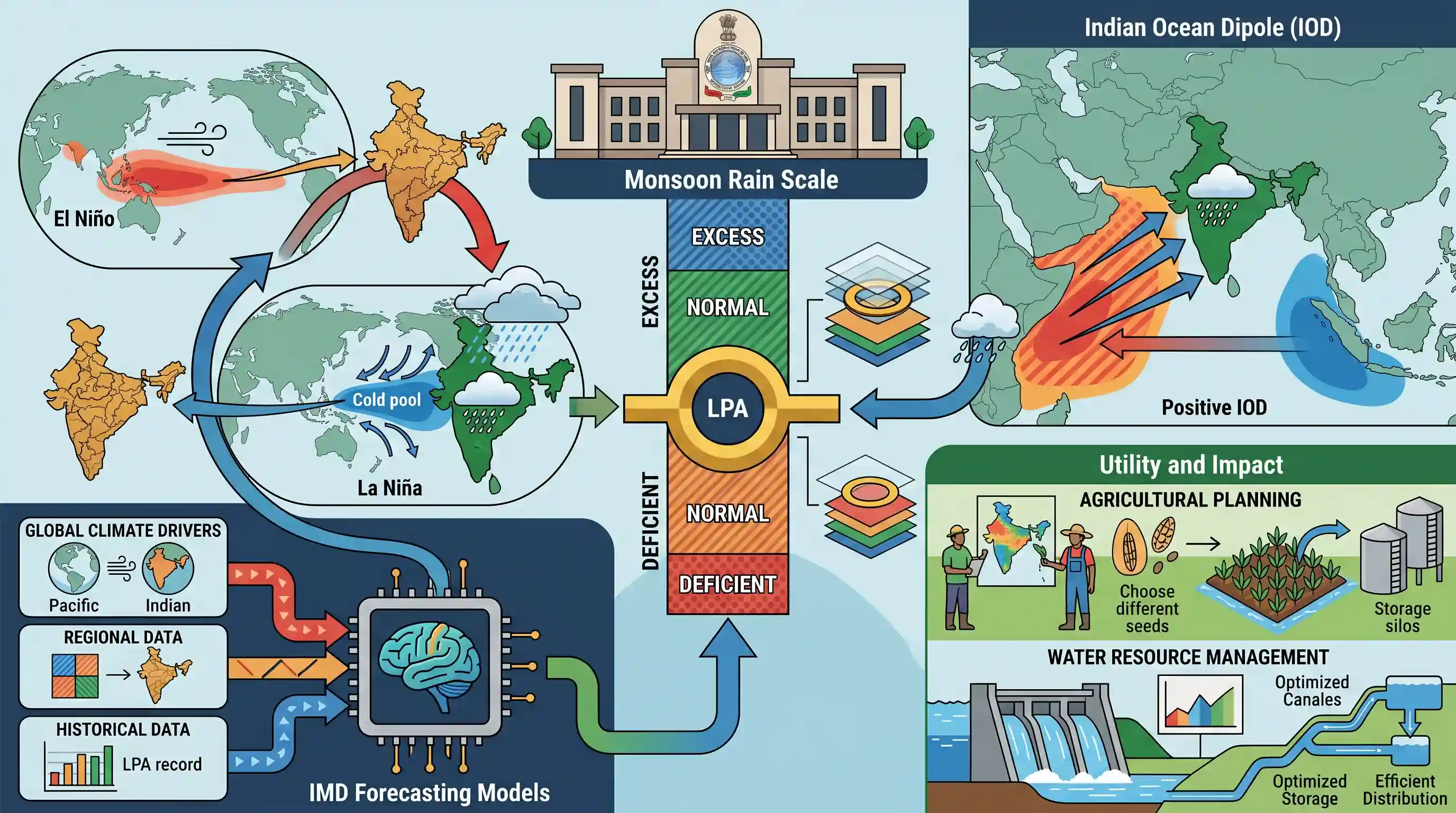
The article outlines the key components of the India Meteorological Department's (IMD) announcement regarding the upcoming southwest monsoon. It highlights the methodology behind the Long Range Forecast, focusing on the Long Period Average (LPA) as the central metric for predicting rainfall levels. The forecast heavily relies on the analysis of global climate drivers, particularly the transition from El Niño to La Niña conditions in the Pacific Ocean, as well as the expected phase of the Indian Ocean Dipole (IOD). These early predictions provide essential guidance for agricultural planning and water resource management, given the profound impact of monsoon variability on India's economy.
Key Points
- The India Meteorological Department (IMD) issues its Long Range Forecast (LRF) for the southwest monsoon in April, establishing a baseline expectation for the season's rainfall.
- The prediction is quantified as a percentage of the Long Period Average (LPA), which serves as the historical benchmark for defining normal, above-normal, or deficient monsoons.
- Crucial parameters determining the forecast include the El Niño-Southern Oscillation (ENSO); an expected transition from El Niño to La Niña conditions generally bodes well for Indian rainfall.
- The status of the Indian Ocean Dipole (IOD) and Eurasian snow cover are also factored into both statistical and dynamic modeling systems to refine regional rainfall probability.
- The IMD’s early announcements play a critical role in macroeconomic planning, water reservoir management, and agricultural preparedness across India's rainfed zones.
Important Terms
India Meteorological Department (IMD)

The principal government agency responsible for meteorological observations, weather forecasting, and seismology. It operates under the Ministry of Earth Sciences and provides critical data for agriculture and disaster management.
UPSC context
Relevant for GS-I (Geography) and GS-III (Disaster Management/Agriculture); tests knowledge of institutional frameworks for climate monitoring.
Long Period Average (LPA)
The benchmark average rainfall recorded over 50 years (currently 1971–2020), used to determine if a monsoon is 'normal.' The current All-India South-West Monsoon LPA is 87 cm.
UPSC context
GS-I (Geography); essential for understanding how 'normal' rainfall is quantified and its implications for food security.
El Niño-Southern Oscillation (ENSO)
A periodic fluctuation in sea surface temperatures and air pressure in the Pacific. El Niño (warming) often suppresses Indian monsoon rainfall, while La Niña (cooling) typically enhances it.
UPSC context
GS-I (Important Geophysical Phenomena); frequently tested in Prelims and Mains regarding its impact on Indian agriculture.
Indian Ocean Dipole (IOD)
An atmosphere-ocean phenomenon in the Indian Ocean. A 'positive IOD' (warmer western pole) can offset El Niño's drying effects, leading to better monsoon rainfall over India.
UPSC context
GS-I (Physical Geography); crucial for understanding regional climate variability beyond global Pacific drivers like ENSO.
Monsoon Mission Coupled Forecasting System (MMCFS)
A high-performance, dynamical (ocean-atmosphere) model used by the IMD for seasonal forecasting. It was developed to shift from purely statistical models to more accurate physics-based predictions.
UPSC context
GS-III (Science and Technology); represents India's progress in indigenous weather modeling and computational meteorology.
Long Range Forecast (LRF)
The IMD's seasonal prediction issued in two stages (April and May/June). It provides the quantitative expectation of rainfall (as a percentage of LPA) for the upcoming four-month monsoon.
UPSC context
GS-III (Economic Development/Agriculture); significant for policy-making, crop insurance, and water resource management.
Prelims Trap
"An El Niño year inevitably results in a deficient southwest monsoon (less than 90% of LPA) in India."
While El Niño strongly correlates with weaker monsoons, it does not guarantee a drought. Other factors like a Positive IOD or low Eurasian snow cover can completely offset its negative impact (e.g., 1997).
Static Concepts Connected
What is the Indian Ocean Dipole (IOD) and how does it impact India?
- Core Definition: The difference in sea surface temperatures between the western (Arabian Sea) and eastern (near Indonesia) equatorial Indian Ocean.
- Positive IOD: Warmer western Indian Ocean. This boosts convection and brings more moisture to India, often enhancing the southwest monsoon.
- Negative IOD: Cooler western Indian Ocean. This suppresses monsoon rainfall over India and can exacerbate the drying effects of El Niño.
How does IMD classify monsoon rainfall using the Long Period Average (LPA)?
- LPA Benchmark: It is the average rainfall recorded over a 50-year period. The current operational LPA is 87 cm, based on the 1971-2020 period.
- Normal Monsoon: Rainfall between 96% and 104% of the LPA.
- Deficient Monsoon: Rainfall falls below 90% of the LPA, which often triggers agricultural contingency plans and drought management protocols.
Cross-Topic Patterns
Monsoon variability and food inflation dynamics
Deficient monsoons impact rainfed kharif crops, often triggering export bans on staples like rice and fueling food inflation. This creates a direct challenge for the RBI's inflation-targeting monetary policy.
Supercomputing in climate modeling
IMD's shift to the Monsoon Mission Coupled Forecasting System (MMCFS) relies heavily on India's high-performance supercomputers (Pratyush and Mihir) to run complex ocean-atmosphere dynamic models.

La Niña transition + Positive IOD interplay is a prime candidate for a paired-statement Prelims question testing climate synergies in 2026.
Linked PYQs · 5
Linked PYQs · 5
- 2017PrelimsGS1
With reference to 'Indian Ocean Dipole (IOD)' sometimes mentioned in the news while forecasting Indian monsoon, which of the following statements is/are correct? 1. IOD phenomenon is characterised by a difference in sea surface temperature between tropical Western Indian Ocean and tropical Eastern Pacific Ocean. 2. An IOD phenomenon can influence an El Nino's impact on the monsoon. Select the correct answer using the code given below:
- 2011PrelimsGS1
La Nina is suspected to have caused recent floods in Australia. How is La Nina different from El Nino? 1. La Nina is characterised by unusually cold ocean temperature in equatorial Indian Ocean whereas El Nino is characterised by unusually warm ocean temperature in the equatorial Pacific Ocean. 2. El Nino has adverse effect on south-west monsoon of India, but La Nina has no effect on monsoon climate. Which of the statements given above is/are correct?
- 2022MainsGS1
Discuss the meaning of colour-coded weather warnings for cyclone prone areas given by India Meteorological Department.
- 2015MainsGS1
How far do you agree that the behaviour of the Indian monsoon has been changing due to humanizing landscapes? Discuss.
- 2014MainsGS1
Most of the unusual climatic happenings are explained as an outcome of the El-Nino effect. Do you agree?
