Government guidelines mandate synthetic media and ai labelling
Source:The Hindu ↗
Why It Matters
The regulation of generative AI and deepfakes intersects with GS3 (Science & Technology and Internal Security) and GS2 (Governance). As synthetic media increasingly threatens democratic processes and public order, understanding the statutory responses (like IT Rules, 2021) and the technological countermeasures (watermarking) is crucial for addressing modern security and governance challenges.
Summary
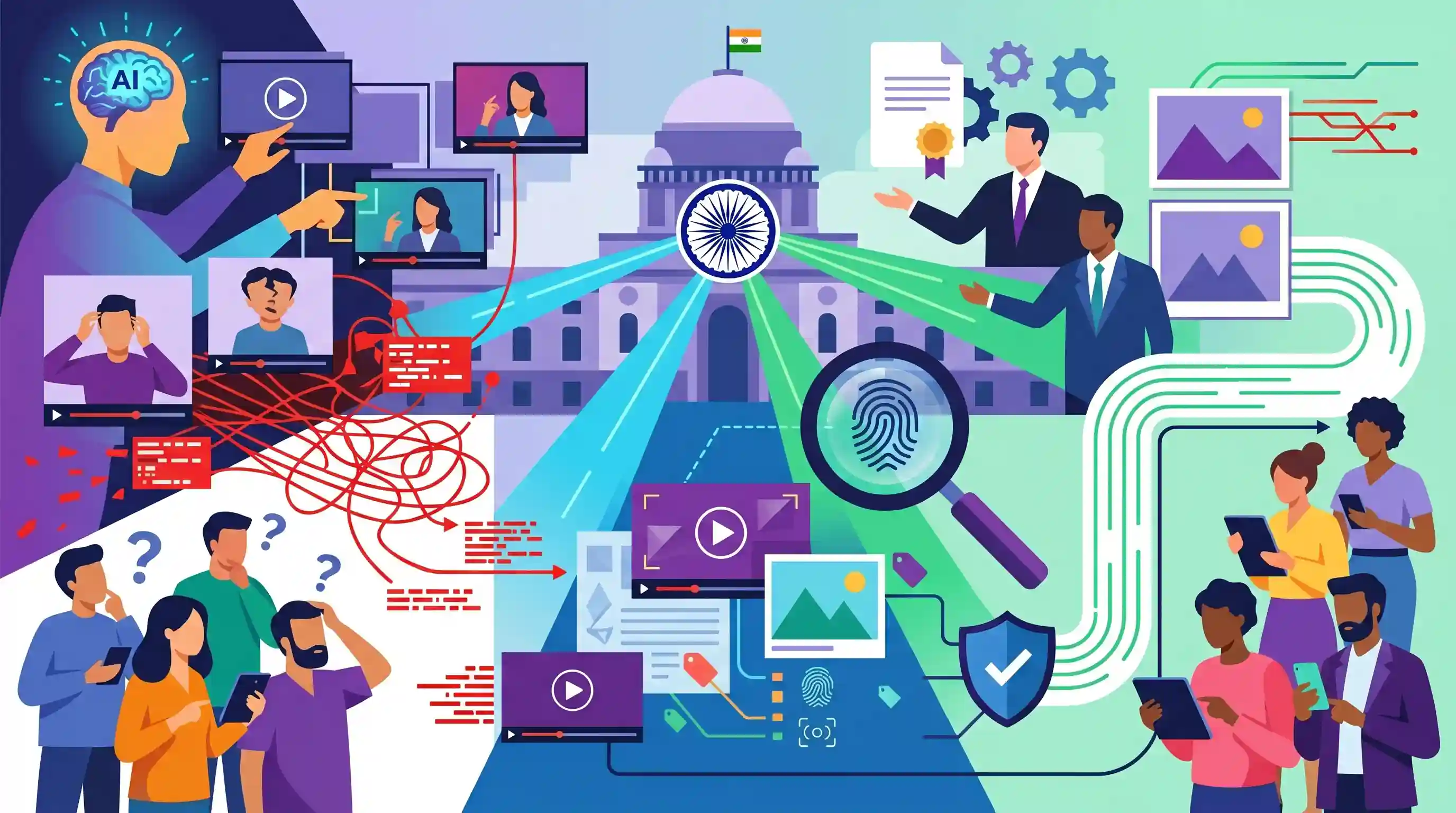
The article details the Indian government's regulatory measures concerning the labelling of Artificial Intelligence (AI) generated content and deepfakes. Issued by the Ministry of Electronics and Information Technology (MeitY) under the IT Rules, 2021, the advisory mandates tech platforms to clearly identify synthetic media using tools like watermarking and metadata. This framework is designed to curb the rapid spread of misinformation, trace the origins of deceptive content, and ensure intermediary accountability, thereby protecting the integrity of the digital space and public order against the misuse of emerging technologies.
Key Points
- The Indian government has mandated the explicit labelling of AI-generated content and deepfakes to combat digital misinformation.
- Tech platforms and intermediaries must implement tracking mechanisms, such as watermarking and metadata, to identify the origin of synthetic media.
- These directives are enforced under the IT Rules, 2021, emphasizing intermediary liability and user safety in the digital ecosystem.
- The advisory aims to safeguard electoral integrity and public order by preventing the malicious use of generative AI technologies.
Important Terms
IT Rules, 2021

Secondary legislation under the IT Act, 2000, regulating social media, OTT platforms, and digital news through due diligence, grievance redressal, and a digital ethics code.
UPSC context
GS Paper II/III. Tests knowledge of digital governance, platform accountability, and the regulatory framework for India's internet ecosystem.
Ministry of Electronics and Information Technology (MeitY)
The nodal Indian ministry for information technology, electronics manufacturing, and internet governance. It issues advisories and administers rules to regulate digital media and cybersecurity.
UPSC context
GS Paper II. Important for understanding the institutional framework and executive role in shaping India's tech policies.
Deepfakes
Hyper-realistic AI-generated synthetic media (audio or video) that manipulates a person’s likeness or voice, often used to spread misinformation or commit fraud.
UPSC context
GS Paper III. Relevant for internal security, cyber threats, and the ethical challenges posed by emerging technologies.
Intermediary
Entities such as social media platforms, search engines, or ISPs that facilitate the storage and transmission of user-generated content on behalf of others.
UPSC context
GS Paper III. Crucial for understanding platform liability, legal definitions under the IT Act, and cybersecurity compliance.
Safe Harbour Protection
Legal immunity granted to intermediaries under Section 79 of the IT Act, protecting them from liability for third-party content if they follow government-mandated due diligence.
UPSC context
GS Paper III. Key concept for digital economy regulation and balancing platform innovation with user safety.
Watermarking
A technical process of embedding identifying labels or metadata into AI-generated content to ensure transparency and traceability for users and regulators.
UPSC context
GS Paper III. Relevant for scientific solutions to misinformation and verifying digital authenticity in a synthetic media landscape.
Prelims Trap
Intermediaries enjoy absolute 'safe harbour' immunity from legal liability for AI-generated deepfakes on their platforms.
Safe harbour under Section 79 of the IT Act is conditional. It is revoked if platforms fail to follow MeitY's due diligence directives, like labelling synthetic content.
Static Concepts Connected
What is 'Safe Harbour' protection under the IT Act, 2000?
- Section 79: Grants digital intermediaries immunity from legal liability for third-party user-generated content hosted on their platforms.
- Conditional immunity: Exemption applies strictly if platforms act as passive conduits and observe government-prescribed due diligence.
- Loss of protection: Protection is revoked if the platform alters the information or ignores government takedown/labelling orders.
How do Generative Adversarial Networks (GANs) create deepfakes?
- Dual neural networks: Comprises a 'generator' creating fake data and a 'discriminator' evaluating authenticity in a continuous competitive loop.
- Deep learning base: Algorithms rely on extensive, real-world training datasets to learn patterns and map facial expressions or voices.
- Synthetic output: Produces highly realistic synthetic media that bypasses basic detection, requiring advanced metadata and watermarking for provenance.
Cross-Topic Patterns
AI deepfakes and cognitive warfare
Deepfakes merge GS-3 cybersecurity with GS-2 electoral dynamics. Expect questions linking AI-driven misinformation campaigns to the Election Commission's Model Code of Conduct challenges and cognitive warfare.
Generative AI and Intellectual Property
AI labelling connects to the GS-3 IPR debate. Mandated metadata tracking could become crucial for identifying if copyrighted Indian media was illegally scraped to train foreign AI models.

A 2026 Prelims question will likely test the conditions for revoking 'Safe Harbour' under Section 79 alongside the tech behind GANs.
Linked PYQs · 4
Linked PYQs · 4
- 2024MainsGS3
Social media and encrypting messaging services pose a serious security challenge. What measures have been adopted at various levels to address the security implications of social media? Also suggest any other remedies to address the problem.
- 2023MainsGS3
Introduce the concept of Artificial Intelligence (AI). How does Al help clinical diagnosis? Do you perceive any threat to privacy of the individual in the use of Al in healthcare?
- 2016MainsGS3
Use of Internet and social media by non-state actors for subversive activities is a major security concern. How have these been misused in the recent past? Suggest effective guidelines to curb the above threat.
- 2025PrelimsGS1
Consider the following statements: I. It is expected that Majorana 1 chip will enable quantum computing. II. Majorana 1 chip has been introduced by Amazon Web Services (AWS). III. Deep learning is a subset of machine learning. Which of the statements given above are correct?
