Digital Public Infrastructure and Data Governance Challenges for India
Source:The Hindu ↗
Why It Matters
Understanding the intersection of public data and private technology infrastructure is crucial for grasping modern debates on data governance, tech monopolies, and India's push for Digital Public Infrastructure (like India Stack). It directly relates to GS3 topics on Science & Technology, AI, and IPR.
Summary
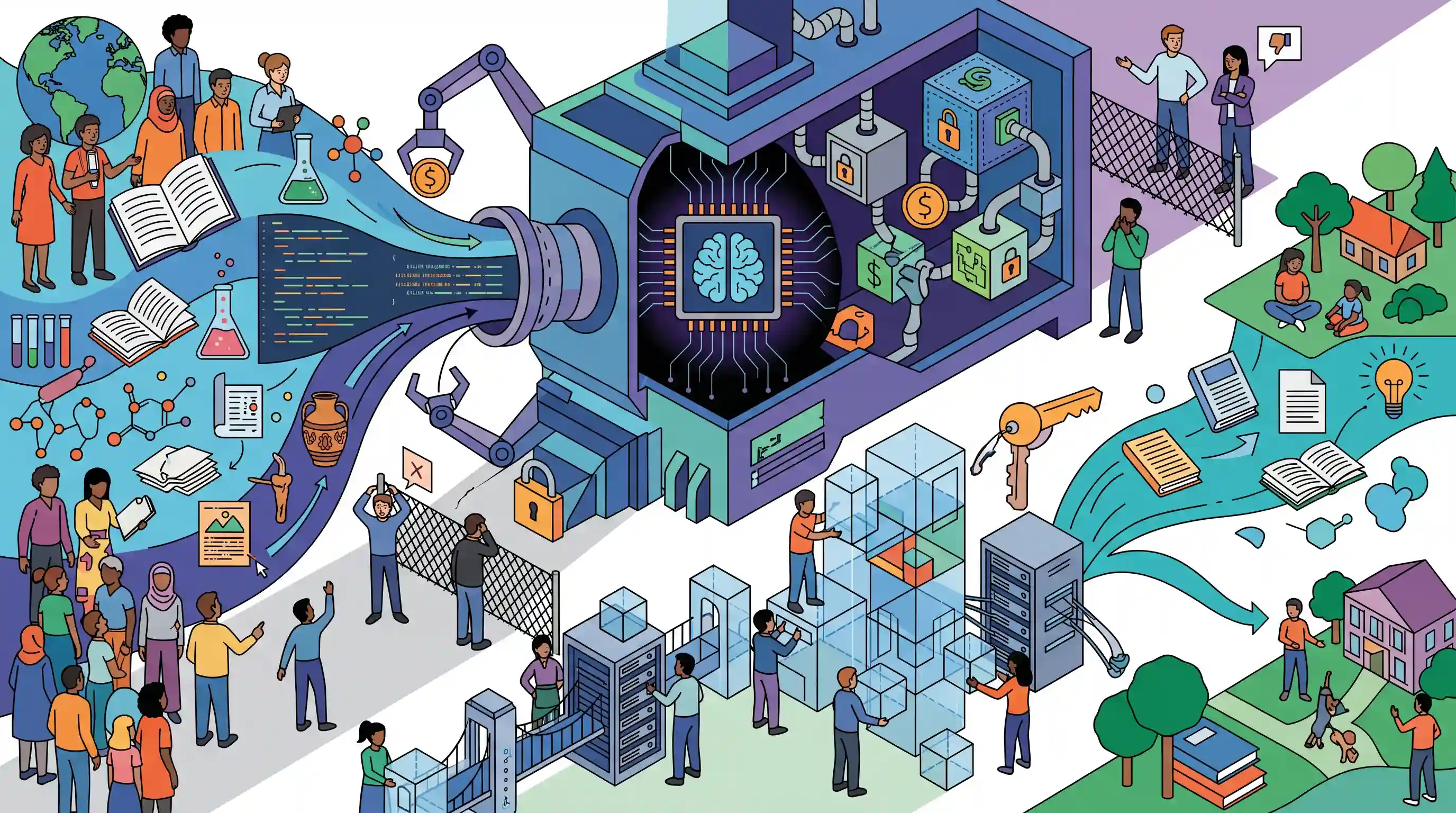
The article examines the policy and ethical implications of hosting and generating public knowledge—such as scientific research, datasets, and cultural information—on privately owned digital infrastructure. With the rise of Artificial Intelligence (AI) and Big Tech cloud monopolies, platforms increasingly ingest public data to build proprietary models, privatizing the resulting insights. This dynamic creates challenges surrounding Intellectual Property Rights, data sovereignty, and accessibility. The discussion underscores the importance of scaling Digital Public Infrastructure (DPI) and promoting open-source licensing to protect public goods from private enclosure, ensuring that knowledge remains accessible for societal benefit rather than being exclusively monetized by private platforms.
Key Points
- The growing reliance of public knowledge creation and scientific research on private technological infrastructure (cloud computing, AI models, publishing platforms).
- Private control over public data creates monopolies, often resulting in publicly funded research or common knowledge being locked behind paywalls or proprietary APIs.
- Raises significant concerns regarding Intellectual Property Rights (IPR), data sovereignty, and the monetization of public goods by Big Tech companies.
- Highlights the need for robust Digital Public Infrastructure (DPI) and open-source models to ensure transparent, equitable access to knowledge and technological tools.
Important Terms
Digital Public Infrastructure (DPI)

Shared digital platforms (e.g., Aadhaar, UPI) built on open standards that enable society-wide service delivery, fostering inclusion, innovation, and interoperability across public and private sectors.
UPSC context
GS-III (Economy/S&T). Tests understanding of India's 'India Stack' and its role in digital governance and financial inclusion.
Data Sovereignty
The principle that data generated within a nation's borders is subject to that country's jurisdiction, ensuring national control over storage, processing, and security.
UPSC context
GS-II (IR) and GS-III (Security). Critical for debates on data localization, DPDP Act 2023, and strategic autonomy.
Intellectual Property Rights (IPR)
Legal protections (patents, copyrights, trademarks) granted to creators for inventions and artistic works, balancing the incentive to innovate with the wider public interest.
UPSC context
GS-III (Economy/S&T). Evaluates knowledge of TRIPS, the National IPR Policy 2016, and global trade dynamics.
Big Tech
Large, dominant multinational technology corporations that wield immense influence over global markets, social discourse, and data through platform-based business models.
UPSC context
GS-III (Regulation). Relevant for discussions on market dominance, antitrust laws, and the Competition Commission of India (CCI).
Open-Source Licensing
Legal frameworks that permit the free use, modification, and distribution of source code, encouraging collaborative development and reducing dependence on proprietary systems.
UPSC context
GS-III (Science & Technology). Tests awareness of FOSS (Free and Open Source Software) and technological self-reliance.
Prelims Trap
"India's Digital Public Infrastructure (DPI) requires its underlying physical servers to be entirely government-owned."
DPI refers to interoperable open protocols and APIs (like UPI), which can run on or interact with privately-owned physical cloud infrastructure, not just state-owned hardware.
Static Concepts Connected
What are the three foundational layers of India's Digital Public Infrastructure (DPI)?
- Identity Layer: Provides unique, verifiable digital identification for citizens, primarily achieved through the Aadhaar system.
- Payments Layer: Enables high-volume, interoperable, and instant financial transactions, dominated by the Unified Payments Interface (UPI).
- Data Exchange: Facilitates secure, consent-based sharing of digital records via platforms like DigiLocker and Account Aggregators.
How does the Traditional Knowledge Digital Library (TKDL) protect public knowledge?
- Defensive Protection: Acts as a prior-art repository to prevent foreign entities from patenting traditional Indian practices, functioning as a defensive IPR shield.
- Format Translation: Translates ancient texts (like Ayurveda and Unani) into five international languages so global patent examiners can easily verify existing knowledge.
Cross-Topic Patterns
AI scraping vs. Traditional Knowledge
Modern AI ingesting public data mirrors historical 'biopiracy' of medicinal plants, linking Big Tech regulation to India's defensive IPR strategies like the TKDL.
Data Sovereignty & Free Trade
India's push to keep public data within its borders clashes with developed nations' demands for free cross-border data flows in plurilateral WTO and FTA negotiations.

A 2026 prelims question merging AI data scraping, copyright 'fair use' exceptions, and India's DPI architecture is highly probable.
Linked PYQs · 4
Linked PYQs · 4
- 2022PrelimsGS1
Consider the following : 1. Aarogya Setu 2. CoWIN 3. DigiLocker 4. DIKSHA Which of the above are built on top of open-source digital platforms?
- 2015MainsGS3
India's Traditional Knowledge Digital Library (TKDL), which has a database containing formatted information on more than 2 million medicinal formulations is proving a powerful weapon in the country's fight against erroneous patents. Discuss the pros and cons of making this database publicly available under open-source licensing.
- 2014MainsGS3
In a globalized world, Intellectual Property Rights assume significance and are a source of litigation. Broadly distinguish between the terms-Copyrights, Patents and Trade Secrets.
- 2023MainsGS3
Introduce the concept of Artificial Intelligence (AI). How does Al help clinical diagnosis? Do you perceive any threat to privacy of the individual in the use of Al in healthcare?
