Government AI Guidelines Set New Framework for Tech Regulation
Source:Indian Express ↗
Why It Matters
Crucial for understanding how regulatory frameworks adapt to disruptive technologies like AI, impacting digital governance, economic innovation, and corporate compliance in India.
Summary
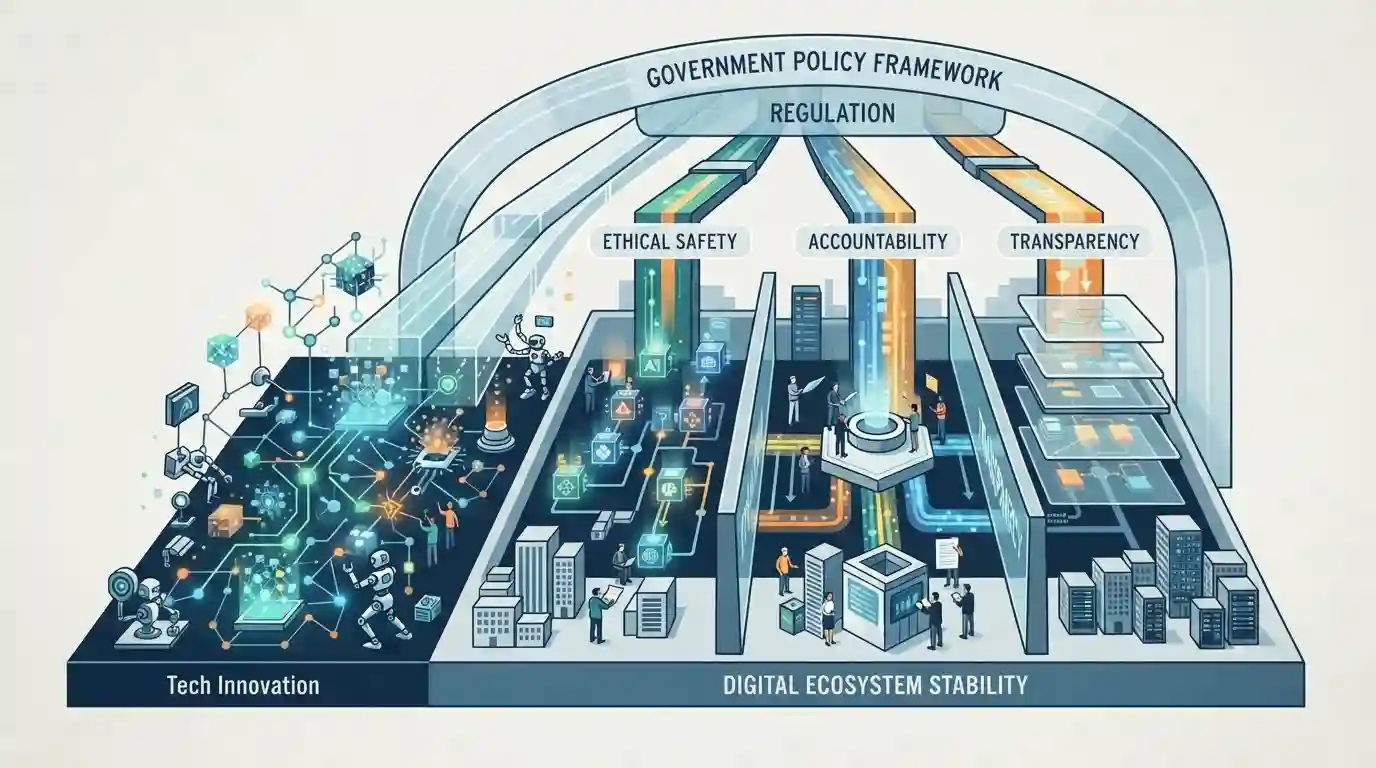
The article discusses the implications of government AI guidelines and regulations for tech companies, focusing on how policy frameworks attempt to balance innovation, ethical safety, and accountability in the digital ecosystem.
Key Points
- Government AI guidelines play a crucial role in establishing ethical boundaries, safety guardrails, and compliance standards for technology companies.
- Balancing innovation and regulation remains a primary challenge for policymakers dealing with rapidly evolving AI technologies.
- Effective tech regulation requires clear accountability frameworks, data protection mechanisms, and transparency in algorithmic decision-making.
Important Terms
Government of India

The supreme executive authority of the nation, which shapes national digital policies, cybersecurity frameworks, and technology regulations through ministries like MeitY to balance innovation with ethical safeguards.
UPSC context
UPSC GS Paper II (Governance) & GS Paper III (Internal Security / IT & Computers); tests understanding of policy formulation and state regulation of emerging technologies.
Prelims Trap
Government AI guidelines automatically create strict criminal liability and statutory penalties for non-compliant tech firms from day one.
Aspirants often confuse government advisory guidelines with statutory legislation; advisories lack direct penal enforceability unless backed by existing statutory rules like the IT Act or DPDP Act.
Static Concepts Connected
What are the key legal pillars of India's digital technology and data regulatory architecture?
- Telecommunications Act: Replaces the colonial Telegraph Act to modernise telecommunications licensing, spectrum management, and digital infrastructure governance.
- DPDP Act 2023: Governs the processing of digital personal data, establishing consent mandates, fiduciary duties, and penalties for data breaches.
- IT Rules 2021: Regulates intermediary due diligence, safe harbour provisions, and grievance redressal mechanisms for digital platforms.
Cross-Topic Patterns
AI Regulation + Data Protection Law
AI governance frameworks overlap directly with data localisation debates under the Digital Personal Data Protection Act, creating complex compliance hurdles for cross-border tech firms.

AI governance + intermediary liability + algorithmic transparency likely to feature as a multi-statement Prelims conceptual question.
Linked PYQs · 1
Linked PYQs · 1
- 2020PrelimsGS1
With the present state of development, Artificial Intelligence can effectively do which of the following? 1. Bring down electricity consumption in industrial units 2. Create meaningful short stories and songs 3. Disease diagnosis 4. Text-to-Speech Conversion 5. Wireless transmission of electrical energy Select the correct answer using the code given below:
