Commercial Space Exploration and Artemis Lunar Landing Systems
Source:The Hindu ↗
Why It Matters
The article highlights the shifting model of space exploration from pure government initiatives to public-private partnerships. Understanding this pivot is crucial for UPSC aspirants studying space commercialization, India's own space sector privatization (IN-SPACe), and the emerging geopolitical race to control lunar resources.
Summary
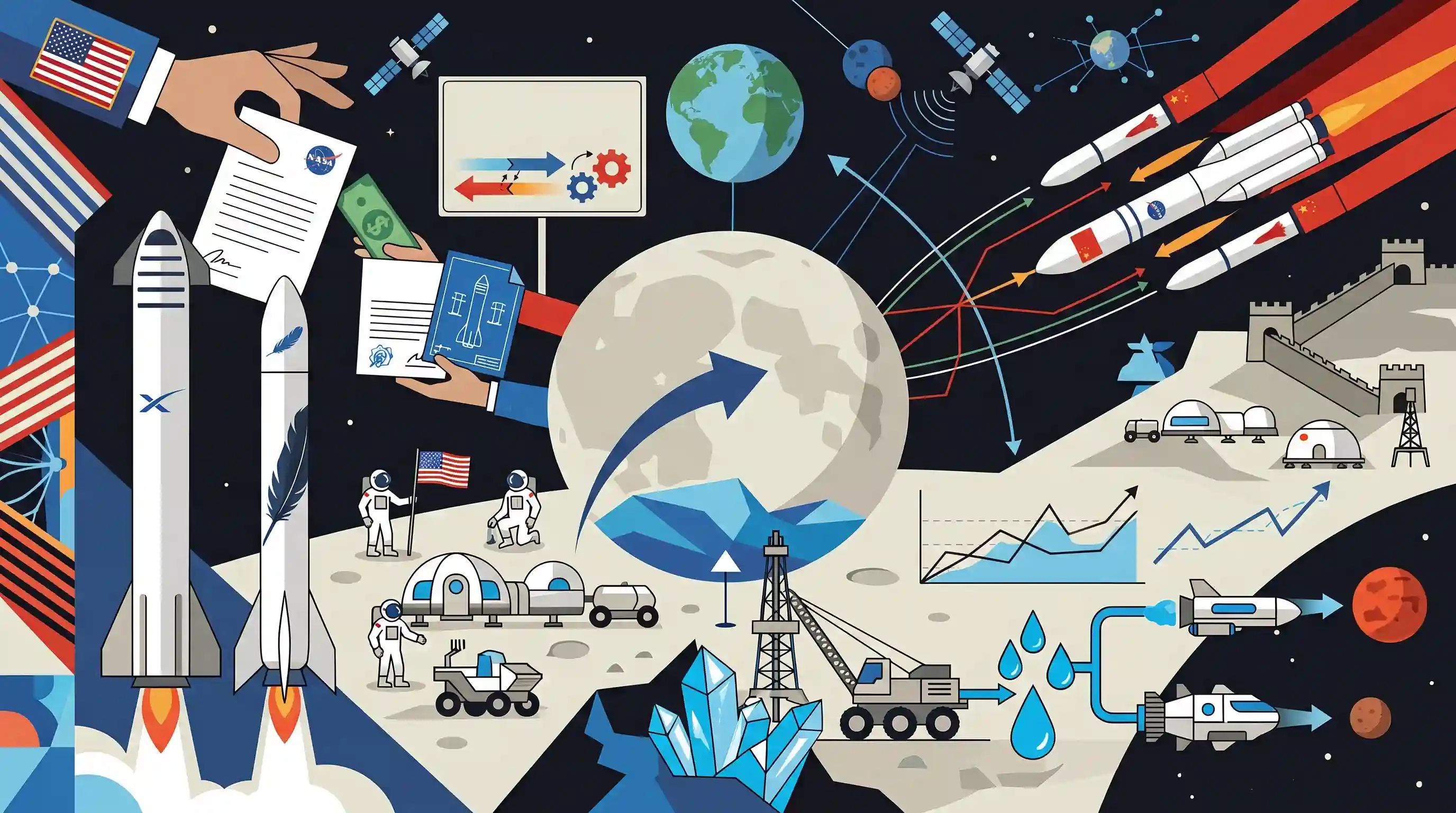
SpaceX and Blue Origin are accelerating their lunar ambitions, driven by NASA's Artemis programme which aims to return humans to the Moon and establish a sustainable lunar presence. Rather than building the spacecraft internally, NASA has awarded Human Landing System (HLS) contracts to these private giants, marking a paradigm shift in space exploration from state monopolies to public-private partnerships. The urgency of these plans is underscored by a geopolitical 'Space Race 2.0' against China's lunar goals, as well as the strategic rush to secure lunar resources like water ice at the South Pole for future deep space endeavours.
Key Points
- NASA is increasingly relying on private companies like SpaceX and Blue Origin to develop Human Landing Systems (HLS) for its Artemis programme, reflecting the growing privatization and commercialization of deep space exploration.
- SpaceX is developing a lunar variant of its Starship, while Blue Origin is working on the Blue Moon lander, both aiming to ferry astronauts to the lunar surface.
- The accelerated moonward push by US private players is heavily driven by 'Space Race 2.0', specifically the geopolitical competition with China and Russia's joint International Lunar Research Station (ILRS) initiative.
- A primary scientific and economic driver is the extraction of lunar resources, particularly water ice at the Moon's South Pole, which is critical for life support and generating rocket propellant for future deep space missions.
Important Terms
Artemis Programme

A NASA-led international initiative to return humans to the Moon, establish a sustainable presence, and use it as a stepping stone for future crewed missions to Mars.
UPSC context
GS III (Science & Tech); Essential for questions on human spaceflight, deep-space exploration, and international scientific collaborations.
Artemis Accords
A US-led non-binding multilateral arrangement between governments establishing principles for cooperation in the civil exploration and sustainable use of the Moon, Mars, and other celestial bodies.
UPSC context
GS II (IR) & GS III; Tests India's strategic space alliances, outer space governance, and adherence to international law (Outer Space Treaty).
International Lunar Research Station (ILRS)
A planned lunar base led by China and Russia, designed for comprehensive scientific research, resource utilization, and long-term uncrewed or crewed operations, serving as a rival to Artemis.
UPSC context
GS II & GS III; Relevant for understanding the geopolitics of "Space Race 2.0" and competing global space exploration frameworks.
Human Landing System (HLS) contracts
NASA's contractual framework procuring lunar lander development from private firms like SpaceX and Blue Origin, signaling a shift from state-led to public-private partnership models in space.
UPSC context
GS III; Tests concepts of privatization, commercialization of the space sector, and evolving procurement models in advanced technology.
China National Space Administration (CNSA)
The agency managing China's civil space activities, famous for the Chang'e lunar missions, including the first-ever soft landing on the Moon's far side (Chang'e 4).
UPSC context
GS III; Significant for monitoring global technological parity, competitive space missions, and China's growing influence in extra-terrestrial exploration.
Prelims Trap
"The International Lunar Research Station (ILRS) is a UN-backed global framework for moon exploration."
Aspirants often confuse "International" with UN-backed. The ILRS is specifically a geopolitical rival initiative led by China and Russia to counter the US-led Artemis programme.
Static Concepts Connected
What are the core principles of the Outer Space Treaty (1967)?
- Non-appropriation: Outer space and celestial bodies cannot be claimed by any nation via sovereignty, use, or occupation.
- Peaceful use: Weapons of mass destruction (WMDs) cannot be placed in orbit; establishing military bases on celestial bodies is strictly banned.
- State responsibility: Nations bear international responsibility for national space activities, whether carried out by governmental or non-governmental (private) entities.
What is In-Situ Resource Utilization (ISRU) in space exploration?
- Definition: The practice of collecting, processing, and utilizing materials found or manufactured on other astronomical objects to replace materials that would otherwise be brought from Earth.
- Water ice extraction: Extracting lunar polar ice to create breathable oxygen for habitats and hydrogen-based propellant for rockets.
- Cost and feasibility: It dramatically reduces the payload mass needed to be launched from Earth's gravity well, serving as a critical enabler for sustainable deep space transit.
Cross-Topic Patterns
Space blocs mirror terrestrial multipolarity
The Artemis (US/India) vs ILRS (China/Russia) divide directly mirrors Earth-bound multipolarity. Watch for Mains questions linking terrestrial groupings (like Quad or BRICS) with these emerging extraterrestrial blocs.
India's parallel space privatization (IN-SPACe)
NASA’s shift to private lunar lander contracts directly parallels ISRO’s recent reforms (IN-SPACe and NSIL) aimed at shifting operational missions to private players while the state focuses on deep-space R&D.

Expect a 2026 Mains question linking space privatization with the geopolitical 'Space Race 2.0' (Artemis Accords vs China-Russia ILRS).
Linked PYQs · 2
Linked PYQs · 2
- 2023MainsGS3
What is the main task of India's third moon mission which could not be achieved in its earlier mission? List the countries that have achieved this task. Introduce the subsystems in the spacecraft launched and explain the role of the Virtual Launch Control Centre' at the Vikram Sarabhai Space Centre which contributed to the successful launch from Sriharikota.
- 2016MainsGS3
Discuss India's achievements in the field of Space Science and Technology. How the application of this technology has helped India in its socio-economic development?
