Board of Peace pledges reconstruction funds for Gaza
Source:Indian Express ↗
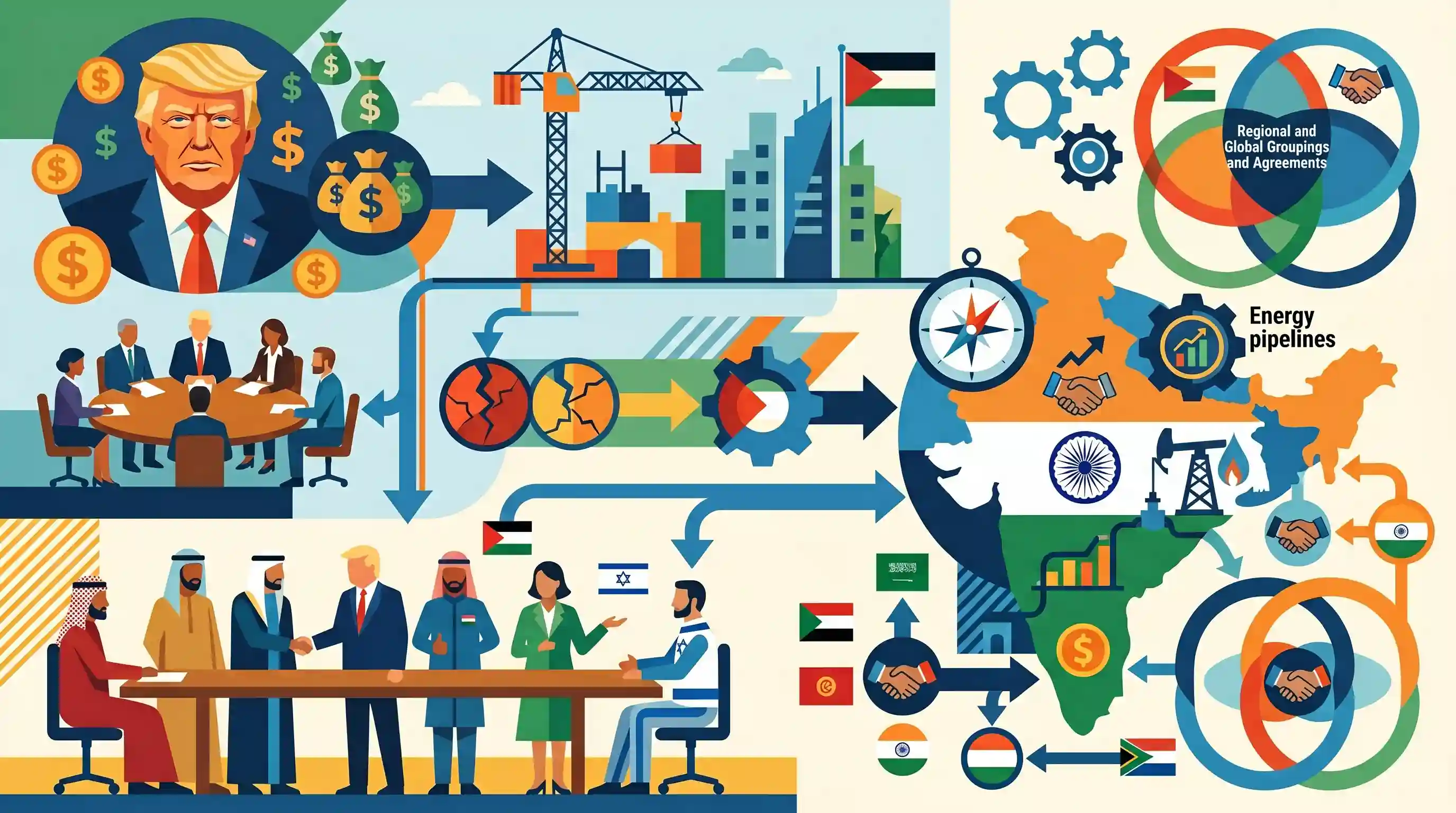
Why It Matters
The Israel-Palestine conflict and broader Middle East stability are crucial for global geopolitics, directly affecting energy markets, trade routes, and regional security. Changes in US foreign policy and reconstruction frameworks like the 'Board of Peace' influence India's strategic balancing act between Israel and the Arab world, making it a critical topic for UPSC candidates.
Summary
The article delves into US President Donald Trump's $7 billion pledge for the relief and reconstruction of Gaza, announced after a 'Board of Peace' meeting. This substantial financial commitment indicates a potential shift in US Middle East policy, prioritizing economic rebuilding as a cornerstone for long-term stability and conflict resolution between Israel and Palestine. The piece explores the geopolitical implications of this move, raising critical questions about the administration of the funds, the alignment of regional stakeholders, and the broader impact on the Middle East peace process.
Key Points
- US President Donald Trump announced a $7 billion pledge aimed at providing relief and funding reconstruction in Gaza.
- The announcement followed a meeting of the 'Board of Peace', suggesting a new US-led multilateral framework to address the post-conflict reality in the Middle East.
- The strategy highlights an approach of using substantial economic incentives and infrastructure investments to stabilize the region and foster a pathway to peace.
- Crucial questions remain regarding the logistical execution, the security environment required for reconstruction, and the involvement of neighboring Arab nations and international organizations.
Important Terms
Board of Peace

An international body chaired by Donald Trump (est. 2026) to oversee Gaza’s post-conflict reconstruction and governance under UN Security Council Resolution 2803.
UPSC context
GS Paper II: International Relations. Tests understanding of US Middle East policy and alternative models to UN-led multilateral diplomacy.
Gaza relief pledge
A $7 billion financial commitment by nine member nations (including Saudi Arabia and UAE) for rebuilding Gaza, announced at the 2026 Board of Peace inaugural meeting.
UPSC context
GS Paper II: Global groupings and agreements. Significant for analyzing economic diplomacy and regional burden-sharing in conflict resolution.
International Stabilization Force (ISF)
A 32,000-person peacekeeping mission mandated by the Board of Peace to provide security and train a new Palestinian police force in post-war Gaza.
UPSC context
GS Paper II: International security and conflict zones. Relevant for peacekeeping mandates and sovereignty issues in Palestine.
National Committee for the Administration of Gaza (NCAG)
A technocratic Palestinian administration supervised by the Board of Peace to manage day-to-day governance and services in Gaza during the reconstruction phase.
UPSC context
GS Paper II: International Relations. Concerns the transition of power and governance models in post-conflict territories.
UNSCR 2803
The 2025 UN Security Council resolution that authorized the Board of Peace mandate for Gaza's reconstruction, security, and the deployment of international forces.
UPSC context
GS Paper II: Important International institutions. Tests knowledge of UNSC mandates and international legal frameworks for peace.
Prelims Trap
"The Board of Peace is a newly established UN-backed multilateral agency for Gaza reconstruction."
Aspirants may assume the 'Board of Peace' is a UN-mandated body. It is actually a US-led, ad-hoc minilateral initiative bypassing traditional UN frameworks.
Static Concepts Connected
What are the bordering countries and water bodies of Israel and Gaza?
- Israel Borders: Lebanon (North), Syria (Northeast), Jordan (East), and Egypt (Southwest).
- Gaza Borders: Egypt (Southwest), Israel (East and North), and the Mediterranean Sea (West).
- Water Bodies: Mediterranean Sea (West), Red Sea via the Gulf of Aqaba (South), and the Dead Sea (East).
How does minilateralism differ from traditional multilateralism in International Relations?
- Minilateralism: Ad-hoc, issue-specific, small-group coalitions (e.g., I2U2, Quad) created to bypass consensus gridlock and act quickly.
- Multilateralism: Broad, treaty-based institutions (e.g., UN, WTO) aiming for universal participation or wide regional consensus.
- India's Stance: India increasingly prefers minilateral, issue-based plurilateralism to maintain its strategic autonomy without committing to rigid geopolitical blocs.
Cross-Topic Patterns
Abraham Accords, I2U2, and Economic Diplomacy
The US focus on economic incentives over immediate political resolution mirrors the Abraham Accords and I2U2. UPSC frequently tests these 'economic-first' approaches to West Asian geopolitics.
India's West Asia Strategic Calculus
Post-conflict stabilization in Gaza directly impacts India's strategic calculations, specifically regarding the IMEC trade corridor, energy security, and the safety of the massive Indian diaspora in the Gulf.

Expect a 2026 Prelims multi-statement question contrasting ad-hoc 'Board of Peace' minilateralism with traditional UNRWA roles.
Linked PYQs · 4
Linked PYQs · 4
- 2023PrelimsGS1
Consider the following statements: Statement-I: Israel has established diplomatic relations with some Arab States. Statement-II: The 'Arab Peace Initiative' mediated by Saudi Arabia was signed by Israel and Arab League. Which one of the following is correct in respect of the above statements?
- 2018MainsGS2
“India’s relations with Israel have, of late, acquired a depth and diversity, which cannot be rolled back.” Discuss.
- 2003PrelimsGS1
Israel has common borders with
- 2022PrelimsGS1
The term "Levant" often heard in the news roughly corresponds to which of the following regions?
