Gaza Reconstruction Pledge and Peace Board Initiative
Source:Indian Express ↗
Why It Matters
The governance and reconstruction of post-conflict Gaza are central to Middle Eastern stability. US-led initiatives, such as massive funding pledges and new administrative frameworks, influence regional dynamics, impacting global energy security, trade corridors (like IMEC), and India's strategic partnerships in the Arab world and with Israel.
Summary
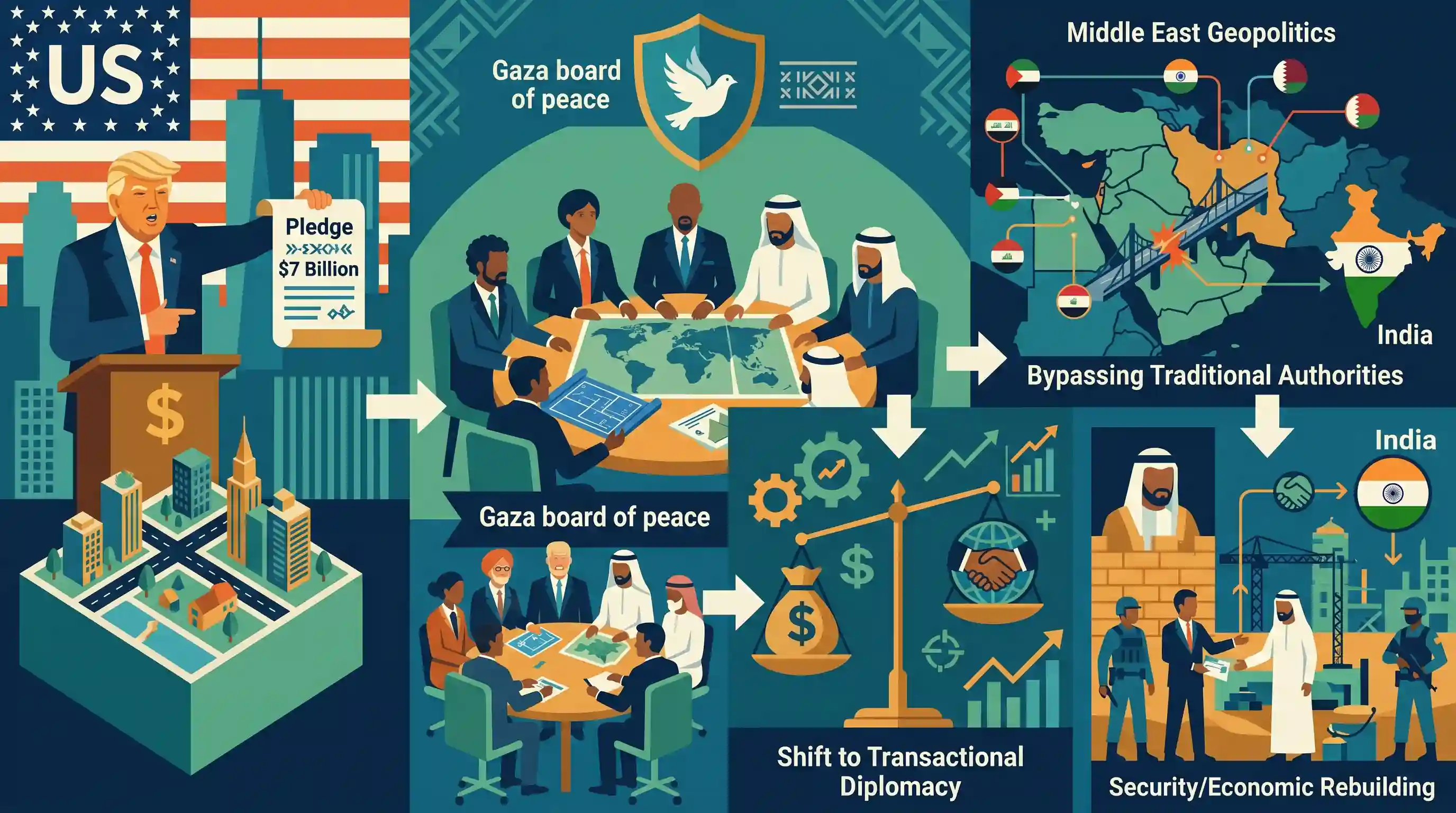
Former US President Donald Trump has pledged $7 billion for the reconstruction of Gaza, introducing the concept of a 'Gaza board of peace' to manage the enclave's post-war recovery. The proposal indicates a significant shift in US Middle East policy, leaning towards transactional diplomacy and regional coalition-building for conflict management. By proposing a new administrative board, the plan might seek to bypass traditional Palestinian authorities, integrating Arab states and international actors into Gaza's security and economic rebuilding, which carries profound implications for the broader geopolitics of the Middle East.
Key Points
- Donald Trump announced a $7 billion relief pledge aimed at the post-war reconstruction of the Gaza Strip.
- The proposal includes the formation of a 'Gaza board of peace', suggesting an international or regional coalition to oversee Gaza's governance and rebuilding.
- This approach reflects a transactional foreign policy strategy, using massive financial incentives to encourage stability and broker peace agreements.
- The initiative could potentially alter traditional conflict resolution frameworks by involving regional Arab states and sidelining existing Palestinian political institutions.
- Such a massive US-led reconstruction effort would significantly impact Middle Eastern geopolitics and post-conflict administrative models.
Important Terms
Gaza Board of Peace (BoP)

An international governance body chaired by Donald Trump to oversee Gaza's post-war administration, security, and $7 billion reconstruction fund, bypassing traditional Palestinian political structures.
UPSC context
GS Paper II: International Relations. Tests understanding of new multilateral frameworks and their impact on global conflict management.
20-point Gaza Peace Plan
A proposed 20-point diplomatic roadmap (2025) to end the Israel-Hamas war, featuring a ceasefire, hostage release, Hamas disarmament, and Gaza's transformation into an economic hub.
UPSC context
GS Paper II: Effect of policies of developed countries. Tests knowledge of major peace initiatives in West Asia.
International Stabilization Force (ISF)
A temporary multinational peacekeeping body, including Arab state personnel, tasked with maintaining security in Gaza and training a new Palestinian police force post-conflict.
UPSC context
GS Paper II: Important International institutions. Relevant for topics on global peacekeeping and regional security architectures.
National Committee for the Administration of Gaza (NCAG)
A technocratic, apolitical Palestinian committee of 15 members responsible for Gaza's day-to-day governance under the direct oversight of the Board of Peace.
UPSC context
GS Paper II: International Relations. Concerns the sovereignty and governance models of occupied or conflict-prone territories.
New Gaza
The vision to rebuild Gaza as a special economic zone featuring coastal tourism, industrial parks, and modern infrastructure to integrate it into the regional economy.
UPSC context
GS Paper II/III: Regional economic integration and its role in sustainable peace and Indian strategic interests like IMEC.
Transactional Diplomacy
A foreign policy approach prioritizing bilateral deals, economic incentives, and immediate strategic gains over long-term normative or ideological alliances.
UPSC context
GS Paper II: International Relations. Tests the ability to analyze shifts in US foreign policy and their global repercussions.
Prelims Trap
The Gaza Board of Peace is a UN-mandated body working in coordination with the Palestinian Authority.
The Board is a US-led intergovernmental body that deliberately seeks to bypass the Palestinian Authority and Hamas in favor of independent technocrats.
Static Concepts Connected
How does the Arab Peace Initiative (2002) differ from recent Middle East normalization efforts?
- Arab Peace Initiative: Demanded the establishment of a sovereign Palestinian state based on 1967 borders as a strict prerequisite before Arab states would normalize ties with Israel.
- Abraham Accords: Flipped the sequence by normalizing diplomatic and economic ties with Israel first, sidelining the immediate creation of a Palestinian state.
- Transactional Diplomacy: Focuses heavily on regional economic coalitions, financial incentives, and technocratic administration to manage conflict, rather than ideological treaties.
What is India's "De-hyphenation" policy regarding West Asia?
- Independent Ties: Treating relations with Israel and Palestine as mutually independent, rather than a zero-sum game where ties with one dictate ties with the other.
- Pragmatism: Balancing support for the Palestinian cause (a two-state solution) with deep strategic, defense, and technological cooperation with Israel.
- Minilateral Engagement: Participating in new minilaterals (like I2U2 with Israel, UAE, USA) for geoeconomic gains while retaining historical diplomatic postures.
Cross-Topic Patterns
Middle East peace & mega-connectivity
India's observer status in the Gaza Board aligns with its need for regional stability to operationalize geo-economic minilaterals like I2U2 and the India-Middle East-Europe Economic Corridor (IMEC).
The rise of transactional diplomacy
The US-led pledge reflects a global shift away from UN-mandated, rights-based resolutions toward unilateral, finance-driven conflict management that sidelines traditional political institutions.

Expect a prelims pair-matching question on West Asian peace frameworks (Oslo Accords, Arab Peace Initiative, Gaza Board) in 2026.
Linked PYQs · 3
Linked PYQs · 3
- 2023PrelimsGS1
Consider the following statements: Statement-I: Israel has established diplomatic relations with some Arab States. Statement-II: The 'Arab Peace Initiative' mediated by Saudi Arabia was signed by Israel and Arab League. Which one of the following is correct in respect of the above statements?
- 2023PrelimsGS1
Consider the following pairs: Regions often mentioned in news Reason for being in news 1. North Kivu and Ituri : War between Armenia and Azerbaijan 2. Nagorno-Karabakh : Insurgency in Mozambique 3. Kherson and Zaporizhzhia : Dispute between Israel and Lebanon How many of the above pairs are correctly matched?
- 2018MainsGS2
“India’s relations with Israel have, of late, acquired a depth and diversity, which cannot be rolled back.” Discuss.
