US Financial Pledge for Gaza Reconstruction and Peace Board
Source:Indian Express ↗
Why It Matters
Understanding shifts in US policy towards the Middle East is crucial for UPSC aspirants, as stability in West Asia directly impacts India's energy security, diaspora interests, and broader strategic calculations. The concept of post-conflict reconstruction frameworks like the 'Gaza Board of Peace' provides insight into modern conflict resolution mechanisms.
Summary
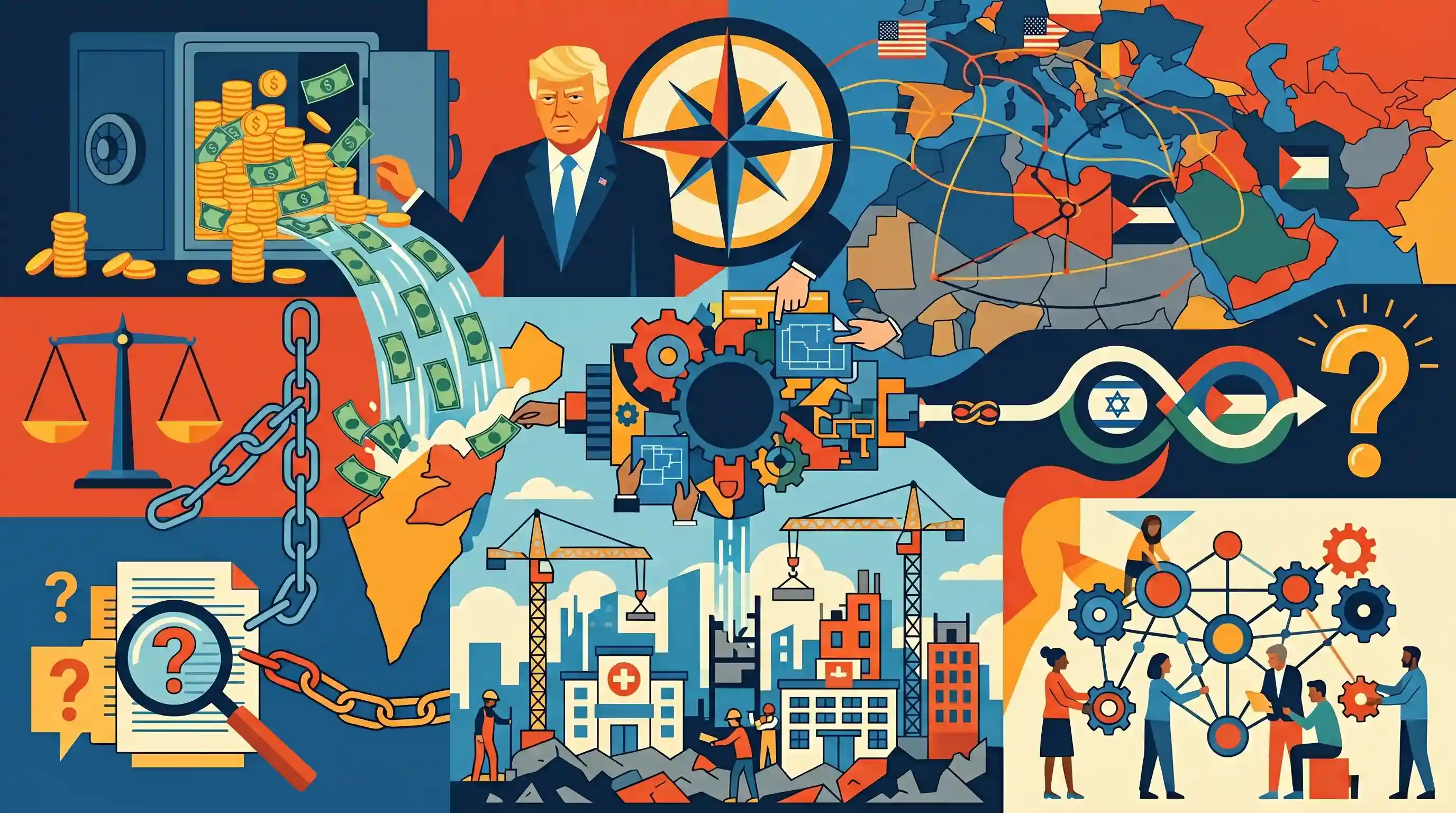
Donald Trump's $7 billion pledge for Gaza relief signifies a major potential intervention in the post-conflict reconstruction of the region. The financial commitment centers around the 'Gaza Board of Peace', an entity likely intended to manage and coordinate large-scale humanitarian assistance and infrastructure recovery. This development highlights evolving US foreign policy strategies in the Middle East, raising questions about the geopolitical implications, the conditions attached to the aid, and the future trajectory of the Israel-Palestine peace process. It also underscores the increasing need for structured multilateral frameworks to address post-war stabilization.
Key Points
- Donald Trump has proposed or pledged $7 billion towards relief and reconstruction efforts in Gaza, marking a substantial financial commitment to the region's post-war recovery.
- The pledge is tied to or highlights the role of the 'Gaza Board of Peace', which is likely envisioned as a coordinating body for administering aid and overseeing reconstruction.
- This move suggests a potential shift in US foreign policy regarding the Israel-Palestine conflict, emphasizing large-scale humanitarian and developmental interventions alongside traditional diplomatic avenues.
- The commitment raises important questions about the conditionalities of the aid, the geopolitical alignment of the Board of Peace, and the broader implications for long-term stability in the Middle East.
Important Terms
Gaza Board of Peace (BoP)

A US-led international organization chaired by Donald Trump, established to manage the reconstruction, funding, and political stabilization of Gaza following the 2023-2025 conflict.
UPSC context
GS Paper-II: International Relations. Tests evolving Middle East diplomacy, US foreign policy strategies, and non-UN multilateral governance frameworks.
UNSC Resolution 2803
A 2025 United Nations Security Council mandate that endorsed the Gaza peace plan and authorized the Board of Peace to oversee reconstruction and stabilization efforts.
UPSC context
GS Paper-II: International Organizations. Essential for understanding international law, peacebuilding mandates, and UN-sanctioned interventions in conflict zones.
International Stabilization Force (ISF)
A multinational peacekeeping force authorized to enforce ceasefires, monitor demilitarization, and provide internal security in Gaza under the supervision of the Board of Peace.
UPSC context
GS Paper-II: Security/International Relations. Relevant to peacekeeping operations, regional security architecture, and challenges of post-war stabilization.
National Committee for the Administration of Gaza (NCAG)
A technocratic, apolitical Palestinian body tasked with day-to-day administrative governance in Gaza during the post-conflict transition, supervised by international monitors.
UPSC context
GS Paper-II: International Relations. Tests concepts of transitional governance, technocratic administration, and the reconstruction of political institutions in fragile states.
Post-Conflict Reconstruction
The multi-dimensional process of rebuilding physical infrastructure, restoring economic systems, and reforming political institutions in a society devastated by armed conflict.
UPSC context
GS Paper-II/III. Core theme in peace studies, international aid dynamics, and sustainable development goals in conflict-affected regions.
Comprehensive Plan to End the Gaza Conflict
A US-brokered 20-point framework aimed at ending the Israel-Hamas conflict through an immediate ceasefire, hostage exchanges, and the creation of a new governance model.
UPSC context
GS Paper-II: International Relations. Tests understanding of diplomatic negotiation processes, regional peace settlement strategies, and Middle East geopolitics.
Prelims Trap
The Gaza Board of Peace is a specialized agency established by the United Nations for post-conflict reconstruction.
Aspirants often assume Middle East relief bodies are UN-affiliated. The Gaza Board of Peace is a US-proposed, non-UN mechanism functioning as a potential alternative to UNRWA.
Static Concepts Connected
What is UNRWA and how does its mandate differ from UNHCR?
- Specific Mandate: UNRWA exclusively serves Palestine refugees in the Middle East, while UNHCR is responsible for refugees globally.
- Generational Refugee Definition: Unlike standard refugee definitions, UNRWA's operational definition includes the descendants of the original 1948 Palestine refugees.
- Voluntary Funding: It relies almost entirely on voluntary contributions from UN member states, making its operations highly vulnerable to geopolitical shifts.
What is India's 'De-hyphenation' policy in the Middle East?
- Independent Relations: Treating bilateral relations with Israel and Palestine as independent and mutually exclusive, rather than viewing one through the lens of the other.
- Strategic Shift: It marked a shift from a historical pro-Palestine alignment to overtly pursuing robust defense and tech ties with Israel while maintaining support for the Palestinian cause.
- Strategic Autonomy: It allows India to maximize its economic, energy, and diaspora interests simultaneously across the divided Middle Eastern landscape.
Cross-Topic Patterns
Bypassing UN Multilateralism for Aid
The US proposing its own 'Board of Peace' reflects a broader trend of bypassing traditional UN bodies (like UNRWA) to retain geopolitical leverage over aid distribution in conflict zones.
Levant Stability & India's IMEEC Corridor
Gaza reconstruction dynamics directly impact India's geoeconomic projects like the IMEEC and I2U2, both of which require sustained stability in the Levant to function effectively.

Expect a 2026 prelims question contrasting UNRWA's mandate with emerging US-led aid bodies, testing knowledge of UN vs non-UN entities.
Linked PYQs · 3
Linked PYQs · 3
- 2025MainsGS2
"Energy security constitutes the dominant kingpin of India's foreign policy, and is linked with India's overarching influence in Middle Eastern countries.” How would you integrate energy security with India's foreign policy trajectories in the coming years?
- 2018MainsGS2
“India’s relations with Israel have, of late, acquired a depth and diversity, which cannot be rolled back.” Discuss.
- 2025MainsGS2
"The reform process in the United Nations remains unresolved, because of the delicate imbalance of East and West and entanglement of the USA vs. Russo-Chinese alliance.” Examine and critically evaluate the East-West policy confrontations in this regard.
