EPFO Wage Ceiling Revision and Social Security Impact
Source:The Hindu ↗
Why It Matters
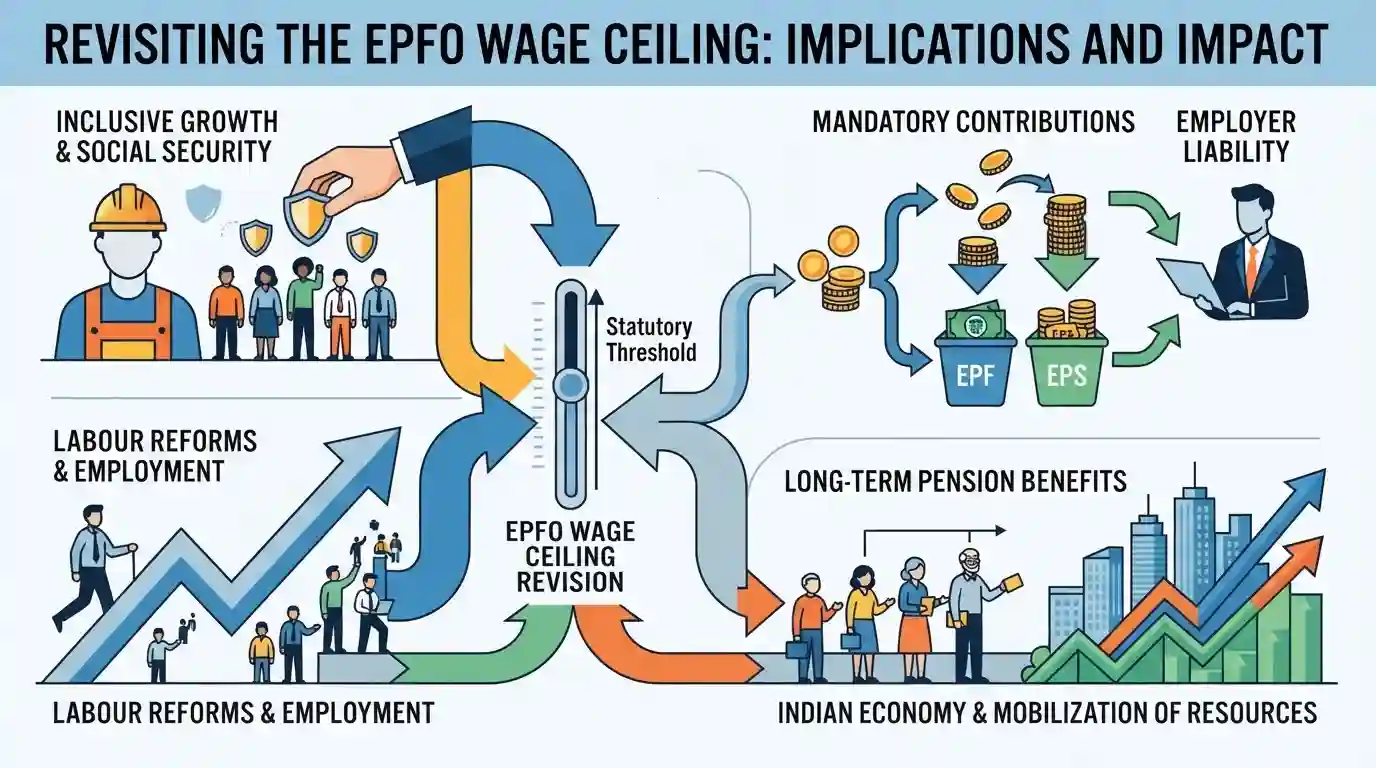
Changes to the EPFO wage ceiling directly affect social security coverage, formal labour dynamics, take-home salaries, and corporate liability, making it a critical topic for understanding India's welfare framework and labour market reforms.
Summary
The article explains the implications of revising the Employees Provident Fund Organisation (EPFO) wage ceiling. It details how altering this statutory threshold changes mandatory social security contributions, formal sector worker coverage, employer liability, and long-term pension benefits under the EPF and EPS frameworks.
Key Points
- The EPFO wage ceiling is the statutory maximum basic wage limit used to determine mandatory coverage and contributions for the Employees' Provident Fund (EPF) and Pension Scheme (EPS).
- Revising the wage ceiling expands social security net coverage to a larger bracket of formal sector workers, increasing mandatory savings and employer contributions.
- A higher wage ceiling impacts employer liability and reduces take-home pay for employees newly brought into the mandatory net, while enhancing their long-term retirement benefits and pension calculations.
- The adjustment aligns with inflationary trends and wage growth in India's formal labour market, feeding into broader discussions on social security reforms and the implementation of the new Labour Codes.
Important Terms
Employees Provident Fund Organisation (EPFO)

The Employees Provident Fund Organisation is a statutory body under the Ministry of Labour and Employment that administers mandatory provident fund, pension, and insurance schemes for the formal sector workforce in India.
UPSC context
Important for UPSC CSE Prelims/Mains (GS Paper II/III: Social Security, Welfare Schemes, and Labour Administration).
Employees’ Provident Funds and Miscellaneous Provisions Act, 1952
A foundational social security statute enacted in 1952 that mandates employer and employee contributions toward retirement savings, pensions, and insurance for eligible workers in organized establishments.
UPSC context
Crucial for GS Paper II (Social Security and Statutory Bodies) and GS Paper III (Labour Welfare and Inclusive Growth).
Labour Codes
Four comprehensive enactments—Code on Wages, Industrial Relations Code, Social Security Code, and OSHWC Code—that consolidate 29 central labour laws to streamline regulations and expand welfare coverage.
UPSC context
Frequent UPSC theme in GS Paper III (Indian Economy, Labour Reforms, Formalization of Employment).
Ministry of Labour and Employment
The nodal central ministry responsible for formulating labour policies, regulating industrial relations, ensuring worker safety and welfare, and administering social security institutions like EPFO and ESIC.
UPSC context
Relevant for GS Paper II and III regarding governance, administrative framework of labour welfare, and social safety nets.
Prelims Trap
The EPFO wage ceiling applies uniformly to the total gross monthly emoluments of all formal sector employees.
Aspirants often confuse voluntary contributions beyond the statutory wage ceiling with mandatory employer liability, or assume the wage ceiling applies to Gross Salary rather than Basic Wages plus Dearness Allowance.
Static Concepts Connected
What are the core statutory schemes administered by the Employees' Provident Fund Organisation (EPFO)?
- EPF Scheme: EPF Scheme, 1952 provides accumulated provident fund, interest, and housing/insurance benefits upon retirement or exigency.
- EPS Scheme: EPS Scheme, 1995 ensures monthly pension for superannuation, disablement, widow(er), and nominees of organized sector workers.
- EDLI Scheme: EDLI Scheme, 1976 offers life insurance assurance benefit linked to the provident fund balance for dependents.
Cross-Topic Patterns
Labour Codes + Fiscal Deficit Dynamics
Changes in statutory wage ceilings intersect directly with the Code on Social Security provisions, altering the fiscal calculations of the Government's contribution to EPS.
EPFO Revisions + MSME Compliance Burden
Expanding formalization via statutory social security thresholds directly impacts MSME compliance costs and ease-of-doing-business indices in manufacturing.

EPFO wage ceiling hikes + Code on Social Security (2020) threshold changes are prime candidates for a matching or statement-based prelims question.
Linked PYQs · 3
Linked PYQs · 3
- 2024MainsGS3
Discuss the merits and demerits of the four 'Labour Codes' in the context of labour market reforms in India. What has been the progress so far in this regard?
- 2024MainsGS3
Examine the pattern and trend of public expenditure on social services in the post-reforms period in India. To what extent this has been in consonance with achieving the objective of inclusive growth?
- 2024PrelimsGS1
In India, which of the following can trade in Corporate Bonds and Government Securities? 1. Insurance Companies 2. Pension Funds 3. Retail Investors Select the correct answer using the code given below:
