EPFO wage ceiling revision and formal sector social security
Source:The Hindu ↗
ఇది ఎందుకు ముఖ్యం
Understanding statutory changes to social security bodies like EPFO is critical for evaluating India's labor market formalization strategies, social safety nets for formal workers, and the implementation dynamics of upcoming labor codes.
సారాంశం
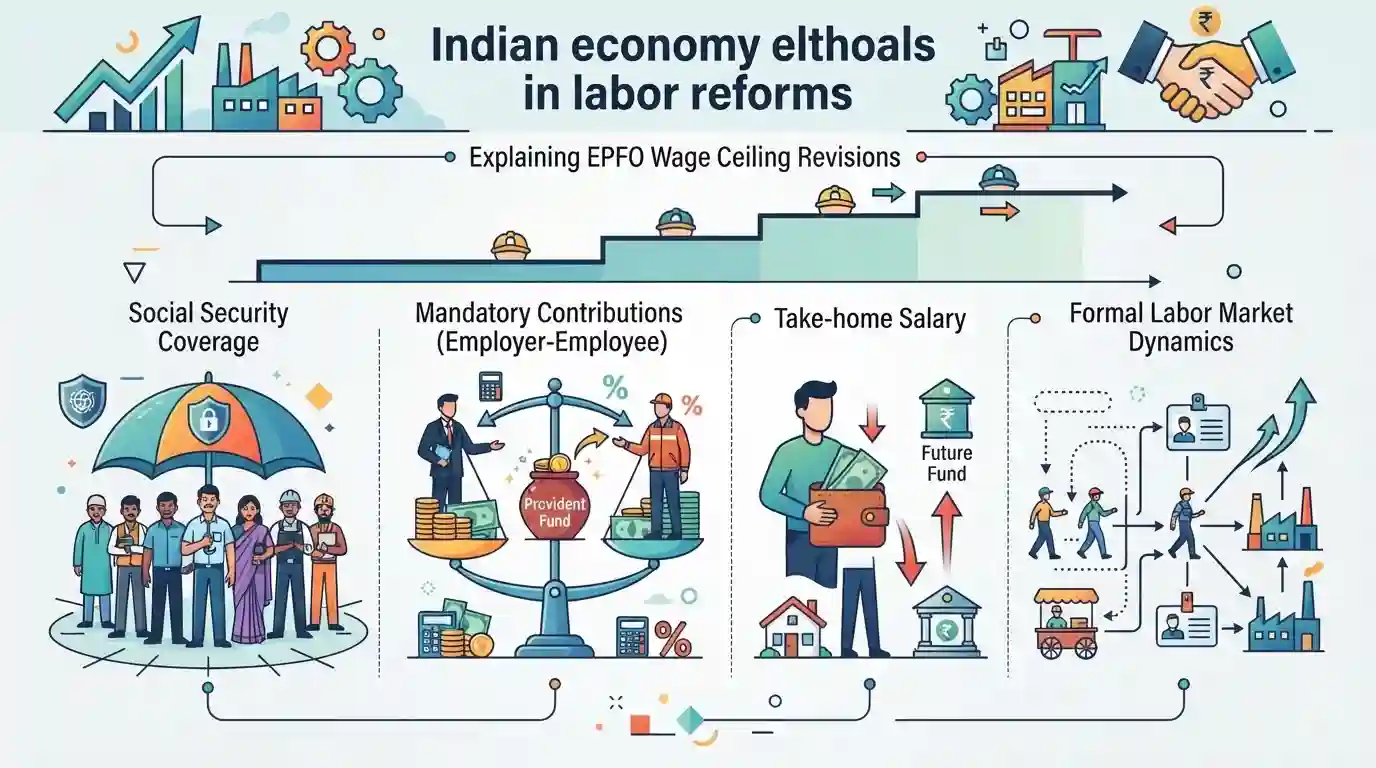
An explanation of what revisions to the Employees' Provident Fund Organisation (EPFO) wage ceiling entail, analyzing its impacts on social security coverage, mandatory employer-employee contributions, take-home salaries, and formal labor market dynamics in India.
ముఖ్య అంశాలు
- The EPFO wage ceiling determines mandatory coverage for formal sector employees' provident fund, pension, and insurance schemes.
- Revising the wage ceiling expands social security net coverage to a larger section of middle- and lower-income formal workers.
- Changes to the ceiling directly impact employers' and employees' statutory contribution burdens, affecting take-home pay and corporate operational costs.
- The reform ties into broader debates surrounding social security extension, formalization of the labor market, and impending implementation of the new Labour Codes.
ముఖ్యమైన పదాలు
Employees' Provident Fund Organisation (EPFO)

A statutory body under the Ministry of Labour and Employment that administers compulsory provident fund, pension, and insurance schemes for organized sector workers in India.
UPSC context
GS Paper III (Indian Economy & Social Security). Tests knowledge of statutory bodies, retirement schemes, and formal sector social safety nets.
Employees' Provident Funds and Miscellaneous Provisions Act, 1952
The principal foundational legislation enacted in 1952 to provide for the institution of provident funds, pension funds, and deposit-linked insurance for employees in factories and other establishments.
UPSC context
GS Paper II/III (Governance & Labour Laws). Tests legal frameworks governing worker welfare, social security, and employer-employee statutory liabilities.
Labour Codes
Consolidated legislative reforms proposed to simplify, amalgamate, and modernize 29 central labour laws into four distinct codes relating to wages, industrial relations, social security, and occupational safety.
UPSC context
GS Paper III (Labour Reforms & Employment). Tests understanding of structural regulatory changes in India's labor market and ease of doing business.
Ministry of Labour and Employment
The apex central government ministry responsible for formulating labor policies, safeguarding worker rights, promoting occupational safety, and administering social security schemes like the EPFO.
UPSC context
GS Paper II (Governance - Ministries & Bodies). Tests understanding of administrative machinery executing social security and employment policies.
ప్రిలిమ్స్ ఉచ్చు
The EPFO wage ceiling determines mandatory coverage for all formal sector employees without exception.
Aspirants often assume the EPFO wage ceiling applies universally to all employees in any establishment, whereas it primarily sets the threshold for mandatory coverage, though voluntary contributions are permitted above it.
అనుసంధానమైన స్థిర భావనలు
What are the core social security schemes administered by the Employees' Provident Fund Organisation (EPFO)?
- EPF Scheme: EPF Scheme 1952 is a mandatory defined-contribution savings scheme for formal sector retirement.
- Pension Scheme: EPS 1995 provides member pension, widow pension, and orphan pension based on service and salary.
- Insurance Scheme: EDLI 1976 offers life insurance benefits to nominees based on average balances.
అంతర-అంశ నమూనాలు
Social Security Revisions + New Labour Codes
EPFO ceiling adjustments directly intersect with the implementation challenges of the four consolidated Labour Codes, specifically wage definitions and social security for gig workers.
Formalization Incentives + Corporate Payroll Burden
Higher mandatory formal contributions influence corporate payroll costs, impacting formalization incentives under PLI and employment-linked incentive schemes.

EPFO wage ceiling revisions + EPS pension formulas are high-yield for both Prelims (statutory thresholds) and Mains (formalization).
అనుసంధాన PYQలు · 3
అనుసంధాన PYQలు · 3
- 2024MainsGS3
Discuss the merits and demerits of the four 'Labour Codes' in the context of labour market reforms in India. What has been the progress so far in this regard?
- 2021PrelimsGS1
With reference to casual workers employed in India, consider the following statements : 1. All casual workers are entitled for Employees Provident Fund coverage. 2. All casual workers are entitled for regular working hours and overtime payment. 3. The government can by a notification specify that an establishment or industry shall pay wages only through its bank account. Which of the above statements are correct?
- 2024PrelimsGS1
With reference to the Pradhan Mantri Shram Yogi Maan-dhan (PM-SYM) Yojana, consider the following statements : 1. The entry age group for enrolment in the scheme is 21 to 40 years. 2. Age specific contribution shall be made by the beneficiary. 3. Each subscriber under the scheme shall receive a minimum pension of ₹ 3,000 per month after attaining the age of 60 years. 4. Family pension is applicable to the spouse and unmarried daughters. Which of the statements given above is/are correct?
