Draft Seeds Bill and Regulatory Framework for Agriculture
Source:The Hindu ↗
Why It Matters
The Draft Seeds Bill is a critical regulatory shift for India's agricultural sector. It touches upon essential UPSC themes such as food security, farmers' rights vs. corporate intellectual property, biological diversity, and decentralized governance, heavily influencing future policies on agricultural sustainability and seed sovereignty.
Summary
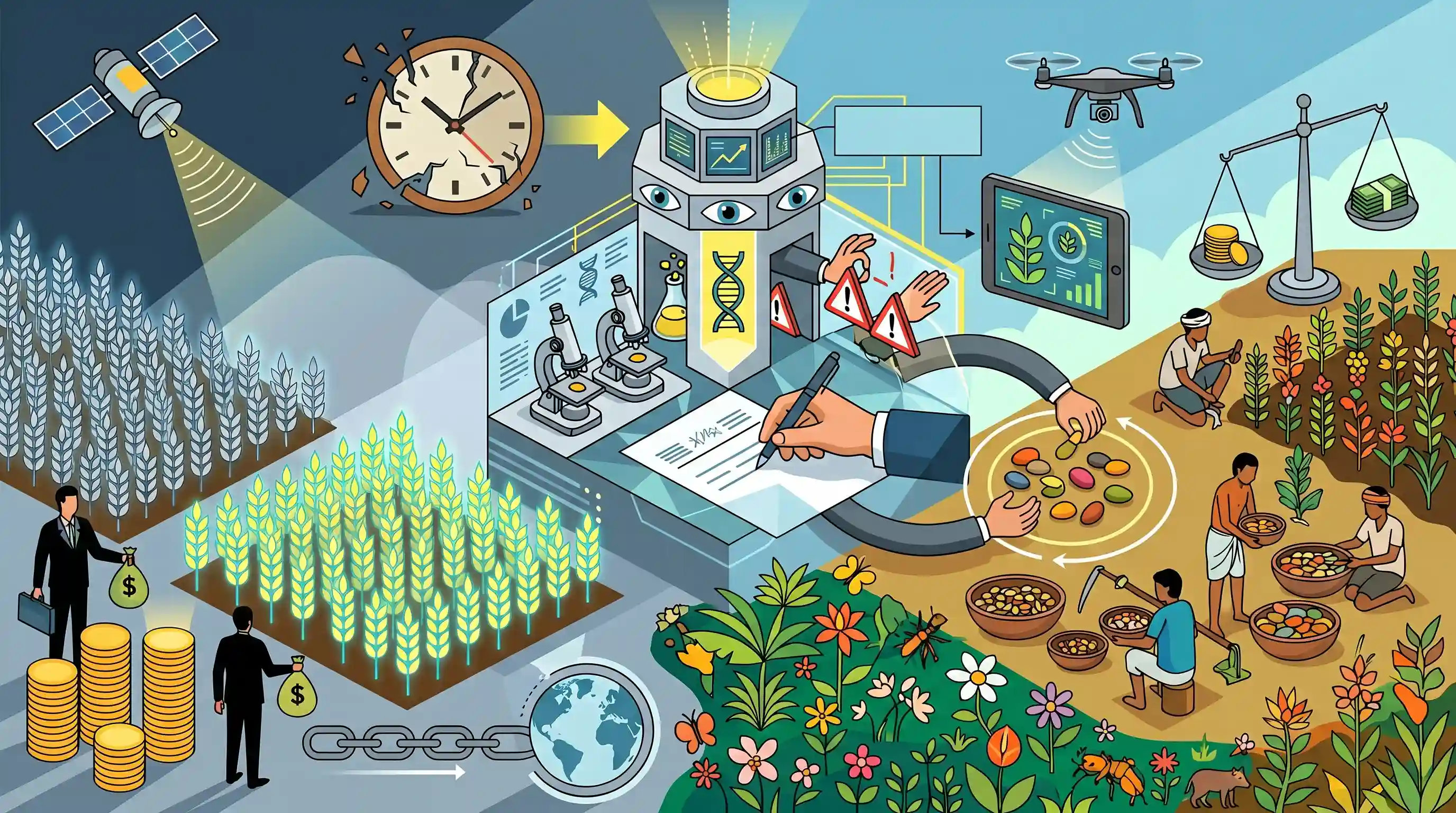
The Union Agriculture Ministry has released the Draft Seeds Bill to overhaul the outdated Seeds Act, 1966, focusing on regulating the import, production, and supply of quality seeds to reflect modern scientific advancements and improve ease of doing business. The Bill establishes Central and State Seed Committees, mandates the registration of seed varieties and processing units, and imposes strict penalties for violations. While the government asserts the Bill protects farmers' rights to save and exchange unbranded seeds under the PPVFR Act, farmers' organizations argue that its highly centralized nature promotes corporate monopolies, raises agricultural costs, and threatens traditional seed sovereignty and global biodiversity commitments.
Key Points
- The Union Agriculture Ministry's Draft Seeds Bill replaces the Seeds Act of 1966 to update regulations in line with technological advancements and ease of doing business.
- The draft proposes a Central Seed Committee (27 members) and State Seed Committees (15 members) to regulate the import, production, and supply of quality seeds.
- It mandates a National Register for all seed varieties and compulsory registration for seed processing units, alongside a Central Accreditation System for entities operating across multiple states.
- The Bill introduces stringent penalties for non-compliance, including fines ranging from ₹50,000 to ₹30 lakh and prison terms of up to three years.
- Farmers' rights to save, use, and exchange unbranded farm seeds are maintained and explicitly linked to the Protection of Plant Varieties and Farmers Rights (PPVFR) Act, 2001.
- Farmer groups like the Samyukt Kisan Morcha oppose the bill, fearing corporate monopolies, increased cultivation costs, centralization of power, and a threat to national seed sovereignty and biodiversity frameworks.
Important Terms
Draft Seeds Bill

A 2025 proposal replacing the Seeds Act 1966 to modernize seed regulation. It mandates registration of all commercial seeds, introduces traceability, and sets stricter penalties while protecting farmers' rights to save and exchange unbranded seeds.
UPSC context
GS-3 (Agriculture). Tests understanding of regulatory reforms in seed sovereignty, technology, and balancing corporate interests with traditional farming rights.
Seeds Act, 1966
India's existing legislation regulating seed quality, focused primarily on "notified" varieties. It lacks provisions for modern biotechnological advancements like GM seeds and lacks a robust statutory mechanism for farmer compensation during crop failure.
UPSC context
GS-3 (Agriculture). Vital for comparing historical regulatory frameworks with modern agricultural reforms and understanding the limitations of past legislative regimes.
Protection of Plant Varieties and Farmers Rights Act, 2001 (PPVFR Act)
A sui generis law granting intellectual property rights to breeders while protecting farmers' traditional rights to save, use, and exchange seeds. It aligns with TRIPS but prioritizes farmer welfare and biodiversity conservation.
UPSC context
GS-3 (IPR & Agriculture). Crucial for questions on agricultural IPR, seed sovereignty, and India’s unique legal stance in international trade.
International Treaty on Plant Genetic Resources for Food and Agriculture (ITPGRFA)
A legally binding global agreement (the "Seed Treaty") aimed at food security through the conservation and sustainable use of plant genetic resources, ensuring fair benefit sharing for farmers and breeders worldwide.
UPSC context
GS-2 (International Treaties) / GS-3 (Environment). Important for global food governance and India's compliance with international biodiversity and seed-sharing frameworks.
Convention on Biological Diversity (CBD)
A 1992 multilateral treaty dedicated to biodiversity conservation, sustainable use, and equitable benefit sharing from genetic resources. It serves as the parent framework for national biodiversity and seed-related laws.
UPSC context
GS-3 (Environment). Fundamental for understanding international conservation obligations and their impact on domestic environmental and agricultural legislation like the Seeds Bill.
Central Seed Committee
A proposed 27-member national statutory body under the Draft Seeds Bill. It is responsible for recommending minimum standards for seed germination, genetic purity, and health, while overseeing the national register.
UPSC context
GS-2 (Statutory Bodies) / GS-3 (Agriculture). Tests knowledge of administrative architecture and the centralization of regulatory powers in India's agricultural supply chain.
Prelims Trap
"The Draft Seeds Bill completely prohibits farmers from selling or exchanging farm-saved seeds to protect commercial seed producers."
Farmers retain the legal right to save, exchange, and sell unbranded seeds under the PPV&FR Act, 2001. The restriction only applies to selling seeds under a commercial brand name.
Static Concepts Connected
How does India's PPV&FR Act balance breeder incentives with farmers' rights?
- UPOV 1991 Convention: Restricts farmers from reusing and exchanging farm-saved protected seeds to heavily protect plant breeders. India rejected this to protect seed sovereignty.
- PPV&FR Act, 2001: India's sui generis system protects breeder innovations while explicitly allowing farmers to save, use, sow, resow, exchange, or sell unbranded protected seeds.
- Indian Patents Act: Under Section 3(j) of the Indian Patents Act, seeds, plants, and essentially biological processes for production or propagation are not patentable.
What is the International Treaty on Plant Genetic Resources for Food and Agriculture (ITPGRFA)?
- Objective: A legally binding treaty aimed at guaranteeing food security through the conservation, exchange, and sustainable use of the world's plant genetic resources.
- Multilateral System: Creates a global pool of 64 vital crops and forages available to member countries for research, breeding, and training purposes.
- Farmers' Rights: Officially acknowledges the enormous contribution of indigenous communities and farmers in conserving agrobiodiversity and crop diversity globally.
Cross-Topic Patterns
Seed Sovereignty & WTO-TRIPS IPR Regimes
The debate links agriculture directly to WTO-TRIPS obligations. India's refusal of UPOV 1991 and its sui generis PPV&FR Act frequently anchor questions on IPR vs. traditional knowledge.
Corporatization of Agriculture & Market Reforms
Fears of seed monopolies mirror past protests against the repealed 2020 farm laws, connecting legislative market reforms with national food security and corporate dominance in farming.

Expect a 2026 Prelims multi-statement question contrasting the PPV&FR Act, Indian Patents Act, and Draft Seeds Bill on farmer seed rights.
Linked PYQs · 4
Linked PYQs · 4
- 2019PrelimsGS1
Consider the following statements : 1. According to the Indian Patents Act, a biological process to create a seed can be patented in India. 2. In India, there is no Intellectual Property Appellate Board. 3. Plant varieties are not eligible to be patented in India. Which of the statements given above is/are correct?
- 2014PrelimsGS1
Consider the following international agreements : 1. The International Treaty on Plant Genetic Resources for Food and Agriculture 2. The United Nations Convention to Combat Desertification 3. The World Heritage Convention Which of the above has/have a bearing on the biodiversity?
- 2023PrelimsGS1
Consider the following statements: 1. In India, the Biodiversity Management Committees are key to the realization of the objectives of the Nagoya Protocol. 2. The Biodiversity Management Committees have important functions in determining access and benefit sharing, including the power to levy collection fees on the access of biological resources within its jurisdiction. Which of the statements given above is/are correct?
- 2019MainsGS3
How can biotechnology help to improve the living standards of farmers?
