Rising Diabetes Prevalence and Public Health Policy Challenges
Source:The Hindu ↗
Why It Matters
India is often referred to as the 'diabetes capital of the world'. The rising prevalence of NCDs poses a severe challenge to the nation's healthcare system and economic productivity. UPSC aspirants must understand the socioeconomic determinants of health, the importance of preventive healthcare, and the role of state policy in mitigating the impact of such lifestyle diseases.
Summary
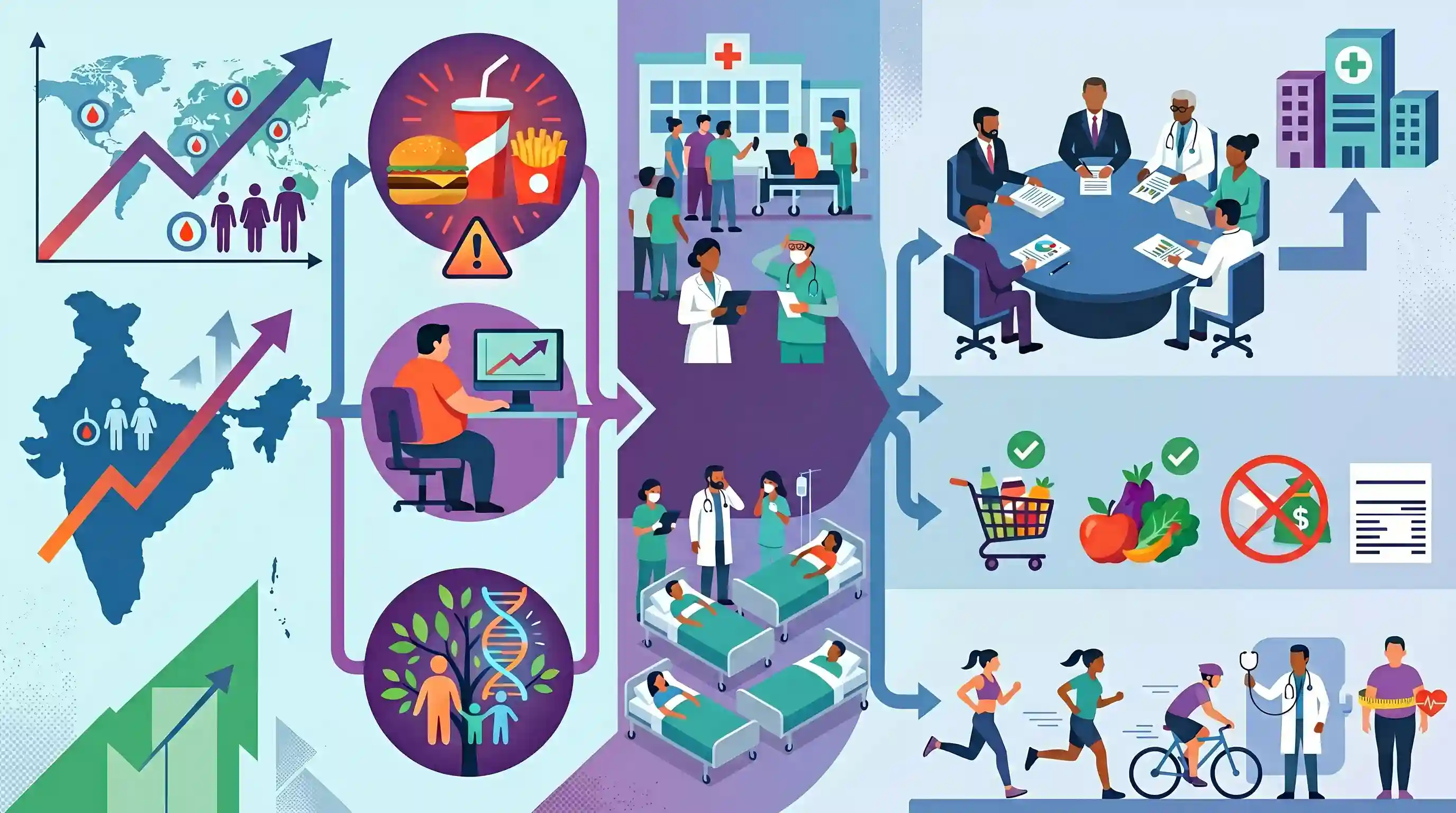
The article explores the findings of recent studies concerning the escalating risks of diabetes, analyzing the lifestyle and genetic factors driving the global and Indian surge in cases. It underscores the critical public health challenge posed by non-communicable diseases (NCDs) and calls for comprehensive healthcare policies, dietary regulations, and preventative strategies to address India's growing diabetes burden.
Key Points
- Recent epidemiological studies emphasize a concerning rise in the prevalence of Type 2 diabetes, disproportionately affecting younger populations and people in developing countries like India.
- Primary risk factors contributing to this surge include poor dietary choices (notably ultra-processed foods), sedentary lifestyles, and specific genetic vulnerabilities inherent to South Asian demographics.
- The growing burden of non-communicable diseases (NCDs) like diabetes strains public healthcare infrastructure and highlights the need for systemic preventative care.
- Effective interventions require a multi-pronged approach encompassing robust food labeling regulations, enhanced public awareness campaigns, and grassroots-level screening programs.
Important Terms
Indian Council of Medical Research (ICMR)

India's apex body for coordinating and promoting biomedical research, operating under the Department of Health Research, Ministry of Health and Family Welfare.
UPSC context
GS Paper II/III: Key for health policies, disease surveillance, and scientific research developments in India.
National Programme for Prevention and Control of Non-Communicable Diseases (NP-NCD)
A flagship government initiative (formerly NPCDCS) focused on infrastructure, health promotion, and early diagnosis of chronic conditions like diabetes and cancer.
UPSC context
GS Paper II: Essential for health services management and government interventions for chronic diseases.
Non-Communicable Diseases (NCDs)
Chronic, non-transmissible medical conditions caused by a combination of genetic, environmental, and lifestyle factors, including diabetes, hypertension, and cancer.
UPSC context
GS Paper II: Tests knowledge of major public health challenges impacting India's economy and social sector.
Food Safety and Standards Authority of India (FSSAI)
An autonomous statutory body under the Ministry of Health and Family Welfare that regulates food safety, standards, and distribution across India.
UPSC context
GS Paper II/III: Relevant for regulatory bodies and their role in food security and nutrition.
World Health Organization (WHO)
A specialized United Nations agency responsible for international public health, setting global health standards, and coordinating international responses to health emergencies.
UPSC context
GS Paper II: Key international institution for global health governance and cross-border disease management.
Prelims Trap
"Indians with a normal Body Mass Index (BMI) are at negligible risk for developing Type-2 diabetes."
The "Asian Indian Phenotype" (Thin-Fat Indian) means South Asians can have normal BMIs but high central adiposity, making them highly susceptible to metabolic diseases.
Static Concepts Connected
What are the core components of the NP-NCD?
- Targeted diseases: Focuses on preventing and controlling major non-communicable diseases, specifically Cancer, Diabetes, Cardiovascular Diseases (CVDs), and Stroke.
- Implementation: Executes opportunistic community-level screening at Ayushman Arogya Mandirs (Health and Wellness Centres) for citizens aged 30 and above.
- Funding framework: It is a Centrally Sponsored Scheme running under the umbrella of the National Health Mission (NHM).
What is FSSAI's Front-of-Pack Labelling (FOPL) initiative?
- Objective: Replaces complex back-of-pack nutritional panels with simple visual cues or star ratings indicating high fat, sugar, and salt (HFSS).
- Statutory backing: Mandated under the Food Safety and Standards Act, 2006, to help consumers quickly identify unhealthy Ultra-Processed Foods (UPFs).
Cross-Topic Patterns
UPFs vs. Food Processing Sector (GS2/GS3)
Promoting food processing schemes like PM-SAMPADA (GS3) must be carefully balanced against the public health costs (GS2) of Ultra-Processed Foods driving India's metabolic disease epidemic.
Genetics and the 'Asian Indian Phenotype'
The genetic vulnerability of South Asians to abdominal adiposity links GS3 biotechnology topics (like IndiGen genome sequencing) directly to the design of GS2 preventive healthcare policies.

A 2026 Prelims statement will likely test the 'Asian Indian Phenotype' against standard BMI, or FSSAI's Front-of-Pack Labelling mandate.
Linked PYQs · 2
Linked PYQs · 2
- 2024MainsGS2
In a crucial domain like the public healthcare system the Indian State should play a vital role to contain the adverse impact of marketisation of the system. Suggest some measures through which the State can enhance the reach of public healthcare at the grassroots level.
- 2020MainsGS2
In order to enhance the prospects of social development, sound and adequate health care policies are needed particularly in the fields of geriatric and maternal health care. Discuss.
