EMudhra Web Security Key Leak and Digital Trust
Source:The Hindu ↗
Why It Matters
The incident underscores systemic risks in digital trust architectures, certificate authorities, and internet security, making it critical for GS3 Cyber Security syllabus.
Summary
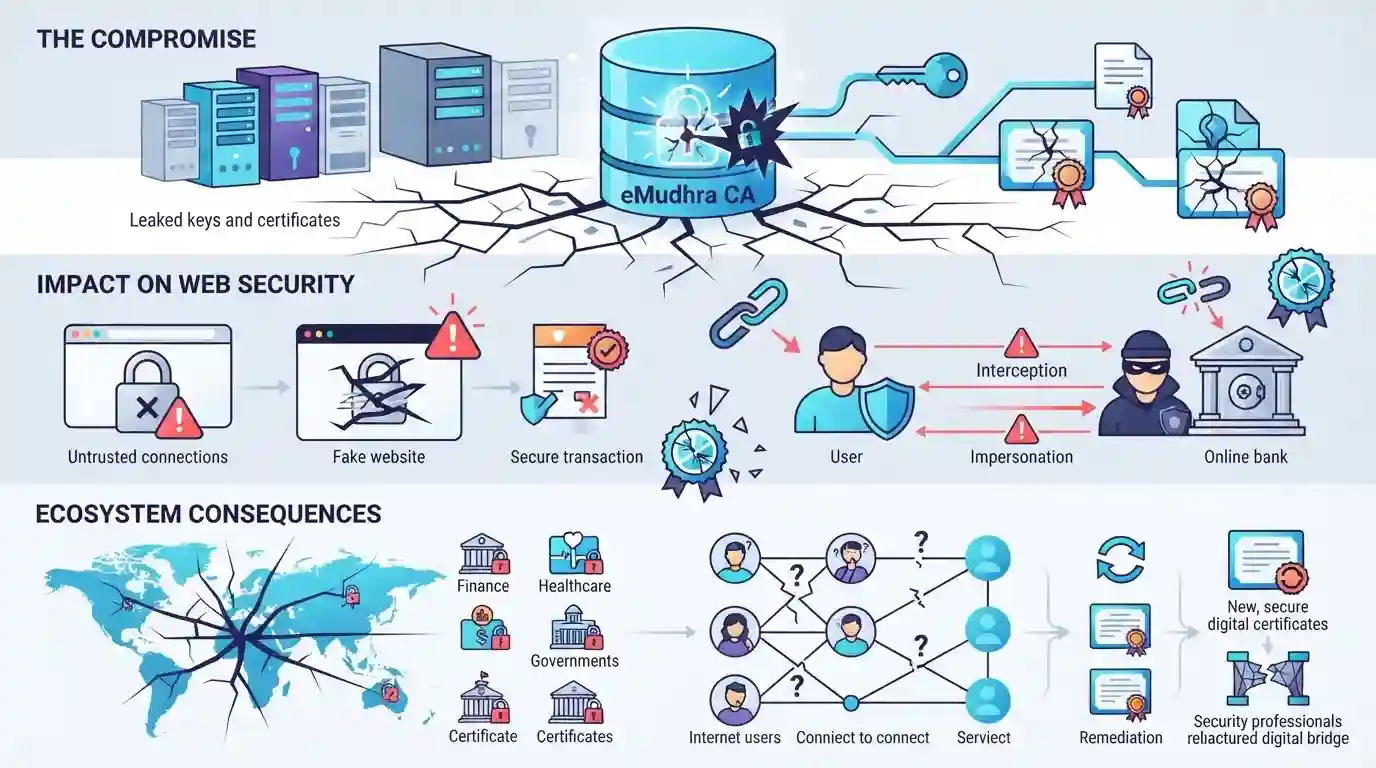
An explanation of eMudhra's web security key leak, exploring how the compromise of digital certificates and security keys impacts internet users, web security, and digital trust infrastructures.
Key Points
- eMudhra, a major Certifying Authority (CA), experienced a security key leak impacting web security.
- Web security keys and digital certificates are crucial for establishing trusted HTTPS connections and authenticating websites.
- A compromise of such keys can expose users to man-in-the-middle (MitM) attacks, phishing, and fake certificate generation.
- Highlights the vulnerability of critical digital infrastructure and the need for robust oversight of Certifying Authorities.
Important Terms
eMudhra

An Indian digital certification authority and public key infrastructure provider licensed by the CCA, which experienced a security flaw when some of its web security keys were found to be weak and compromised.
UPSC context
UPSC GS-3 (Cyber Security & Information Technology). Tests understanding of digital trust infrastructure, Certifying Authorities, and cybersecurity vulnerabilities in India.
Public Key Infrastructure (PKI)
A framework of cryptographic systems, hardware, software, and policies used to create, manage, distribute, use, store, and revoke digital certificates and secure electronic communications.
UPSC context
UPSC GS-3 (Cyber Security). Core concept for IT security, encryption, data privacy, and secure internet communication architectures.
Controller of Certifying Authorities (CCA)
A government body under the Information Technology Act, 2000, that licenses, regulates, and supervises Certifying Authorities issuing digital signature certificates in India.
UPSC context
UPSC GS-3 (Cyber Security & Governance). Relevant for institutional framework governing e-signatures and legal validity of digital documents in India.
TLS/SSL Certificates
Digital certificates used to secure HTTPS connections by encrypting data between a user's browser and a web server, verifying website identity and authenticity.
UPSC context
UPSC GS-3 (Cyber Security). Tests knowledge of website encryption, web browser trust mechanisms, and protection against interception attacks.
Prelims Trap
Compromise of security keys means the underlying asymmetric encryption algorithm has been mathematically broken globally.
Aspirants often assume that a Certifying Authority breach means the entire asymmetric encryption algorithm (like RSA or ECC) has been mathematically broken, whereas here the vulnerability lay in poor cryptographic randomness during key generation.
Static Concepts Connected
How does Public Key Infrastructure (PKI) and the Certifying Authority hierarchy operate in India?
- CCA Oversight: Controller of Certifying Authorities (CCA) licenses and regulates CAs under the Information Technology Act, 2000.
- CA Hierarchy: Root CAs issue self-signed certificates, while intermediate CAs (like eMudhra) issue end-entity certificates to servers and users.
- Asymmetric Crypto: Digital Signature Certificates (DSCs) use asymmetric cryptography (public and private key pairs) for authentication and non-repudiation.
Cross-Topic Patterns
Certifying Authorities + Critical Information Infrastructure Protection
A failure in cryptographic randomness or key generation directly threatens National Critical Information Infrastructure Protection Centre (NCIIPC) mandates and digital governance frameworks under the IT Act.
Digital Public Infrastructure + Cyber Trust Systems
Certificate Authority breaches can undermine secure e-governance portals, compromising citizen data trust and transactional security across state digital platforms.

Expect a statement-based prelims question on the role of Certifying Authorities under the IT Act and Public Key Infrastructure (PKI).
Linked PYQs · 3
Linked PYQs · 3
- 2017MainsGS3
Discuss the potential threats of Cyber attack and the security framework to prevent it.
- 2018MainsGS3
Data security has assumed significant importance in the digitized world due to rising cyber crimes. The Justice B. N. Srikrishna Committee Report addresses issues related to data security. What, in your view, are the strengths and weaknesses of the Report relating to protection of personal data in cyber space?
- 2024MainsGS3
Social media and encrypting messaging services pose a serious security challenge. What measures have been adopted at various levels to address the security implications of social media? Also suggest any other remedies to address the problem.
