Socioeconomic Impacts of Artificial Intelligence Automation
Source:Indian Express ↗
Why It Matters
As AI accelerates into major economic sectors, addressing structural unemployment, equitable wealth distribution, and the ethical considerations of human irrelevance in labor markets is vital for future governance and policy-making.
Summary
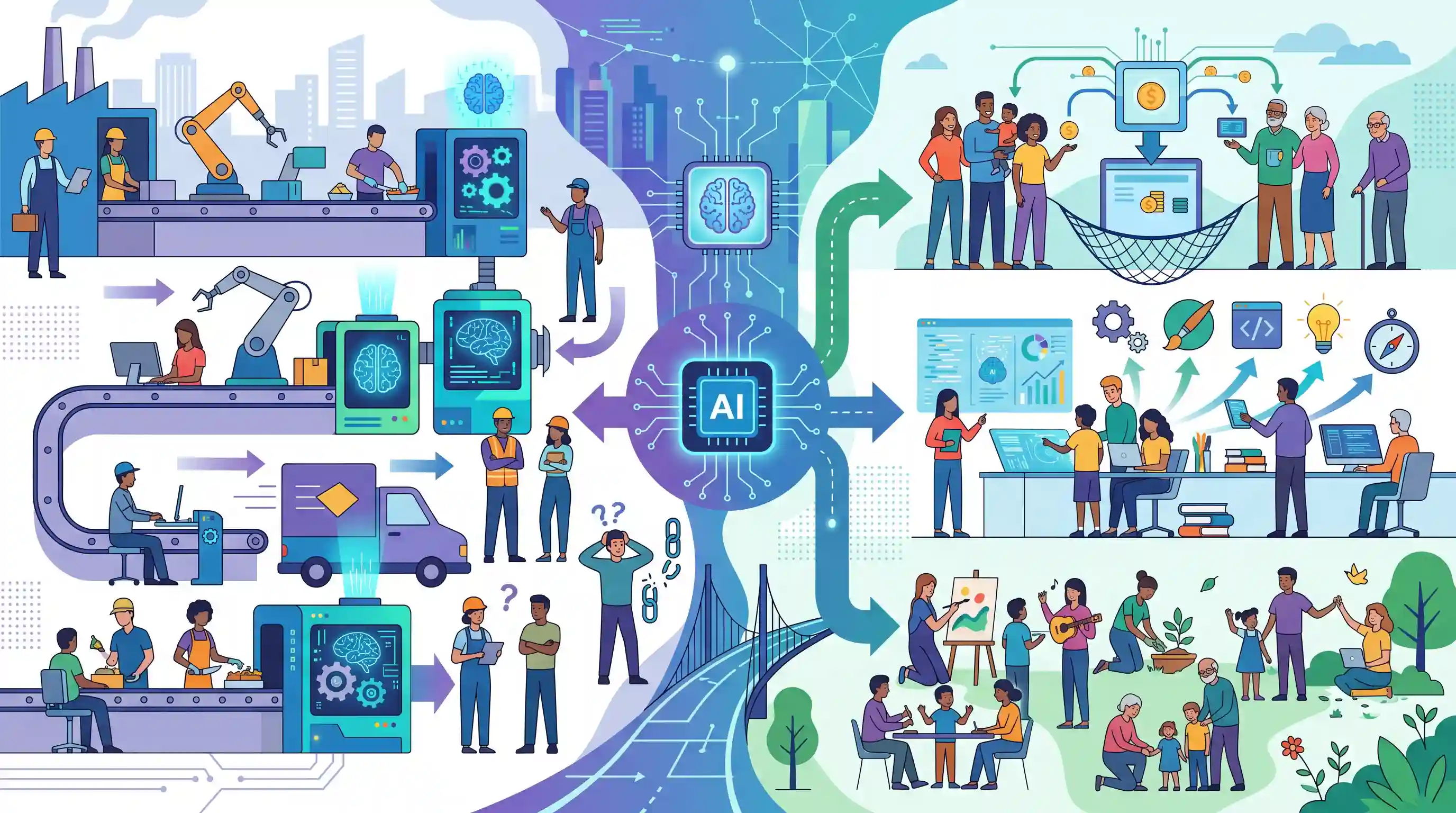
The article explores the profound economic and existential implications of an increasingly automated future where Artificial Intelligence and machines can perform almost all tasks currently done by humans. It delves into the potential for mass job displacement, challenging the traditional link between human labor and economic security. Furthermore, it touches upon the necessity of systemic adaptations such as Universal Basic Income, the rethinking of education for reskilling, and the urgent need to redefine human purpose in a post-labor economy.
Key Points
- The rapid advancement of AI and automation poses a significant threat to traditional employment paradigms, disrupting both manual and cognitive professions.
- A 'jobless future' challenges the foundational economic model where human labor is exchanged for income, making radical social safety nets like Universal Basic Income (UBI) a central policy debate.
- Beyond economic displacement, the automation of human labor raises existential questions about meaning, purpose, and identity, which have historically been tied to one's profession.
- Societal adaptation requires a pivot towards reskilling, upskilling, and emphasizing intrinsically human qualities—such as empathy, creativity, and ethical judgment—that machines cannot replicate.
- Robust policy and ethical frameworks are needed to ensure the wealth generated by machine-driven productivity is equitably distributed, preventing extreme inequality.
Important Terms
Universal Basic Income (UBI)

A social welfare system providing all citizens a regular, unconditional cash payment from the state, regardless of wealth or employment status, to ensure a minimum financial safety net.
UPSC context
GS-III/Economy: Tests knowledge of inclusive growth and radical welfare alternatives to targeted subsidies.
Technological Unemployment
Job loss specifically caused by technological change, where automation or artificial intelligence replaces human labor faster than the economy can create new roles for workers.
UPSC context
GS-III/Economy: Crucial for understanding structural labor market shifts and the impact of automation on employment.
Artificial Intelligence (AI)
The simulation of human intelligence processes by computer systems, encompassing learning, reasoning, and self-correction to perform tasks that typically require human cognition.
UPSC context
GS-III/Science & Tech: Core for discussing emerging technologies, socio-economic impacts, and national technology strategies.
Fourth Industrial Revolution (Industry 4.0)
The current industrial era characterized by the fusion of digital, physical, and biological spheres, driven by AI, robotics, the Internet of Things (IoT), and big data.
UPSC context
GS-III/Economy: Essential for analyzing industrial transformation, manufacturing productivity, and global competitiveness.
Reskilling
The process of learning new skills to transition into a different job role, necessitated by technological displacement or evolving industry requirements.
UPSC context
GS-II/Social Justice: Vital for discussing human resource development, Skill India, and workforce adaptability.
AI Ethics
The study of moral principles applied to AI systems, focusing on ensuring fairness, transparency, accountability, and the prevention of algorithmic bias or mass surveillance.
UPSC context
GS-IV/Ethics: Key for addressing dilemmas in technology, data privacy, and responsible automation.
Prelims Trap
Universal Basic Income is a targeted social security measure for citizens who lose their jobs to AI and automation.
UBI is inherently 'universal' and 'unconditional.' It is provided to all citizens regardless of employment status or income level, contrasting with targeted unemployment benefits or means-tested welfare.
Static Concepts Connected
What are the fundamental characteristics of Universal Basic Income (UBI)?
- Universality: Provided to all citizens without means-testing, targeting, or income thresholds.
- Unconditionality: Distributed without stipulations on employment status, seeking work, or how the money is spent.
- Cash payment: Given as direct cash transfers (financial liquidity) rather than in-kind benefits like food or vouchers.
How does AI-induced job loss relate to macroeconomic types of unemployment?
- Structural Unemployment: Occurs when there is a fundamental mismatch between the skills workers possess and the new skills required by the AI economy.
- Technological Unemployment: A specific subset of structural unemployment caused directly by the introduction of labor-saving machines and automation.
Cross-Topic Patterns
AI, Capital Returns, and Inequality
As machines replace human labor, the capital share of national income rises. This links automation directly to wealth concentration and macroeconomic metrics like the Gini coefficient.
Algorithmic Logic vs GS4 Compassion
Contrasts AI's administrative efficiency with the foundational civil service values (GS4) of empathy, compassion towards weaker sections, and ethical judgment that machines cannot replicate.

2026 Prelims may feature a multi-statement question linking UBI characteristics with AI-induced structural and technological unemployment.
Linked PYQs · 4
Linked PYQs · 4
- 2019MainsEssay
Rise of Artificial Intelligence: the threat of jobless future or better job opportunities through reskilling and upskilling
- 2015MainsEssay
Technology cannot replace manpower.
- 2024MainsGS4
The application of Artificial Intelligence as a dependable source of input for administrative rational decision-making is a debatable issue. Critically examine the statement from the ethical point of view.
- 2022MainsGS3
Economic growth in the recent past has been led by increase in labour productivity." Explain this statement. Suggest the growth pattern that will lead to creation of more jobs without compromising labour productivity.
