PostBlast Forensic Investigation and Evidence Collection Methods
Source:The Hindu ↗
Why It Matters
Forensic science is the backbone of modern anti-terrorism and criminal investigations. Understanding the scientific and methodological approach to post-blast investigations helps aspirants appreciate how technology empowers central intelligence and investigative agencies in tackling internal security threats and ensuring judicial accountability.
Summary
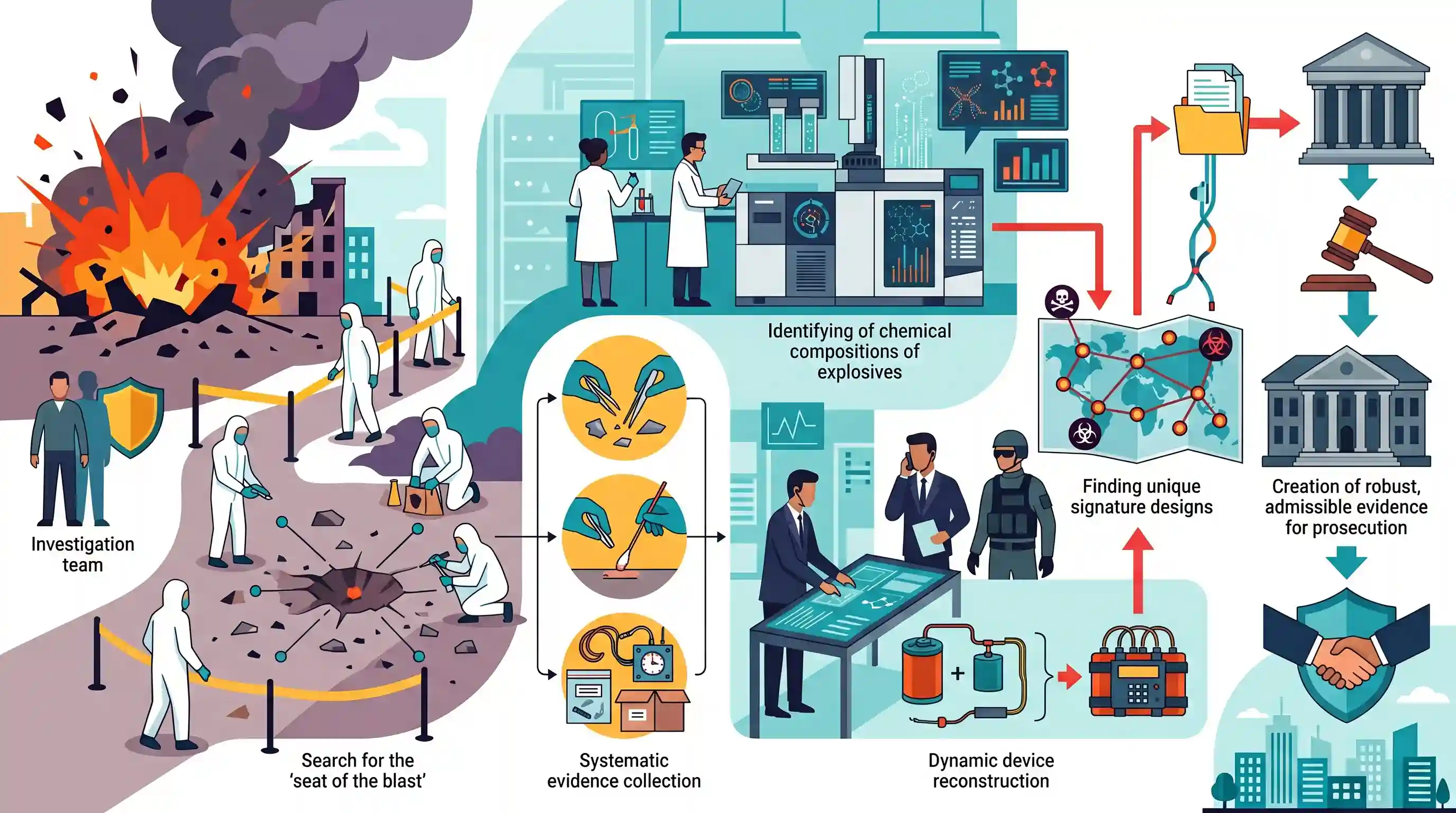
The article explains the critical procedures followed by forensic experts in the aftermath of an explosion. It highlights how forensic teams secure the blast site, locate the epicenter (seat of the blast), and systematically collect evidence such as shrapnel, explosive residues, and components of Improvised Explosive Devices (IEDs). Utilizing advanced analytical technologies like Gas Chromatography-Mass Spectrometry (GC-MS), experts identify the chemical composition of the explosives. This scientific analysis is vital for investigative agencies like the NIA and NSG, as it helps reconstruct the device, link the attack to specific terror groups based on signature designs, and provides robust, legally admissible evidence for prosecution.
Key Points
- Post-Blast Scene Management: The primary forensic step is securing the site and locating the 'seat' of the blast, typically indicated by a crater or the point of maximum structural damage.
- Evidence Collection: Experts gather crucial physical evidence including explosive residues, shrapnel, and remnants of Improvised Explosive Devices (IEDs) such as timers, wires, and power sources.
- Analytical Techniques: Advanced chemical analysis using tools like Gas Chromatography-Mass Spectrometry (GC-MS) and Ion Mobility Spectrometry is deployed to identify the specific explosive compounds used (e.g., RDX, TNT, Ammonium Nitrate).
- Investigative Linkage: The scientific reconstruction of the explosive device allows intelligence agencies to attribute attacks to specific terrorist groups by identifying 'signature' bomb-making techniques.
- Safety and Protocols: Checking for secondary explosive devices to protect first responders and maintaining a rigorous chain of custody to ensure evidence is legally admissible in court.
Important Terms
National Investigation Agency (NIA)

India’s premier counter-terrorism agency, established as a statutory body under the NIA Act 2008. It investigates offenses affecting national sovereignty and security without requiring state-level permission.
UPSC context
GS Paper 3: Internal Security; tests knowledge of statutory bodies, mandates, and federal investigative powers in counter-terrorism.
National Security Guard (NSG)
An elite counter-terrorism unit (Black Cats) established under the National Security Guard Act, 1986. It acts as a federal contingency force for hostage rescue and neutralizing high-risk terror threats.
UPSC context
GS Paper 3: Internal Security; tests understanding of specialized security forces and their role in tackling extraordinary threats.
Improvised Explosive Device (IED)
A non-conventional "homemade" bomb constructed from military or commercial components. It typically includes an initiator, switch, main charge, and power source, often enhanced with shrapnel for maximum damage.
UPSC context
GS Paper 3: Internal Security; relevant for understanding asymmetric warfare tactics and terrorism challenges like LWE and insurgency.
Forensic Science
The application of scientific methods and techniques to investigate crimes. It is increasingly vital under the Bharatiya Sakshya Adhiniyam, 2023, which mandates forensic evidence for serious offenses.
UPSC context
GS Paper 3: Science & Tech/Internal Security; tests understanding of modern investigative tools and their legal admissibility.
Gas Chromatography-Mass Spectrometry (GC-MS)
An analytical technique that separates and identifies chemical substances within a mixture. It is the forensic "gold standard" for identifying trace amounts of explosives, drugs, or toxins.
UPSC context
GS Paper 3: Science and Technology; tests familiarity with advanced analytical methods used in chemical analysis and security.
Seat of the Blast
The epicenter or specific point where an explosive device was detonated. Locating it is essential for reconstructing the device's design and determining the explosion's intensity.
UPSC context
GS Paper 3: Internal Security; relevant for understanding post-blast investigation protocols and crime scene management by specialized agencies.
Prelims Trap
"The National Bomb Data Centre (NBDC) functions under the National Investigation Agency (NIA)."
The National Bomb Data Centre (NBDC) was established in 1988 and functions under the National Security Guard (NSG), not the NIA or NCRB.
Static Concepts Connected
How does Gas Chromatography-Mass Spectrometry (GC-MS) work in forensics?
- Separation (GC): GC vaporizes the sample and separates chemical mixtures into individual components based on their volatility.
- Identification (MS): MS ionizes these components and measures their mass-to-charge ratio, identifying exact molecular structures.
- Forensic Utility: It is crucial for detecting trace levels of volatile explosive residues, narcotics, and complex environmental pollutants.
What are the respective mandates of NIA and NSG in post-blast scenarios?
- NIA Mandate: The NIA is India's premier federal agency for investigating and prosecuting scheduled offences related to terrorism.
- NSG Mandate: The NSG is a federal contingency force that conducts anti-terror operations and provides technical expertise in post-blast investigations (PBI).
- Synergy: NSG experts reconstruct the device and log it into the NBDC, while the NIA utilizes this scientific evidence to prosecute terror modules.
Cross-Topic Patterns
Tech-driven Terror vs Tech-driven Forensics
UPSC frequently tests the juxtaposition of evolving terror tactics (drones, encrypted triggers) against modern forensic attribution methods like Ion Mobility Spectrometry.
Chain of Custody & UAPA Convictions
Low conviction rates in terror cases are often linked to procedural lapses in evidence collection. Strict chain-of-custody protocols bridge forensics with UAPA prosecutions.

Expect a Prelims S&T question matching forensic tools (GC-MS, IMS) to applications, or a GS3 Mains Q on inter-agency synergy (NSG/NIA).
Linked PYQs · 2
Linked PYQs · 2
- 2023MainsGS3
What are the internal security challenges being faced by India? Give out the role of Central Intelligence and Investigative Agencies tasked to counter such threats.
- 2021MainsGS3
Analyse the complexity and intensity of terrorism, its causes, linkages and obnoxious nexus. Also suggest measures required to be taken to eradicate the menace of terrorism.
