Supreme Court Examines Scheduled Caste Status and Religion
Source:The Hindu ↗
Why It Matters
The debate over SC status and religious conversion involves critical constitutional questions about the definition of 'caste' in India, the secular nature of the state, and the intended reach of reservation policies. It directly addresses UPSC syllabus themes concerning affirmative action, fundamental rights, and the protection of vulnerable sections.
Summary
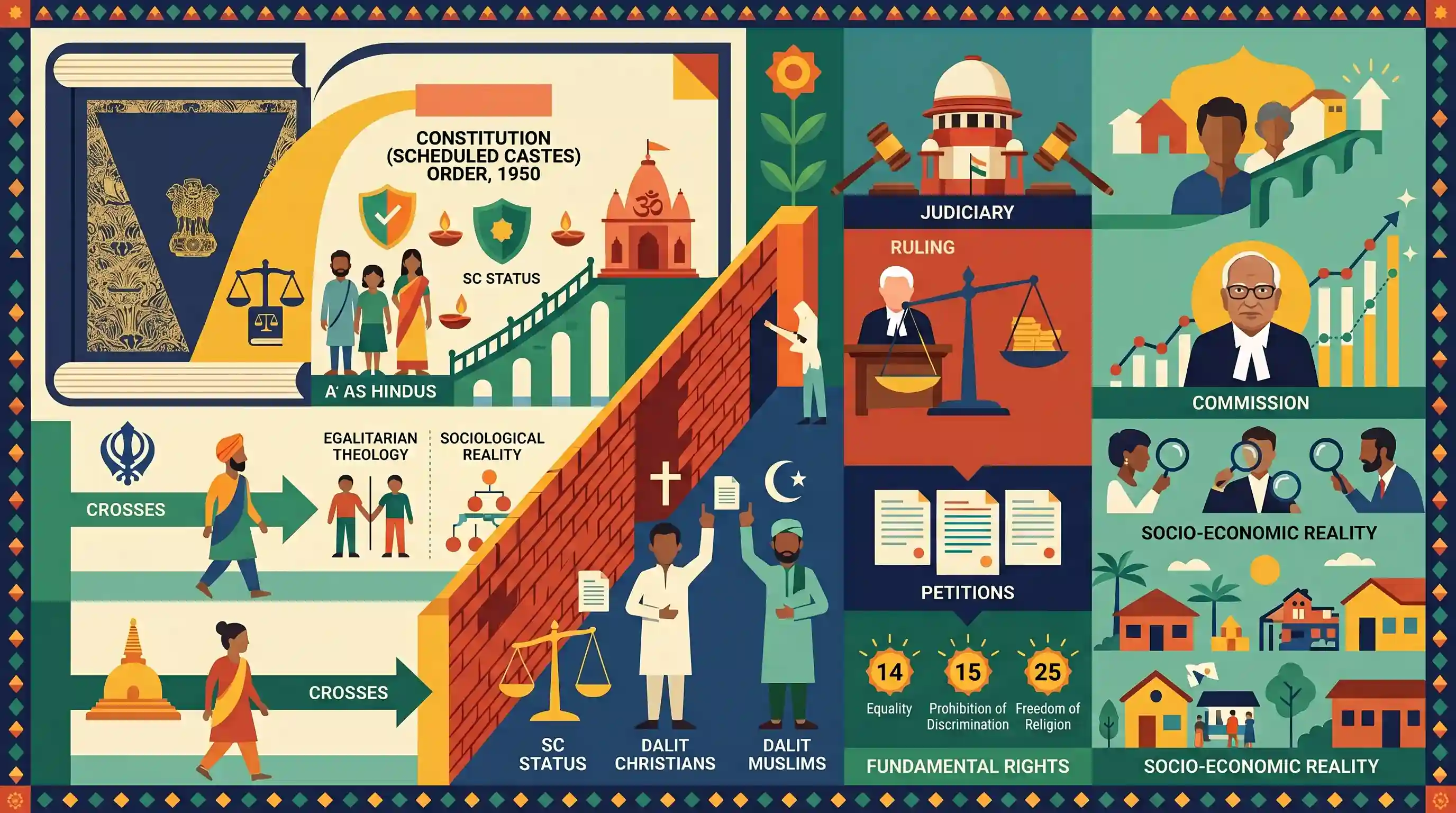
The article examines the constitutional and legal complexities surrounding the intersection of Scheduled Caste (SC) status and religious conversion in India. At the center of the debate is the Constitution (Scheduled Castes) Order, 1950, promulgated under Article 341, which initially restricted SC recognition to Hindus. Subsequent amendments extended this status to Sikhs (1956) and Buddhists (1990), acknowledging the persistence of caste-based discrimination within these communities. However, Dalit Christians and Dalit Muslims remain excluded, based on the theological argument that Christianity and Islam are egalitarian religions free from untouchability. The article explores key Supreme Court rulings, such as the 1985 Soosai judgment, which upheld this exclusion due to insufficient empirical proof of identical social disabilities post-conversion. Amidst ongoing petitions challenging this exclusion as a violation of fundamental rights (Articles 14, 15, and 25), the Union Government has appointed the Justice K.G. Balakrishnan Commission to investigate the socio-economic reality of Dalit converts, highlighting the ongoing friction between religious theology and the sociological realities of the caste system in India.
Key Points
- The Constitution (Scheduled Castes) Order, 1950, enacted under Article 341, originally limited SC status to Hindus, but was amended to include Sikhs in 1956 and Buddhists in 1990.
- Dalit Christians and Dalit Muslims are currently excluded from the SC list based on the premise that their respective religions theoretically do not recognize the caste system or practice untouchability.
- Supreme Court precedents, notably the Soosai vs Union of India (1985) judgment, historically upheld the constitutionality of the 1950 Order, citing a lack of empirical evidence that Dalit Christians suffer the exact same social disabilities as Hindu Dalits.
- Ongoing petitions before the Supreme Court challenge this religion-based exclusion, arguing that it violates the Fundamental Rights to equality (Article 14), non-discrimination (Article 15), and freedom of religion (Article 25).
- The Union Government has constituted a commission led by former Chief Justice of India K.G. Balakrishnan to conduct a comprehensive study on the socio-economic conditions of Dalits who have converted to Islam and Christianity.
Important Terms
Constitution (Scheduled Castes) Order, 1950

A Presidential Order identifying communities recognized as Scheduled Castes. It currently restricts SC status to those professing Hinduism, Sikhism, or Buddhism to address historical disabilities arising from untouchability.
UPSC context
GS Paper II (Social Justice). Tests knowledge of legal frameworks for affirmative action and religious criteria in reservation policies.
Article 341
Constitutional provision authorizing the President to notify Scheduled Castes. It specifies that only Parliament has the power to subsequently include or exclude any community from this list via legislation.
UPSC context
GS Paper II (Polity). Tests understanding of executive vs. legislative roles in identifying vulnerable sections for protection.
Justice K.G. Balakrishnan Commission
A commission appointed in 2022 to examine the socio-economic status and persistence of discrimination among Dalits who converted to religions like Christianity and Islam to decide SC eligibility.
UPSC context
GS Paper II (Social Justice). Relevant for current affairs regarding minority rights and caste vs. religion debates.
Article 25
Fundamental Right guaranteeing freedom of conscience and the right to profess, practice, and propagate religion. It allows the State to open Hindu religious institutions to all sections of Hindus.
UPSC context
GS Paper II (Fundamental Rights). Tests the balance between religious freedom and the state's power to provide reservations.
Article 14
Fundamental Right ensuring equality before the law and equal protection of laws. It is frequently invoked to challenge religion-based exclusions in reservation policies as being "arbitrary classification."
UPSC context
GS Paper II (Fundamental Rights). Central to legal challenges against discriminatory exclusions from constitutional benefits.
Article 15
Prohibits discrimination by the State on grounds of religion, race, caste, sex, or birth. Clause (4) enables the State to make special provisions for the advancement of Scheduled Castes.
UPSC context
GS Paper II (Social Justice). Tests knowledge of non-discrimination principles and the constitutional basis for protective discrimination.
Prelims Trap
"The Constitution of India explicitly restricts Scheduled Caste status to individuals professing Hinduism, Sikhism, or Buddhism."
The restriction comes from a delegated instrument—the Constitution (Scheduled Castes) Order, 1950—not the Constitution itself. Aspirants often confuse statutory orders with original constitutional text.
Static Concepts Connected
How is the list of Scheduled Castes modified under Article 341?
- Initial Notification: The President, after consulting the Governor of a State, first specifies the castes or tribes deemed to be Scheduled Castes via a public notification.
- Parliamentary Amendment: Any subsequent inclusion or exclusion from this initial Presidential list cannot be done by the President; it can only be made by Parliament through a law.
Does the Constitution define explicit criteria for Scheduled Caste status?
- No explicit criteria: The Constitution does not specify sociological criteria like 'untouchability' or religion for SC status. The parameters were established via executive drafting of the 1950 Order.
- Article 366(24): It merely defines SCs as "such castes, races or tribes... as are deemed under article 341 to be Scheduled Castes for the purposes of this Constitution."
Cross-Topic Patterns
Religion-neutral STs vs Religion-specific SCs
Unlike the Scheduled Castes Order, the identification of Scheduled Tribes (Article 342) is completely independent of religion. An ST person retains their status and benefits irrespective of religious conversion.
Executive Commissions preceding Judicial Review
The Balakrishnan Commission mirrors the Justice Rohini Commission (OBC sub-categorization). Both demonstrate how executive fact-finding on socio-economic backwardness is required before constitutional courts adjudicate on equality and reservation frameworks.

Expect a 2026 Prelims statement contrasting religion-neutral ST status under Article 342 with religion-specific SC status under 1950 Order.
Linked PYQs · 3
Linked PYQs · 3
- 2018MainsGS2
Whether National Commission for Scheduled Castes (NCSC) can enforce the implementation of constitutional reservation for the Scheduled Castes in the religious minority institutions? Examine.
- 2018MainsGS1
Caste system is assuming new identities and associational forms. Hence, caste system cannot be eradicated in India." Comment.
- 2024PrelimsGS1
Consider the following statements : 1. It is the Governor of the State who recognizes and declares any community of that State as a Scheduled Tribe. 2. A community declared as a Scheduled Tribe in a State need not be so in another State. Which of the statements given above is/are correct?
