International Court Delivers Advisory Opinion on Climate Duties
Source:The Hindu ↗
Why It Matters
The ICJ's advisory opinion significantly impacts how international climate law is interpreted. Understanding the legal nuances of CBDR&RC, 'obligations of conduct' vs 'obligations of result', and the Global South's concerns regarding carbon space and climate finance is crucial for answering Mains questions on global environmental governance and India's climate diplomacy.
Summary
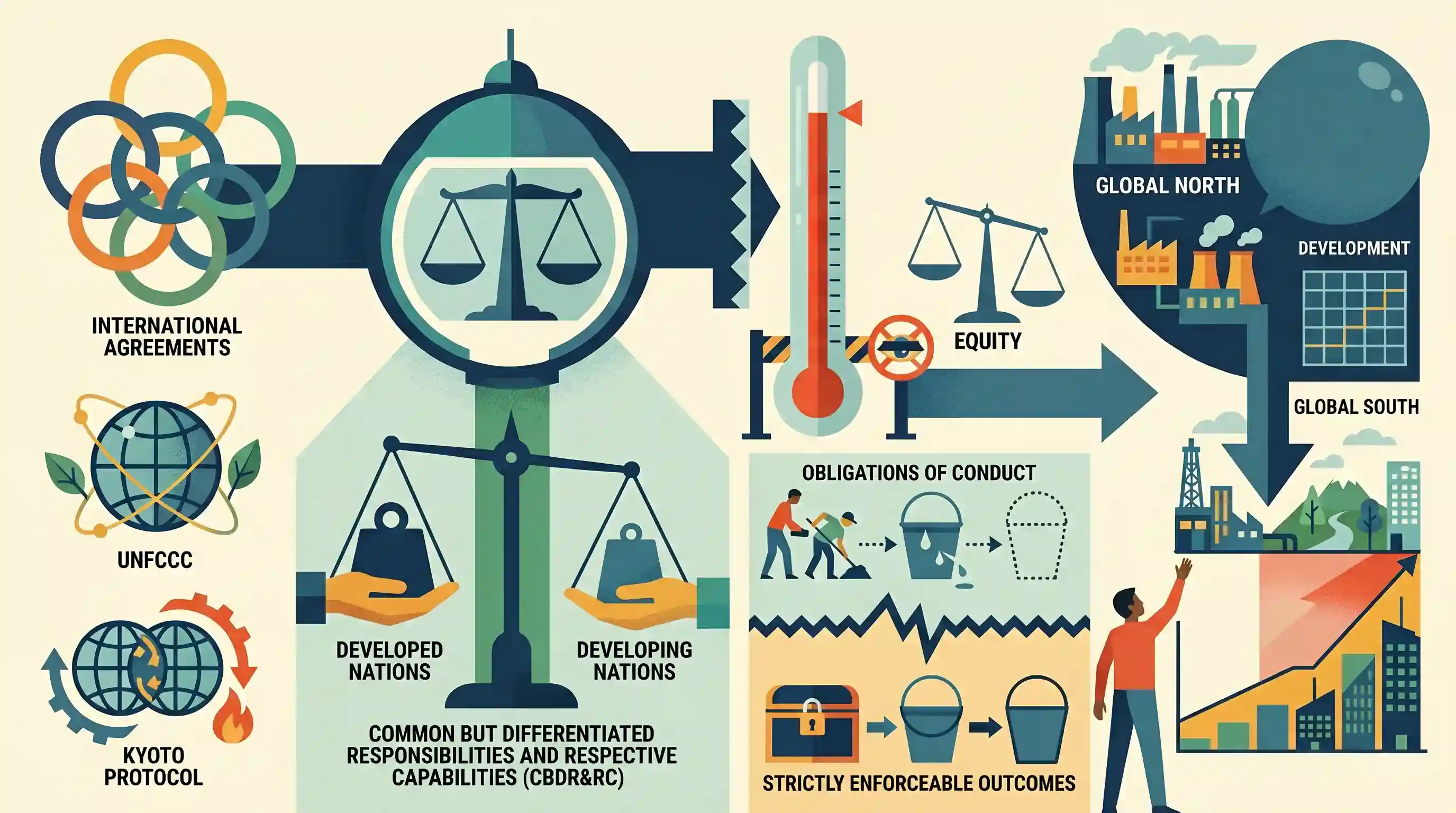
The article analyzes the July 2025 advisory opinion of the International Court of Justice (ICJ) regarding state obligations on climate change. While it positively reaffirmed the fundamental roles of the UNFCCC, the Kyoto Protocol, and the principle of Common But Differentiated Responsibilities and Respective Capabilities (CBDR&RC), it has been criticized for uncritically endorsing the 1.5°C temperature target without addressing equity. Furthermore, the opinion maintains that domestic mitigation and climate finance are merely 'obligations of conduct' rather than strictly enforceable outcomes, largely sidelining the critical development imperatives and carbon space requirements of the Global South.
Key Points
- The ICJ's advisory opinion affirmed the totality of the multilateral climate regime, including the UNFCCC, Kyoto Protocol, and Paris Agreement, rejecting developed countries' attempts to solely focus on the Paris accord.
- The ruling reiterated Common But Differentiated Responsibilities and Respective Capabilities (CBDR&RC) as the core guiding principle of international climate treaties, validating the Global South's demand for equity.
- The Court surprisingly reinterpreted the Paris Agreement's temperature goal by prioritizing the 1.5°C limit over the 'well below 2°C' target, relying on uncritical readings of COP decisions and IPCC AR6 reports.
- Obligations for domestic mitigation and providing climate finance were classified merely as 'obligations of conduct' rather than strict results, resulting in weak enforcement mechanisms against historical polluters.
- The opinion was criticized for ignoring the developmental imperatives of developing nations, particularly the need for adequate carbon space, finance, and technology to balance poverty eradication with low-carbon growth.
Important Terms
International Court of Justice (ICJ)

The United Nations' principal judicial organ, which settles legal disputes between states and provides advisory opinions on international legal questions, such as climate change obligations.
UPSC context
GS Paper 2: International Institutions. Important for understanding the legal enforcement of global environmental norms and state responsibility.
UNFCCC
A 1992 international treaty that established the primary framework for global climate action, aiming to stabilize greenhouse gas concentrations in the atmosphere.
UPSC context
GS Paper 3: Environment and Conservation. Essential foundational knowledge for all international climate negotiations and agreements.
Paris Agreement
A 2015 legally binding treaty within the UNFCCC that aims to limit global warming to well below 2°C, preferably 1.5°C, through Nationally Determined Contributions (NDCs).
UPSC context
GS Paper 3: Climate Change. Key for questions on global mitigation strategies, NDCs, and the 1.5°C temperature target.
CBDR-RC
A principle acknowledging that while all states are responsible for environmental protection, their duties differ based on historical contributions to emissions and their technical/financial capacities.
UPSC context
GS Paper 3: Climate Justice. Vital for discussing equity between the Global North and South in climate negotiations.
Kyoto Protocol
A 1997 treaty that operationalized the UNFCCC by committing industrialized nations to legally binding greenhouse gas emission reduction targets during specific commitment periods.
UPSC context
GS Paper 3: Environment. Important historical context for the evolution of binding international climate law and the differentiation of state responsibilities.
Obligation of Conduct
A legal requirement where a state must exert its best efforts or exercise due diligence to reach a goal, without being strictly liable if the specific result is not achieved.
UPSC context
GS Paper 2: International Law. Crucial for understanding the enforceability and "due diligence" standards often applied to climate mitigation and finance.
Prelims Trap
The ICJ ruled that providing climate finance is an enforceable obligation of result for developed nations.
The ICJ explicitly classified climate finance and domestic mitigation as 'obligations of conduct' (duty to try/make an effort), limiting strict enforcement for outcomes.
Static Concepts Connected
What is the principle of CBDR-RC under the UNFCCC?
- Origin: Formalized at the 1992 Earth Summit (Rio Declaration) and forms the cornerstone of the UNFCCC and Kyoto Protocol.
- Core meaning: Acknowledges that all states share responsibility for environmental protection, but differentiated based on national circumstances and capabilities.
- Historical burden: Dictates that developed nations (historical polluters) must bear the primary burden for mitigation and provide finance/technology to developing nations.
How do ICJ Advisory Opinions differ from contentious cases?
- Authorization: Only authorized UN organs (like the General Assembly) and specialized agencies can request advisory opinions, not individual states.
- Binding nature: Unlike judgments in contentious cases between states, advisory opinions are not legally binding, though they carry immense moral and authoritative legal weight.
Cross-Topic Patterns
Climate Lawfare by Island Nations
The push for this ICJ opinion originated from Vanuatu and Small Island Developing States (SIDS), marking a growing trend of using international tribunals (ICJ, ITLOS) for climate lawfare.
Carbon Colonialism vs Right to Development
The ICJ’s strict endorsement of the 1.5°C limit connects to GS3 debates on 'carbon colonialism', as it severely shrinks the remaining carbon budget needed for India's poverty eradication and industrialization.

Expect a 2026 Prelims statement testing whether climate finance is a strict 'obligation of result' or merely an 'obligation of conduct'.
Linked PYQs · 4
Linked PYQs · 4
- 2025PrelimsGS1
Consider the following statements : Statement I: Article 6 of the Paris Agreement on climate change is frequently discussed in global discussions on sustainable development and climate change. Statement II: Article 6 of the Paris Agreement on climate change sets out the principles of carbon markets. Statement III : Article 6 of the Paris Agreement on climate change intends to promote inter-country non-market strategies to reach their climate targets. Which one of the following is correct in respect of the above statements?
- 2022PrelimsGS1
"Climate Action Tracker" which monitors the emission reduction pledges of different countries is a :
- 2025MainsGS3
Write a review on India's climate commitments under the Paris Agreement (2015) and mention how these have been further strengthened in COP26 (2021). In this direction, how has the first Nationally Determined Contribution intended by India been updated in 2022?
- 2020MainsGS3
Explain intra-generational and inter-generational issues of equity from the perspective of inclusive growth and sustainable development.
