Yamuna Rejuvenation Plan Limitations and Environmental Flow Issues
Source:Indian Express ↗
Why It Matters
Provides a critical evaluation of urban river rejuvenation models, emphasizing the necessity of maintaining 'environmental flow' (e-flow) and adopting integrated urban water management (such as rainwater harvesting and wetland conservation). These concepts are highly relevant for GS3 (Environment/Pollution) and GS1 (Geography/Urban Water Resources).
Summary
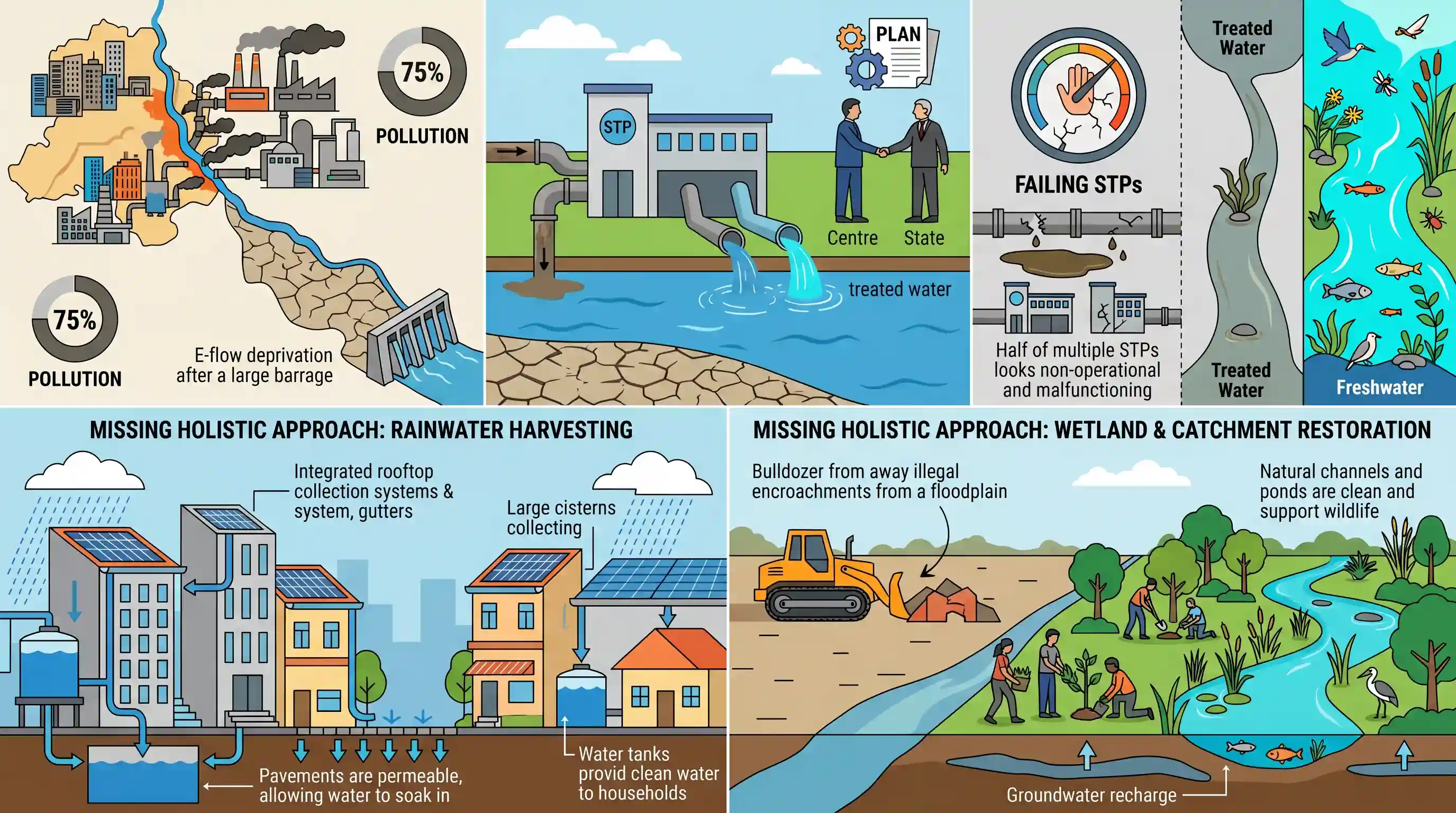
The article analyzes a new joint action plan by the Centre and the Delhi government aimed at rejuvenating the heavily polluted Yamuna River. Although Delhi accounts for merely 22 km of the river's length, it generates 75% of its pollution, severely depriving the Yamuna of its environmental flow (e-flow) downstream of the Wazirabad Barrage. While the new project intends to utilize treated water from Sewage Treatment Plants (STPs) to restore some ecological functions, the editorial highlights multiple shortcomings. It notes that 50% of Delhi's STPs fail to meet operating standards and emphasizes that treated wastewater cannot substitute the freshwater required for a thriving aquatic ecosystem. Furthermore, the plan fails to adopt a holistic approach; it overlooks the essential integration of rainwater harvesting to reduce the city's water dependence, as well as the need to actively refurbish urban wetlands and catchment areas rather than solely clearing floodplain encroachments.
Key Points
- Delhi spans only 22 km of the Yamuna's 1,400 km stretch but is responsible for 75% of the river's pollution.
- The river loses its entire environmental flow (e-flow) downstream of the Wazirabad Barrage, primarily carrying wastewater from over 20 drains instead of freshwater.
- A new joint action plan by the Centre and Delhi government aims to restore e-flow by discharging treated water from Sewage Treatment Plants (STPs) downstream of the Wazirabad and Okhla barrages.
- According to the Delhi Pollution Control Committee (DPCC), at least half of Delhi's STPs currently fail to meet operating standards, making upgrades a prerequisite.
- The plan overly relies on treated STP water, which is not equivalent to freshwater; natural freshwater is vital to nurture a healthy aquatic ecosystem.
- Comprehensive river rejuvenation must go beyond removing floodplain encroachments to include rainwater harvesting, urban wetland refurbishment, and catchment area protection to reduce the city's dependence on the river.
Important Terms
Environmental Flow (e-flow)

The minimum volume, timing, and quality of water flow required to sustain freshwater ecosystems and the human livelihoods that depend on them.
UPSC context
GS III: Environment & Conservation. Tests understanding of ecological sustainability in river rejuvenation and federal water-sharing disputes.
Yamuna Action Plan (YAP)
A bilateral project between India and Japan (via JICA) launched in 1993 to reduce Yamuna's pollution; current phases focus on intercepting sewage and upgrading Delhi's treatment capacity.
UPSC context
GS II & III: Governance & Environment. Relevant for evaluating multi-billion dollar environmental missions and urban infrastructure challenges.
Delhi Pollution Control Committee (DPCC)
A statutory body under the Air and Water Acts responsible for implementing environmental laws, monitoring pollution levels, and ensuring industry compliance within the National Capital Territory.
UPSC context
GS II: Statutory Bodies. Essential for questions on institutional failure in environmental governance and urban pollution control.
Parliamentary Standing Committee on Water Resources
A department-related legislative body that provides oversight on the Ministry of Jal Shakti, reviewing national water policies, river projects, and interstate water conflicts.
UPSC context
GS II: Parliament & State Legislatures. Tests knowledge of legislative oversight and committees' roles in monitoring executive environmental performance.
Sewage Treatment Plant (STP)
Infrastructure designed to remove physical, chemical, and biological contaminants from municipal wastewater; key indicators of their efficiency include BOD (Biochemical Oxygen Demand) and COD levels.
UPSC context
GS III: Infrastructure & Pollution. Focuses on technological interventions for waste management and the 'polluter pays' principle.
Dissolved Oxygen (DO)
The amount of oxygen dissolved in water, critical for aquatic life; levels below 5 mg/l generally indicate a stressed or "dead" river ecosystem.
UPSC context
GS III: Environment & Science. A core scientific metric for assessing water quality and ecological degradation in Mains answers.
Wazirabad Barrage
A structure on the Yamuna in North Delhi that serves as the city's primary source of raw drinking water; it marks the point where river flow drastically declines.
UPSC context
GS I: Geography & GS III: Water Management. Crucial geographical landmark for discussing Delhi's water crisis and interstate river distribution.
Prelims Trap
Mandatory Environmental Flow (e-flow) of rivers can be achieved solely by discharging treated wastewater from sewage treatment plants.
E-flow fundamentally requires natural freshwater to sustain specific temperature, nutrient balance, and biodiversity. Treated sewage water cannot biologically replicate these natural ecological properties.
Static Concepts Connected
What is Environmental Flow (e-flow) in river management?
- Definition: The minimum quantity, timing, and quality of water flow required to sustain freshwater and estuarine ecosystems, along with human livelihoods depending on them.
- Regulatory Mandate: The concept was legally codified for the Ganga basin in 2018 via an executive notification under the EPA 1986, setting mandatory minimum flow thresholds during different seasons.
- Ecological Role: Ensures natural sediment transport, maintains dissolved oxygen levels, prevents salinity intrusion in estuaries, and supports the life cycles and migration of aquatic fauna.
What are the key parameters used to measure river pollution levels?
- BOD (Biochemical Oxygen Demand): The amount of dissolved oxygen needed by aerobic organisms to break down organic material. Higher BOD indicates higher organic sewage pollution (a major issue for the Yamuna).
- COD (Chemical Oxygen Demand): Measures the total oxygen required to chemically oxidize all organic and inorganic substances in water. COD is inherently higher than BOD.
- Dissolved Oxygen (DO): The oxygen freely available in water. When BOD rises due to untreated sewage discharge, DO drops significantly, severely compromising the survival of aquatic life.
Cross-Topic Patterns
Sponge City approach to river rejuvenation
Replacing the narrow focus on clearing floodplains with holistic urban wetland restoration and rainwater harvesting mirrors the 'Sponge City' model, linking pollution control to urban flood management.
Inter-state water disputes & upper riparians
Delhi’s inability to maintain natural e-flow downstream of Wazirabad is deeply entangled with upstream barrages (Hathnikund) and historical water-sharing disputes with Haryana under the 1994 Upper Yamuna agreement.

Expect a multi-statement question on 'e-flow' assessing the ecological differences between natural freshwater and treated STP wastewater.
Linked PYQs · 5
Linked PYQs · 5
- 2024MainsGS3
Industrial pollution of river water is a significant environmental issue in India. Discuss the various mitigation measures to deal with this problem and also the government's initiatives in this regard.
- 2018MainsGS1
The ideal solution of depleting ground water resources in India is water harvesting system." How can it be made effective in urban areas?
- 2021MainsGS1
What are the environmental implications of the reclamation of water bodies into urban land use ? Explain with examples.
- 2015MainsGS3
Discuss the Namami Gange and National Mission for Clean Ganga (NMCG) programmes and causes of mixed results from the previous schemes. What quantum leaps can help preserve the river Ganga better than incremental inputs?
- 2013MainsGS3
Enumerate the National Water Policy of India. Taking river Ganges as an example, discuss the strategies which may be adopted for river water pollution control and management. What are the legal provisions of management and handling of hazardous wastes in India?
