Strategic Implications of United States Strike on Iran
Source:Indian Express ↗
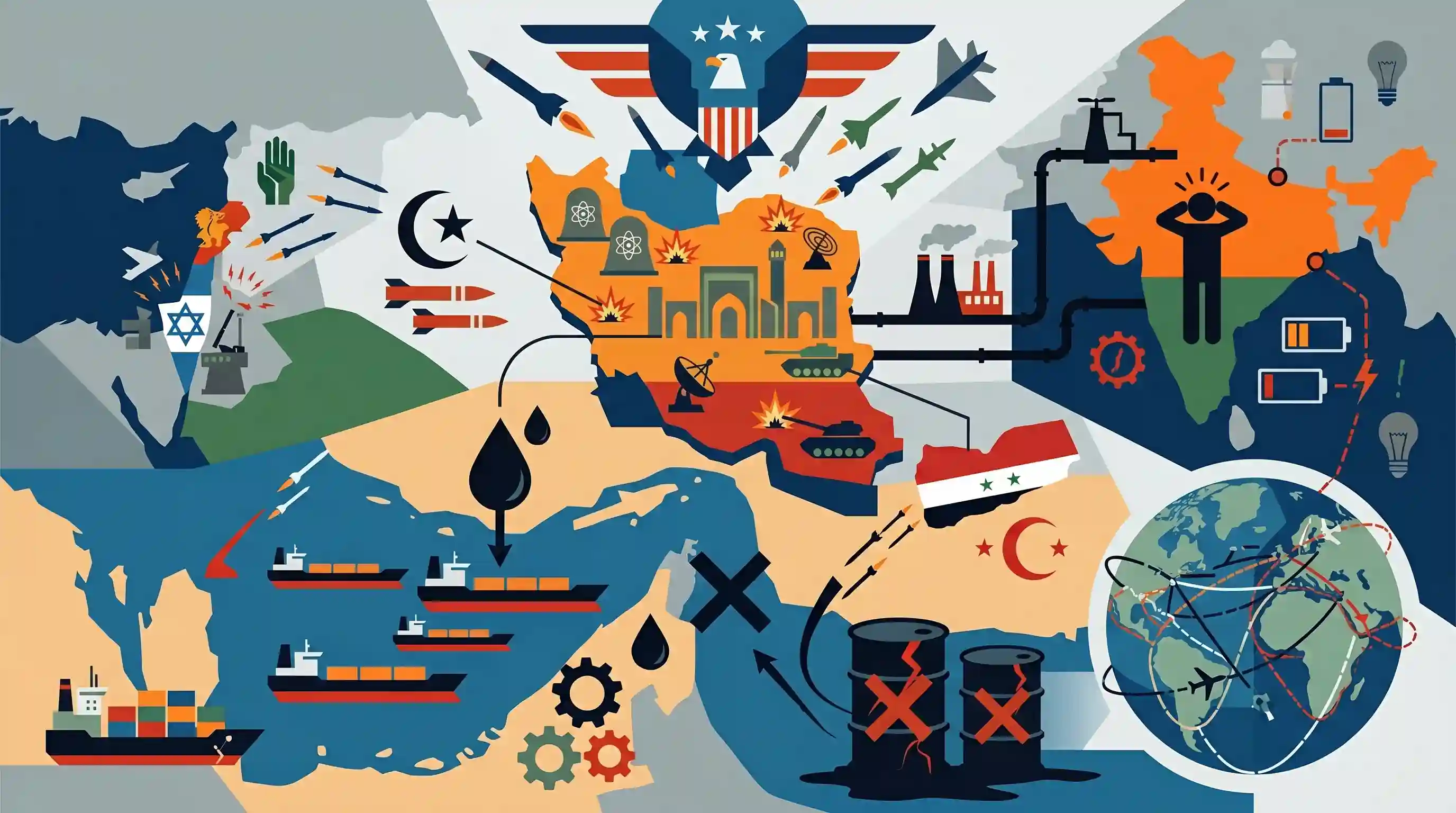
Why It Matters
West Asia is critical to India's energy security (supplying the majority of its crude oil imports) and hosts a large Indian diaspora contributing significant remittances. Instability in the Persian Gulf directly threatens India's macroeconomic stability through oil-driven inflation.
Summary
The article outlines the potential scenarios and global ramifications of a direct US military strike on Iran. It analyzes the escalation pathways, including attacks on Iranian nuclear or military sites, and Iran's likely asymmetric responses through its regional proxy networks like Hezbollah and the Houthis. A critical focal point is the threat to the Strait of Hormuz, which could disrupt a significant portion of global oil transit, leading to severe economic shocks. The geopolitical fallout would destabilize the Middle East, drawing in regional powers like Israel and posing severe macroeconomic risks to oil-importing nations like India due to energy insecurity and supply chain chaos.
Key Points
- The article evaluates multiple scenarios of a direct US military strike on Iran, ranging from targeted attacks on nuclear sites to broader assaults on IRGC infrastructure.
- Iran's asymmetric retaliation strategy would likely involve activating its 'Axis of Resistance' proxies (Hezbollah, Houthis) to target US regional assets and Israel.
- A key choke point is the Strait of Hormuz; any Iranian attempt to block or disrupt shipping here would trigger a severe global energy crisis by halting significant portions of the world's oil transit.
- Such a conflict would have profound macroeconomic implications for energy-importing countries like India, manifesting through imported inflation and supply chain bottlenecks.
Important Terms
JCPOA (Joint Comprehensive Plan of Action)

A 2015 landmark agreement between Iran and world powers (P5+1) aimed at limiting Iran's nuclear enrichment capabilities in exchange for lifting international economic sanctions.
UPSC context
GS-II: International Relations. Tests understanding of nuclear non-proliferation and its impact on India's energy security and regional connectivity.
Islamic Revolutionary Guard Corps (IRGC)
An elite branch of Iran's armed forces, independent of the regular military, responsible for protecting the Islamic system and overseeing regional proxy operations through its Quds Force.
UPSC context
GS-II: International Relations. Tests knowledge of regional security dynamics and the role of state-sanctioned paramilitary forces in West Asia.
Strait of Hormuz
A vital maritime chokepoint between Oman and Iran connecting the Persian Gulf to the Gulf of Oman; it handles approximately 20% of global petroleum and LNG trade.
UPSC context
GS-I: Geography; GS-III: Energy Security. Tests awareness of global oil transit vulnerabilities and India's macroeconomic exposure.
Hezbollah
A Lebanon-based Shia militant group and political party supported by Iran; it acts as a significant regional proxy and is a core member of the "Axis of Resistance."
UPSC context
GS-II: International Relations. Tests understanding of West Asian geopolitics and the strategic "proxy war" between Iran and Israel.
Houthis (Ansar Allah)
A Zaydi Shia militant movement in Yemen, backed by Iran, which controls significant territory and has disrupted global maritime trade through attacks in the Red Sea.
UPSC context
GS-II: International Relations. Tests knowledge of regional conflicts, maritime security, and threats to the global supply chain.
Hamas
A Palestinian Sunni Islamist organization that has governed the Gaza Strip since 2007; it receives significant funding and training from Iran for armed resistance against Israel.
UPSC context
GS-II: International Relations. Tests awareness of the Israel-Palestine conflict and regional power struggles involving Iranian-backed groups.
Prelims Trap
"The Strait of Hormuz connects the Red Sea to the Gulf of Aden."
UPSC frequently swaps geographical features in West Asia. Hormuz connects the Persian Gulf to the Gulf of Oman, not the Red Sea/Gulf of Aden.
Static Concepts Connected
How do severe crude oil price shocks affect India's macroeconomy?
- CAD Widening: Higher import bills for crude oil directly expand India's Current Account Deficit (CAD), straining foreign exchange reserves.
- Imported Inflation: Increased fuel and freight costs cascade into domestic transport and manufacturing, raising CPI and WPI inflation.
- Currency Depreciation: Higher dollar demand by oil marketing companies to pay for imports puts downward pressure on the Indian Rupee.
What are the critical maritime chokepoints in the Middle East?
- Strait of Hormuz: Links the Persian Gulf to the Gulf of Oman; crucial for oil exports from the UAE, Saudi Arabia, and Iran.
- Bab el-Mandeb: Links the Red Sea to the Gulf of Aden; vital for all maritime traffic heading towards the Suez Canal.
- Suez Canal: An artificial sea-level waterway in Egypt connecting the Mediterranean Sea to the Red Sea.
Cross-Topic Patterns
Instability threatening Chabahar & INSTC
Geopolitical escalation and potential US sanctions on Iran directly jeopardize India's strategic access to Afghanistan and Central Asia via Chabahar port and the International North-South Transport Corridor (INSTC).
Energy crises and India's SPRs
Supply shocks in the Persian Gulf highlight the urgency of expanding India's Strategic Petroleum Reserves (SPRs) beyond the current Phase 1 capacity (5.33 MMT) to buffer against energy insecurity.

Expect a 2026 Prelims matching question linking West Asian straits (Hormuz, Bab el-Mandeb) with regional proxy actors (Houthis, Hezbollah).
Linked PYQs · 4
Linked PYQs · 4
- 2018MainsGS2
In what ways would the ongoing US-Iran Nuclear Pact Controversy affect the national interest of India? How should India respond to this situation?
- 2025MainsGS2
"Energy security constitutes the dominant kingpin of India's foreign policy, and is linked with India's overarching influence in Middle Eastern countries.” How would you integrate energy security with India's foreign policy trajectories in the coming years?
- 2017MainsGS2
The question of India's Energy Security constitutes the most important part of India's economic progress. Analyze India's energy policy cooperation with West Asian countries.
- 2024PrelimsGS1
Consider the following statements : Statement-I : Sumed pipeline is a strategic route for Persian Gulf oil and natural gas shipments to Europe. Statement-II : Sumed pipeline connects the Red Sea with the Mediterranean Sea. Which one of the following is correct in respect of the above statements?
