COP31 Deadlock Implications for India Climate Policy
Source:Indian Express ↗
Why It Matters
It sheds light on the fragility of global climate multilateralism and its direct impact on India's climate financing, negotiation strategy, and domestic mitigation-adaptation balance.
Summary
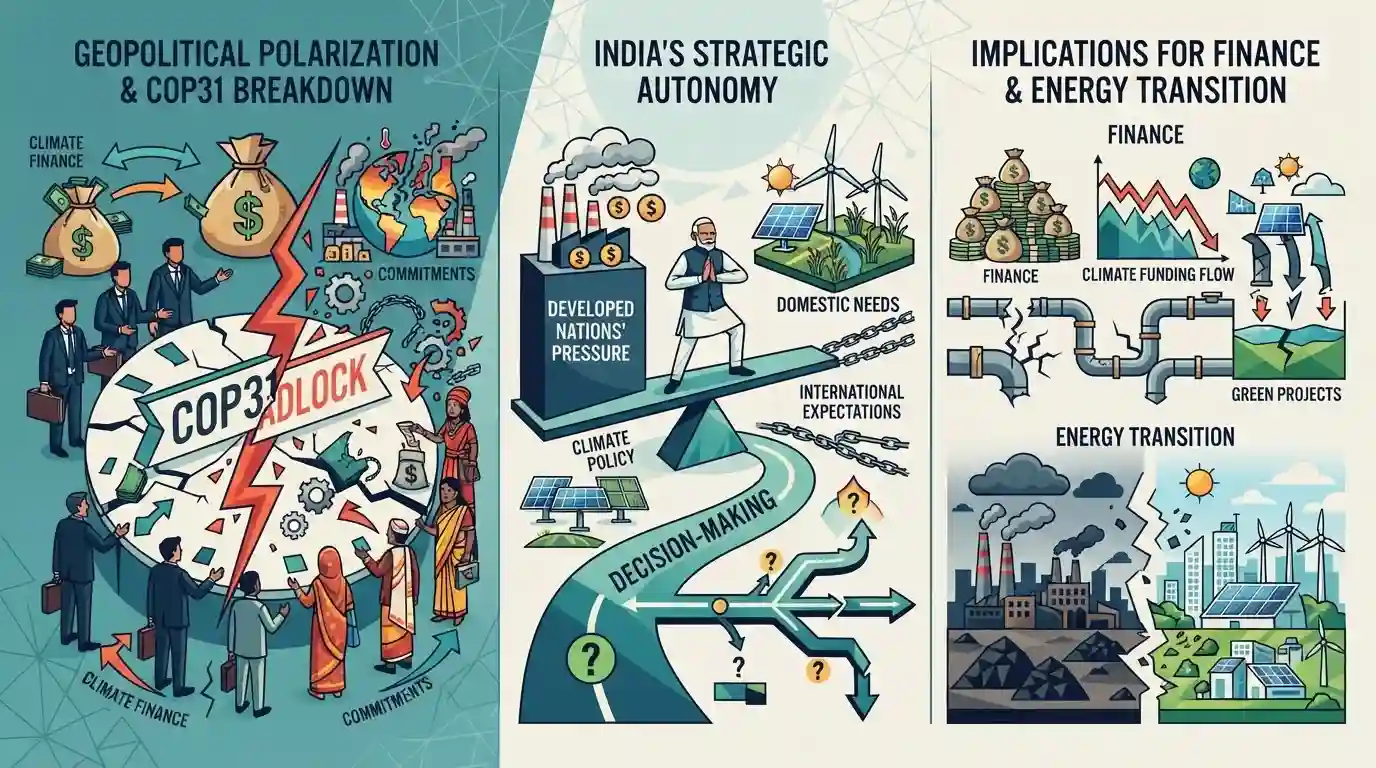
The breakdown of COP31 negotiations and bidding processes reflects deep-seated geopolitical polarization over climate finance and commitments. This article examines what such multilateral deadlocks mean for India's climate policy, emphasizing the implications for finance, energy transition, and strategic autonomy in global climate forums.
Key Points
- The collapse of COP31 hosting bids and ongoing geopolitical gridlock highlight the growing challenges in international climate multilateralism.
- For India, global climate deadlock affects predictable climate finance flows and technology transfer essential for meeting enhanced NDCs.
- India must balance its rapid economic development goals with long-term net-zero commitments while navigating shifting geopolitical alignments on climate.
- The breakdown underscores the need for developing nations to reassess adaptation priorities and domestic resilience strategies independent of stalled global negotiations.
Important Terms
Paris Agreement

A legally binding international treaty on climate change adopted at COP21 in Paris, aiming to hold global temperature rise well below 2°C and pursue efforts to limit it to 1.5°C.
UPSC context
UPSC GS Paper III (Environment & Ecology); tests international conventions, climate governance, and India's global commitments.
Nationally Determined Contributions
Grassroots climate action plans submitted by each country under the Paris Agreement, outlining emissions reduction targets and adaptation strategies tailored to national circumstances.
UPSC context
UPSC GS Paper III (Environment); vital for understanding India's domestic climate policy, energy transition milestones, and equity in burden-sharing.
UNFCCC
The parent treaty of the 1992 Rio Earth Summit that provides the overarching international legal framework for intergovernmental efforts to address climate change.
UPSC context
UPSC GS Paper III (Environment & Ecology); tests foundational multilateral bodies, climate diplomacy principles like CBDR-RC.
COP31
The 31st Conference of the Parties to the UNFCCC, serving as a key annual summit for negotiating international climate rules, finance, and commitments.
UPSC context
UPSC GS Paper III (Environment); tests contemporary geopolitical developments in multilateral climate negotiations and India's strategic positioning.
Static Concepts Connected
What are the core principles governing the UNFCCC and its Paris Agreement?
- CBDR-RC Principle: States share responsibility for environmental degradation but differ in contribution; developed nations must take the lead.
- Precautionary Approach: Lack of full scientific certainty shall not be used as a reason to postpone cost-effective measures to prevent environmental degradation.
- Cost-Effective Measures: Measures to protect the climate system should be cost-effective to ensure global benefits at the lowest possible cost.
Cross-Topic Patterns
Climate Multilateralism + Strategic Autonomy
India's stance at COP forums balances common but differentiated responsibilities with domestic energy security, echoing non-aligned diplomatic postures in global governance.

LMDC equity principles vs. developed world finance pledges will likely feature in a 2-statement Prelims question on UNFCCC frameworks.
Linked PYQs · 2
Linked PYQs · 2
- 2025MainsGS3
Write a review on India's climate commitments under the Paris Agreement (2015) and mention how these have been further strengthened in COP26 (2021). In this direction, how has the first Nationally Determined Contribution intended by India been updated in 2022?
- 2021MainsGS3
Describe the major outcomes of the 26th session of the Conference of the Parties (COP) to the United Nations Framework Convention on Climate Change (UNFCCC). What are the commitments made by India in this conference?
