Central Information Commission Rules on BCCI Public Authority Status
Source:Indian Express ↗
Why It Matters
This topic is crucial for UPSC as it highlights the complex intersection of administrative law, constitutional rights, and corporate governance. The debate on whether private entities performing public duties (like BCCI) should be subject to transparency laws directly relates to GS Paper 2 (Governance & Polity) and GS Paper 4 (Ethics and Accountability). It emphasizes how statutory tests of financing and control limit the reach of transparency, raising broader questions about institutional accountability.
Summary
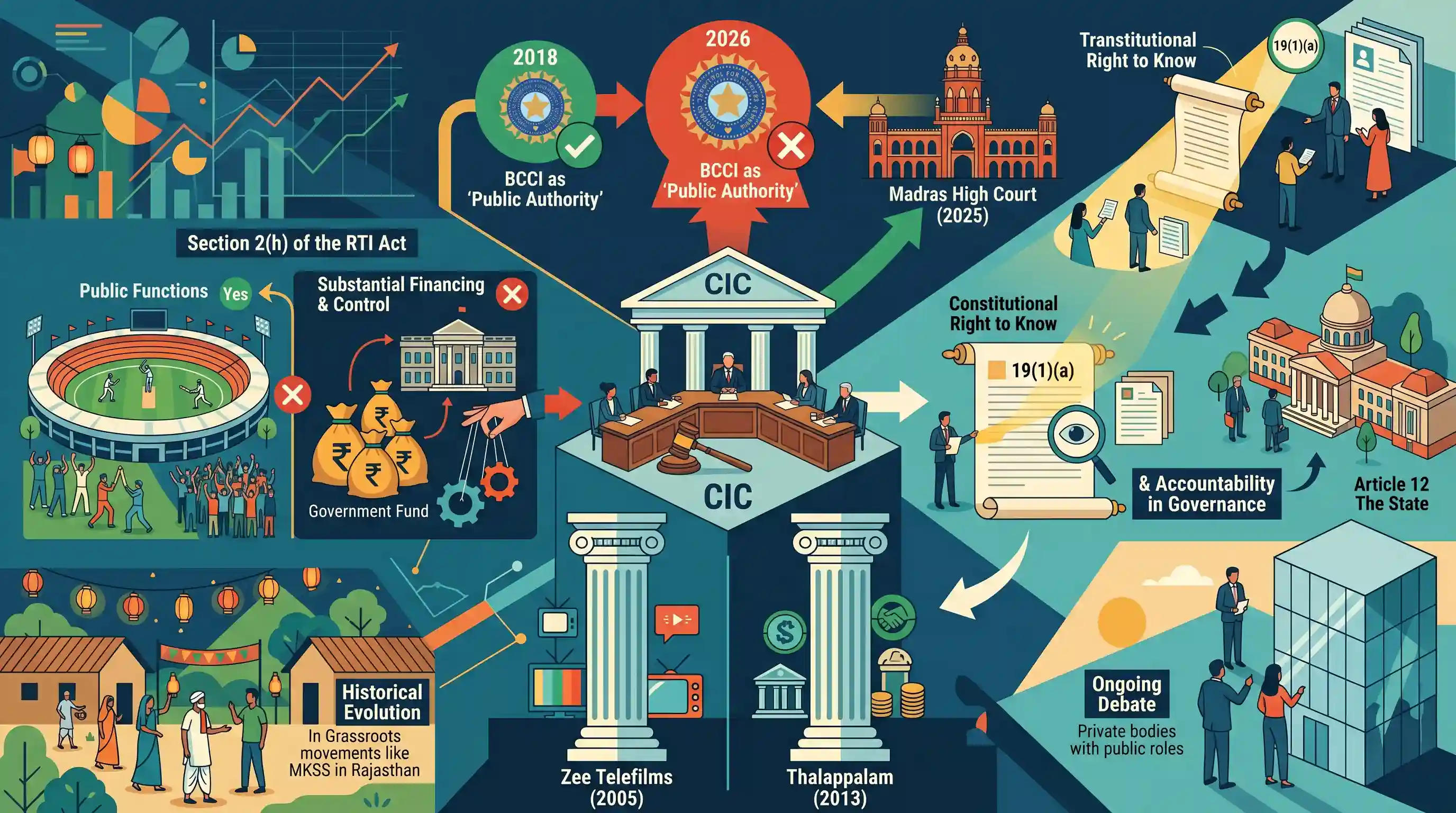
The Central Information Commission (CIC) in May 2026 ruled that the Board of Control for Cricket in India (BCCI) is not a 'public authority' under the Right to Information (RTI) Act, 2005. This decision reversed a 2018 ruling by the then-CIC after the Madras High Court sent the issue back for fresh consideration in September 2025. Relying on key Supreme Court precedents—primarily Thalappalam Service Cooperative Bank (2013) and Zee Telefilms (2005)—the CIC clarified that while the BCCI performs significant 'public functions', performing public functions alone does not fulfill the statutory definitions of 'substantial financing' and 'control' under Section 2(h) of the RTI Act. The article traces the constitutional foundation of the right to know under Article 19(1)(a), the historical evolution driven by grassroots campaigns like the MKSS in Rajasthan, and the ongoing debate over transparency in private-character bodies that handle public roles.
Key Points
- The Central Information Commission (CIC) in May 2026 ruled that the BCCI is a private society registered under the Tamil Nadu Societies Registration Act, 1975, and is not a 'public authority' under Section 2(h) of the RTI Act, 2005.
- Under Section 2(h) of the RTI Act, a 'public authority' includes bodies established by the Constitution, Parliament/State law, government notifications, or bodies owned, controlled, or 'substantially financed' by the government.
- The Supreme Court in Thalappalam Service Cooperative Bank v. State of Kerala (2013) clarified that government 'control' must be deep and pervasive (not merely regulatory) and 'substantial financing' must be essential to the body's functioning; tax exemptions do not satisfy this test.
- The CIC maintained that performing 'public functions' (such as choosing the national team or using the name 'India') does not automatically bring an entity under Section 2(h), as the term 'public function' is not present in the statutory definition.
- Section 4 of the RTI Act mandates proactive disclosure, systematic record-keeping, and the designation of Public Information Officers (PIOs) for all public authorities to facilitate access to information.
- The constitutional underpinnings of the 'right to know' stem from Article 19(1)(a) (Freedom of Speech and Expression), as established in State of UP v. Raj Narain (1975), and was propelled into law by the Mazdoor Kisan Shakti Sangathan (MKSS) movement in 1990s Rajasthan.
Important Terms
Right to Information (RTI) Act, 2005

A landmark Indian legislation that empowers citizens to secure access to information under the control of public authorities, promoting transparency and accountability in governance.
UPSC context
GS Paper II (Governance). Tests accountability, transparency, citizen charters, and the statutory frameworks governing public information disclosure in India.
Central Information Commission (CIC)
The statutory appellate authority established under the RTI Act, 2005, to adjudicate complaints and second appeals regarding information access from central public authorities.
UPSC context
GS Paper II (Constitutional & Statutory Bodies). Evaluates knowledge of oversight bodies, administrative dispute resolution, and regulatory independence.
Mazdoor Kisan Shakti Sangathan (MKSS)
A grassroots peasant and worker organization in Rajasthan, formed in 1990, whose struggle for wage transparency pioneered the civil society movement that led to the RTI Act.
UPSC context
GS Paper II (Civil Society & Governance). Analyzes the role of non-governmental organizations, grassroots mobilization, and social audits in policymaking.
Board of Control for Cricket in India (BCCI)
The national governing body for cricket in India, operating as an autonomous private society registered under the Tamil Nadu Societies Registration Act, 1975.
UPSC context
GS Paper II (Governance). Explores the interface between private organizations, public functions, and the statutory limits of transparency laws.
Constitution of India
The supreme legal document of India, establishing the political framework and fundamental rights, which judicially underpins the "right to know" under Article 19(1)(a).
UPSC context
GS Paper II (Polity). Crucial for analyzing fundamental rights, judicial interpretation, and constitutional limits of state authority versus private entities.
Tamil Nadu Societies Registration Act, 1975
A state legislation governing the registration and regulation of societies, scientific, or charitable associations in Tamil Nadu, under which the BCCI is registered.
UPSC context
GS Paper II (Governance). Evaluates the legal and statutory framework under which private autonomous associations and non-governmental bodies are regulated.
Prelims Trap
Any entity performing public functions or representing India internationally is deemed a public authority under the RTI Act.
The Supreme Court ruled that performing public functions is not a statutory category under Section 2(h). Control must be deep/pervasive, and funding must be essential.
Static Concepts Connected
What defines a 'public authority' under Section 2(h) of the RTI Act?
- Core Establishment: Created by the Constitution, Parliament, State Legislatures, or executive notifications.
- Financial Test: Owned, controlled, or substantially financed directly or indirectly by government funds.
- NGO Coverage: Non-governmental organizations (NGOs) that receive substantial funding from government sources.
How does 'State' under Article 12 differ from 'Public Authority'?
- Article 12: Broader definition for enforcing fundamental rights; includes entities performing public functions.
- RTI Section 2h: Strictly requires structural ownership, deep control, or substantial financing, not just functional nature.
- Judicial Nuance: An entity can be subject to writ jurisdiction without being answerable under the RTI Act.
Cross-Topic Patterns
Sports bodies & financial transparency
Excluding autonomous sports monopolies from RTI highlights the policy gap between public representation and governance accountability in privately run national sports boards.
Constitutional rights vs statutory limits
Balances the constitutional right to information under Article 19(1)(a) against literal statutory limits governing administrative transparency laws.

Expect a 2026 question contrasting Article 12 'State' with RTI 'Public Authority' based on the BCCI and Thalappalam rulings.
Linked PYQs · 2
Linked PYQs · 2
- 2018MainsGS4
"The Right to Information Act is not all about citizens' empowerment alone, it essentially redefines the concept of accountability." Discuss.
- 2020MainsGS2
Recent amendments to the Right to Information Act will have profound impact on the autonomy and independence of the Information Commission". Discuss.
