Bharat Stage Seven Emission Standards and Air Pollution Policy
Source:The Hindu ↗
কেন এটি গুরুত্বপূর্ণ
Understanding vehicular emission standards like BS-VII is crucial for evaluating India's policy framework on air pollution mitigation, urban air quality management under initiatives like NCAP, and technological transitions in the automotive sector.
সারসংক্ষেপ
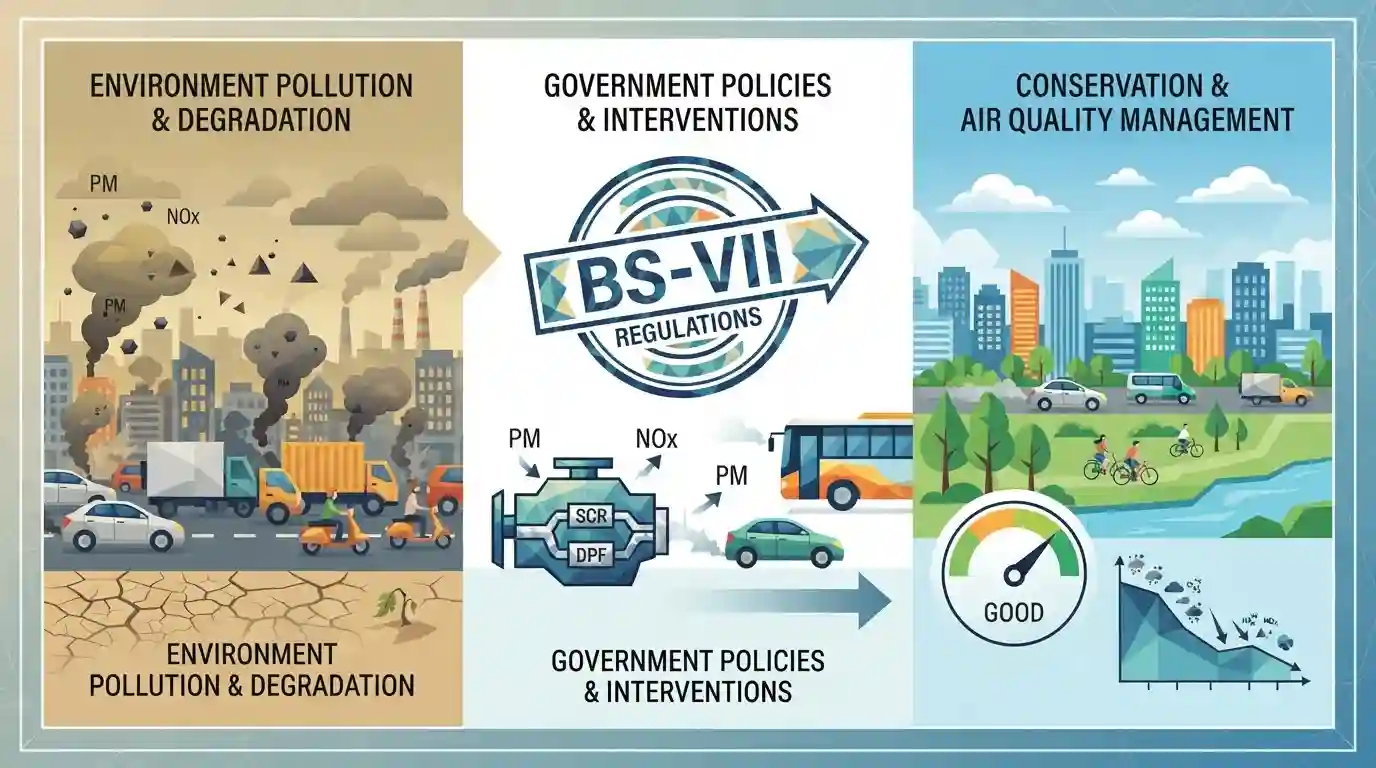
The article explains the proposed Bharat Stage-VII (BS-VII) vehicle emission regulations in India, detailing how stricter norms for vehicular pollutants like NOx and particulate matter will impact automobile manufacturing, pricing, and air quality management.
মূল বিষয়
- India is moving forward with proposed Bharat Stage VII (BS-VII) vehicle emission regulations to further curb vehicular pollution and align with global environmental benchmarks.
- The proposed norms aim to target stricter emission limits for particulate matter (PM), nitrogen oxides (NOx), and other pollutants from new vehicles.
- Autom automakers face technological and cost challenges in upgrading engines and exhaust after-treatment systems, which may impact vehicle pricing.
- The transition emphasizes India's broader climate commitments and ongoing urban air quality management strategies.
গুরুত্বপূর্ণ শব্দ
Bharat Stage VII Emission Norms

Proposed ultra-strict vehicle emission standards in India aimed at significantly lowering pollutants like NOx, particulate matter, and non-exhaust emissions while introducing advanced monitoring like Environmental Vehicle Passports.
UPSC context
UPSC Prelims/Mains (GS Paper III - Environment Pollution & Degradation, Government Policies). Tests knowledge of cutting-edge policy tools for vehicular emission control.
National Clean Air Programme
India’s flagship national strategy launched to improve air quality in non-attainment cities, aiming for targeted reductions in PM10 and PM2.5 pollutant concentrations.
UPSC context
UPSC Prelims/Mains (GS Paper III - Environmental Conservation and Pollution). Essential for questions on national action plans and targets against urban air pollution.
Central Pollution Control Board
The apex central statutory body under the Ministry of Environment, Forest and Climate Change mandated to promote cleanliness of streams and wells and improve air quality across India.
UPSC context
UPSC Prelims (GS Paper III - Environment/Statutory Bodies). Tests understanding of environmental governance, regulatory authorities, and implementation agencies.
Ministry of Road Transport and Highways
The central government ministry responsible for formulating and administering national policies, rules, and regulations relating to road transport, national highways, and vehicular safety and emission standards.
UPSC context
UPSC Prelims/Mains (GS Paper II/III - Governance and Infrastructure Policy). Important for tracking inter-ministerial roles in framing vehicle regulatory standards.
সংযুক্ত স্থির ধারণা
What is the genesis and evolution of Bharat Stage (BS) emission norms in India?
- Policy Genesis: Auto Fuel Policy: Introduced in 2003, recommending roadmaps for rollout of Euro-based norms across India.
- Leapfrogging: Direct Leap: India bypassed BS-V entirely, jumping from BS-IV directly to nationwide BS-VI on April 1, 2020.
- Fuel Quality: Fuel Standards: BS-VI mandated ultra-low sulfur fuel (10 ppm sulfur) and reduced benzene and aromatics content.
আন্তঃবিষয় প্যাটার্ন
EV Battery Life & Non-Exhaust Pollution
BS-VII standards regulate non-exhaust sources like tire and brake wear alongside EV battery durability, linking transport policy directly to urban air pollution and circular economy frameworks.

BS-VII non-exhaust standards and EV battery durability clauses will likely feature in a statement-based environment prelims question.
সংযুক্ত PYQ · 1
সংযুক্ত PYQ · 1
- 2020MainsGS3
What are the key features of the National Clean Air Programme (NCAP) initiated by the Government of India?
