BS VII Vehicle Emission Standards and Policy Changes
Source:The Hindu ↗
ఇది ఎందుకు ముఖ్యం
Vehicle emission standards like BS-VII are central to India's urban air pollution control strategy and its long-term climate commitments, making it a recurring theme for GS Paper III (Environment and Pollution).
సారాంశం
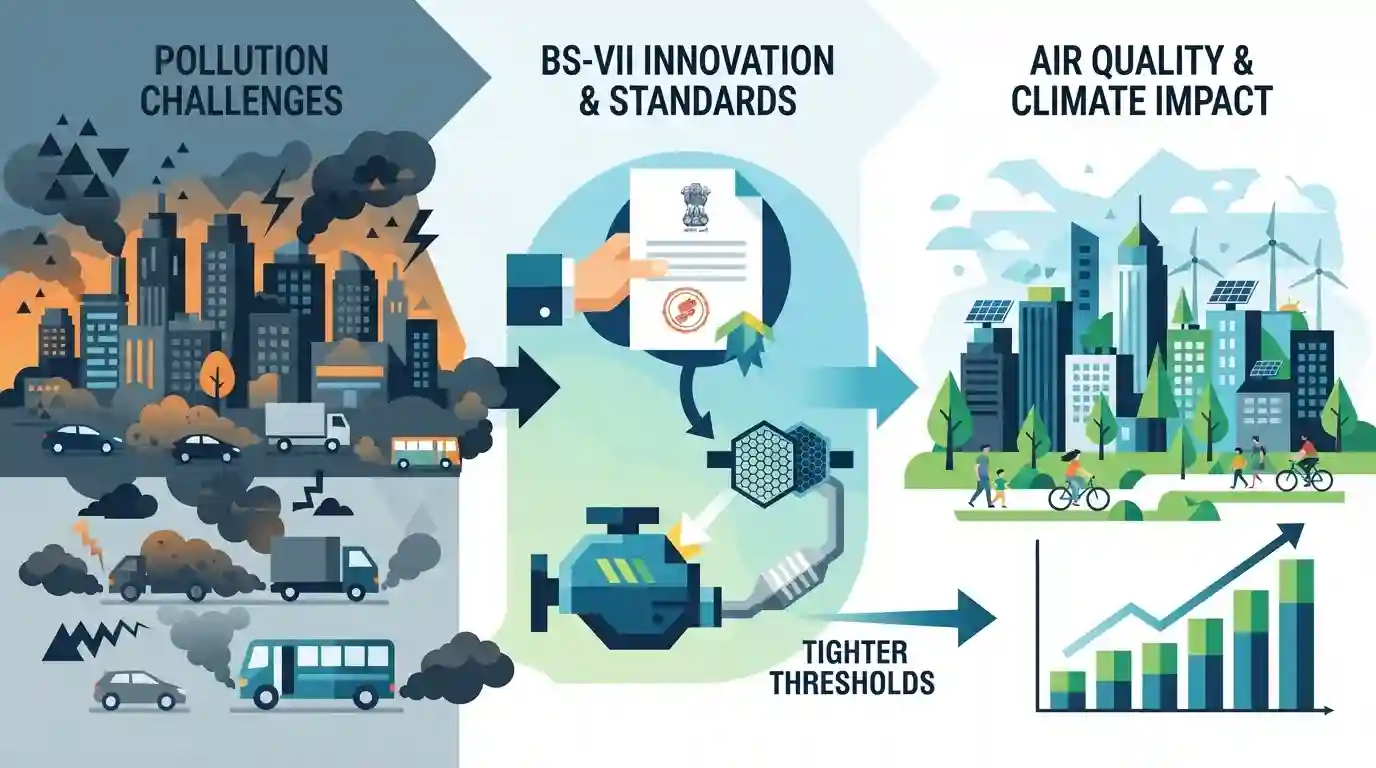
The article explains India's proposed Bharat Stage VII (BS-VII) vehicle emission rules, detailing the upcoming changes, tighter pollution thresholds, technological updates required for automakers, and its overarching significance for India's air quality and climate goals.
ముఖ్య అంశాలు
- India is proposing the transition to Bharat Stage VII (BS-VII) vehicle emission standards to further curb air pollution and align with global best practices.
- BS-VII norms aim to introduce stricter limits on particulate matter (PM), nitrogen oxides (NOx), and introduce more rigorous real-world driving emissions (RDE) testing.
- The implementation timeline requires automobile manufacturers to upgrade technology, potentially impacting vehicle costs while driving green mobility transitions.
- Challenges include balancing stringent ecological mandates with economic viability and ensuring fuel availability upgrades across the country.
ప్రిలిమ్స్ ఉచ్చు
Transition to BS-VII necessitates major upstream modifications in fuel refining infrastructure similar to the BS-IV to BS-VI leap.
Aspirants often assume BS-VII requires massive upstream refinery overhauls like BS-VI did; however, BS-VII focuses primarily on vehicle technology upgrades (brakes, tyres, miniaturized PM capture) without needing 10 ppm sulfur fuel changes.
అనుసంధానమైన స్థిర భావనలు
What are the institutional framework and statutory bodies governing vehicle emission standards in India?
- Legal Basis: Statutory backing comes via the Environment (Protection) Act, 1986, empowering the central government to set emission standards.
- Ministry Role: MoRTH notifies vehicle emission norms under the Central Motor Vehicles Rules (CMVR), 1989.
- Enforcement: CPCB works alongside agencies like ARAI to test compliance and monitor ambient air quality thresholds.
అంతర-అంశ నమూనాలు
Vehicle Emissions + Microplastic Pollution
BS-VII expands regulation to tyre abrasion and brake dust, linking urban transport policy directly with microplastic pollution and waste management frameworks.
Automotive Standards + Circular Economy
Strict non-exhaust and battery durability rules under BS-VII force automakers to integrate circular economy principles into vehicle life cycle assessments.

Expect a statement-based prelims question distinguishing BS-VII's inclusion of non-exhaust emissions from traditional tailpipe-only standards.
అనుసంధాన PYQలు · 1
అనుసంధాన PYQలు · 1
- 2026PrelimsGS1
Consider the following statements with reference to India's response to climate change : I. India's Long-Term Low Emission Development Strategy (LT-LEDS) is a crucial tool for achieving net-zero emissions by 2070. II. India's 4th Biennial Update Report (BUR-4) submitted in December, 2024 recorded around 8% decrease in Greenhouse gas emissions in 2020 over 2019. III. Climate-resilient development necessarily depends on quick and short-term achievement of emission reduction targets. Which of the following relationships among the above statements is/are correct ? 1. Statement I is empirically supported by statement II. 2. Statement III contradicts the approach implicit in statement I. 3. Statement I and statement III together establish the premise of long-term sustainability. Select the answer using the code given below :
