Himalayan Floods Emphasize Need for Transboundary Disaster Resilience
Source:The Hindu ↗
हे का महत्त्वाचे आहे
Transboundary disaster management and climate resilience in the Himalayan ecosystem are crucial for India's national security, environmental stability, and regional cooperation in South Asia.
सारांश
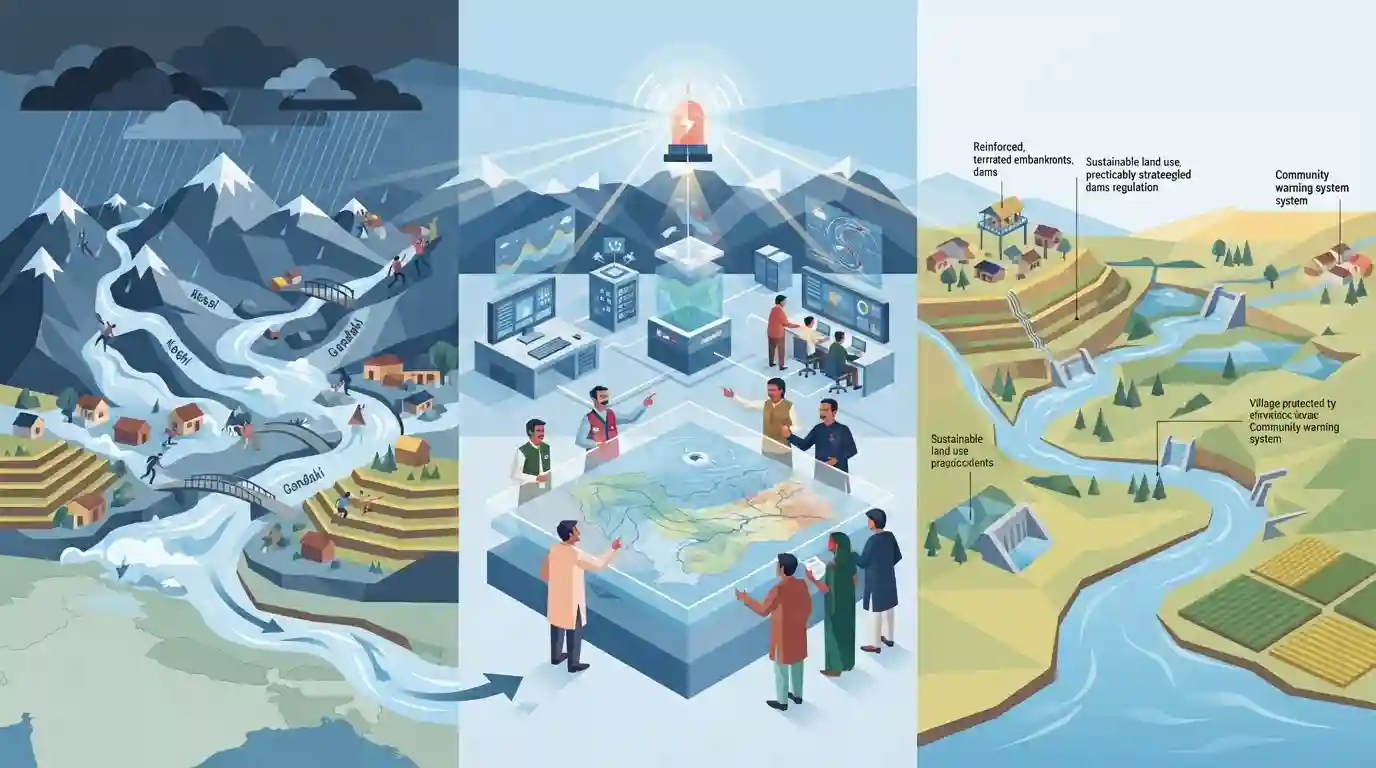
Recent catastrophic floods in Nepal and the wider Himalayan region have brought attention to the pressing need for enhanced regional cooperation and disaster preparedness in South Asia. Experts stress that transboundary early warning systems and integrated river basin management are crucial to combating climate-induced weather extremes.
मुख्य मुद्दे
- Severe floods in Nepal and the Himalayan region underline the urgent necessity for robust cross-border regional disaster preparedness.
- Climate change has increased the frequency and intensity of extreme weather events, including cloudbursts and flash floods across shared Himalayan river basins.
- Transboundary cooperation, data sharing, and early warning systems between South Asian countries are vital to mitigating downstream and upstream devastation.
- Experts like Safi Ahsan Rizvi emphasize moving from reactive disaster response to proactive resilience frameworks aligned with global targets like the Sendai Framework.
महत्त्वाच्या संज्ञा
Sendai Framework for Disaster Risk Reduction

An international agreement (2015-2030) adopted at Sendai, Japan, aimed at preventing new and reducing existing disaster risks through targeted resilience and preparedness measures.
UPSC context
Crucial for GS Paper III (Disaster Management); tests international frameworks, goals, and strategies for risk reduction and climate resilience.
South Asian Association for Regional Cooperation (SAARC)
A regional intergovernmental organization of South Asian nations established in 1985 to promote economic, technological, social, and cultural cooperation and collective self-reliance.
UPSC context
Important for GS Paper II (International Relations); tests regional groupings, bilateral dynamics, and challenges of multilateral cooperation in South Asia.
संबंधित स्थिर संकल्पना
What are the key priorities of the Sendai Framework for Disaster Risk Reduction (2015-2030)?
- Priority 1: Understanding disaster risk across all dimensions of vulnerability, capacity, and exposure.
- Priority 2: Strengthening disaster risk governance to manage disaster risk at local, national, and regional levels.
- Priority 3: Investing in disaster risk reduction for economic, social, cultural, and environmental resilience.
- Priority 4: Enhancing disaster preparedness for effective response and to Build Back Better in recovery.
आंतर-विषय नमुने
Transboundary Waters + Climate Adaptation
Himalayan flash floods illustrate how international river basin governance intersects with climate adaptation and regional security in South Asia.

Himalayan disasters + Sendai Framework + transboundary data sharing mechanisms will feature in GS-3 Disaster Management.
संबंधित PYQ · 3
संबंधित PYQ · 3
- 2019MainsGS3
Disaster preparedness is the first step in any disaster management process. Explain how hazard zonation mapping will help disaster mitigation in the case of landslides.
- 2024MainsGS3
What is disaster resilience? How is it determined? Describe various elements of a resilience framework. Also mention the global targets of Sendai Framework for Disaster Risk Reduction (2015–2030).
- 2024MainsGS3
Flooding in urban areas is an emerging climate-induced disaster. Discuss the causes of this disaster. Mention the features of two such major floods in the last two decades in India. Describe the policies and frameworks in India that aim at tackling such floods.
