Strategic Autonomy Defines India Contemporary Foreign Policy
Source:Indian Express ↗
Why It Matters
Understanding the conceptual friction between India and major global powers is crucial for GS2. It provides the analytical vocabulary needed to answer questions on why India refrains from formal alliances, balances Indo-Russian defense ties with the Quad, and navigates great power competition.
Summary
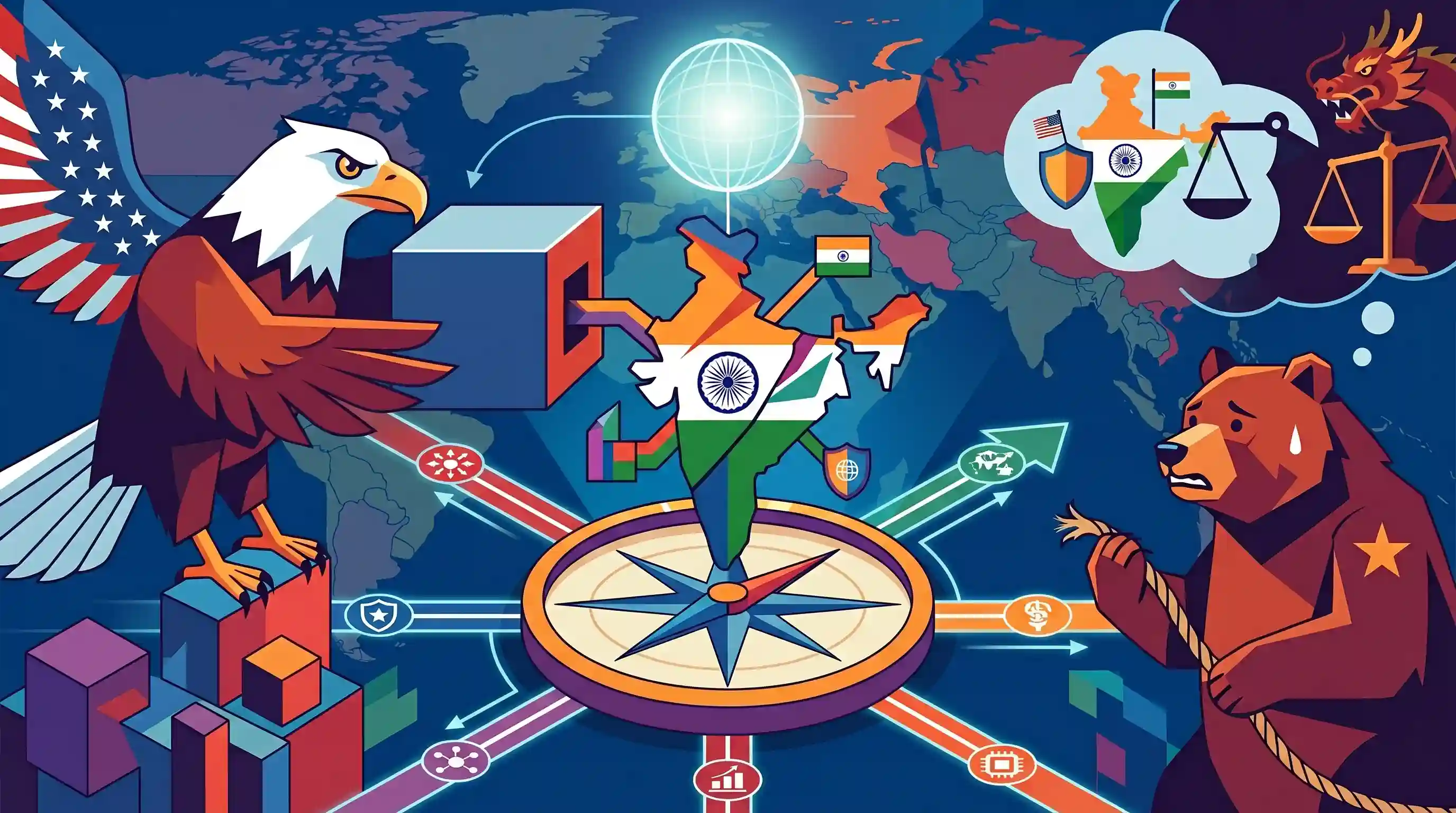
The article critically analyzes the structural misunderstandings that both the United States and Russia harbor regarding India's contemporary foreign policy. The US frequently fails to accommodate India's great-power ambitions and insistence on strategic autonomy, expecting a level of alignment more typical of traditional treaty allies. Conversely, Russia views India's growing strategic and defense partnerships with the West—driven largely by the necessity to counter China—through a zero-sum lens, fearing the loss of a historic partner. The piece argues that both superpowers overlook the fact that today's India pursues an assertive 'multi-alignment' strategy, seeking to maximize its national interests and establish itself as an independent pole in a multipolar global order rather than picking sides in a new Cold War.
Key Points
- Washington often expects India to align seamlessly with Western strategic objectives (e.g., on the Ukraine conflict), failing to appreciate India's insistence on strategic autonomy and its refusal to be a junior partner.
- Moscow views India's deepening defense and strategic ties with the US and the Quad with suspicion, misinterpreting India's need to balance a rising China as a complete pivot to the West.
- India's foreign policy has transitioned from traditional non-alignment to pragmatic multi-alignment, actively engaging with competing global powers based on issue-specific convergences and national interests.
- Ultimately, India seeks to establish itself as an independent, major pole in a multipolar world order, requiring nuanced diplomatic balancing between the US and Russia despite their intense bilateral rivalry.
Important Terms
Strategic Autonomy

A nation's ability to pursue its own foreign policy and national interests without being forced into alliances or dictated to by external powers.
UPSC context
GS II (International Relations). Core pillar of Indian diplomacy, reflecting the shift from Cold War non-alignment to issue-based partnerships.
Multi-alignment
An assertive foreign policy strategy involving concurrent engagement with multiple global powers and groupings (e.g., Quad and BRICS) to maximize national interest.
UPSC context
GS II (Foreign Policy). Represents the transition from passive non-alignment to proactive, pragmatic diplomacy in a multipolar world.
Quad (Quadrilateral Security Dialogue)
An informal strategic forum comprising India, USA, Japan, and Australia, focused on ensuring a free, open, and inclusive Indo-Pacific.
UPSC context
GS II (Regional Groupings). Key mechanism for maritime security and balancing China's influence in the Indo-Pacific region.
NATO (North Atlantic Treaty Organization)
An intergovernmental military alliance established in 1949 for collective defense among Western nations, where an attack on one is an attack on all.
UPSC context
GS II (Global Groupings). Analyzed in terms of India's decision to maintain political dialogue without formal membership.
Zero-sum game
A situation in game theory where one participant's gain is exactly balanced by the losses of other participants.
UPSC context
GS II (IR Theory). Used to critique how superpowers view India's ties with their rivals (e.g., Russia viewing India-US ties).
Indo-Pacific
A critical maritime and terrestrial region spanning the Indian and Pacific Oceans, serving as the primary theater for modern global geopolitics.
UPSC context
GS II (Bilateral/Regional Relations). Focus of India's 'Act East' policy and strategic cooperation with Western partners.
Prelims Trap
"India's participation in the Quad signifies its entry into a formal military alliance."
The Quad is a strategic and economic minilateral dialogue, not a mutual-defense treaty or military alliance. Aspirants frequently mistake it for an "Asian NATO".
Static Concepts Connected
How does Multi-Alignment differ from traditional Non-Alignment?
- Non-Alignment: Historically focused on maintaining a deliberate, ideological distance from Cold War power blocs.
- Multi-Alignment: Involves actively and simultaneously engaging with multiple competing global powers to maximize national interest.
- Issue-based partnerships: Shifts from broad ideological neutrality to pragmatic, flexible, and issue-specific convergences.
What characterizes 'Minilateralism' in modern foreign policy?
- Format: Small, ad-hoc, informal coalitions (e.g., Quad, I2U2) rather than massive, treaty-based organizations (e.g., UN, WTO).
- Purpose: Designed for targeted, flexible problem-solving on specific regional or functional issues.
- Agility: Allows countries to bypass the bureaucratic gridlock and lowest-common-denominator consensus of traditional multilateral forums.
Cross-Topic Patterns
Currency & Strategic Autonomy
India's push for Rupee-Ruble trade and local currency settlements reflects economic strategic autonomy, running directly parallel to its geopolitical multi-alignment.
Defense Indigenization & IR
Reducing dependency on Russian arms isn't just about Western pressure; it connects directly to India's domestic Atmanirbhar Bharat push to secure true long-term strategic autonomy.

Expect a GS-II mains question contrasting India's multi-alignment in 'Cold War 2.0' with its NAM origins, citing Quad and SCO.
Linked PYQs · 3
Linked PYQs · 3
- 2019MainsGS2
‘What introduces friction into the ties between India and the United States is that Washington is still unable to find for India a position in its global strategy, which would satisfy India's national self-esteem and ambitions.’ Explain with suitable examples.
- 2020MainsGS2
What is the significance of Indo-US defence deals over Indo-Russian defence deals? Discuss with reference to stability in the Indo-Pacific region.
- 2023MainsGS2
‘The expansion and strengthening of NATO and a stronger US-Europe strategic partnership works well for India.’ What is your opinion about this statement ? Give reasons and examples to support your answer.
