Transient Lunar Phenomena and Their Significance in Space Science
Source:The Hindu ↗
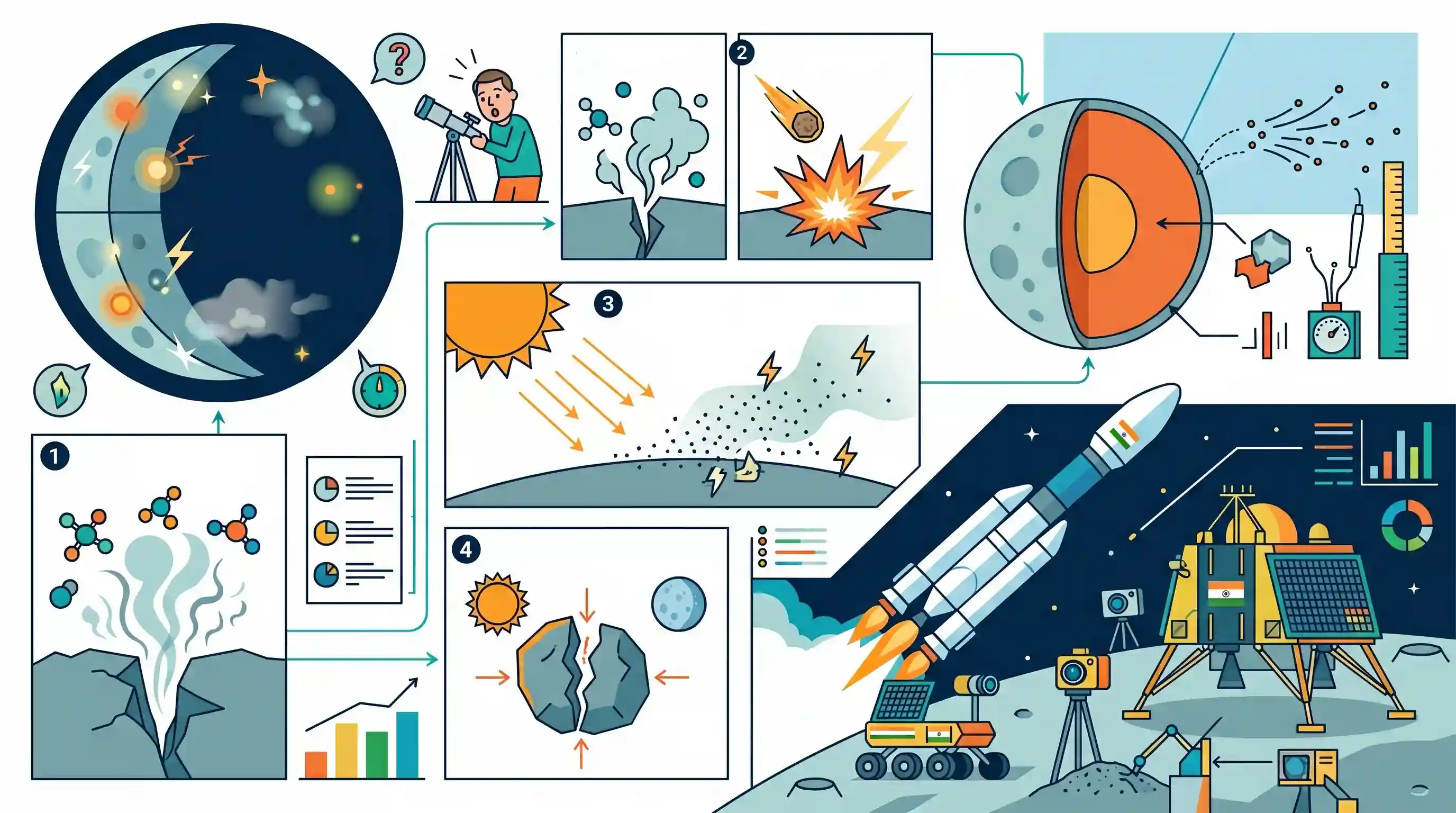
Why It Matters
UPSC frequently asks questions on astronomical terms and space phenomena (like pulsars and nebulae in Prelims) and space exploration missions (like Chandrayaan in Mains). TLPs are relevant to India's continued interest in studying the lunar surface and exosphere.
Summary
Transient Lunar Phenomena (TLP) refer to short-lived anomalies observed on the Moon's surface, such as brief flashes of light, transient colours, or temporary hazy obscurations. Because the Moon is considered geologically inactive and lacks a substantial atmosphere, these events have historically intrigued and puzzled astronomers. Modern science proposes several mechanisms to explain TLPs, including lunar outgassing (where gases like radon escape from surface fissures), meteoroid impacts that create brief flashes of light upon striking the surface, electrostatic levitation of lunar dust driven by solar wind, and thermal fracturing of rocks due to extreme day-night temperature shifts. Studying TLPs provides vital clues about the Moon's exosphere and interior, which is a major focus for global space missions, including India's Chandrayaan programme.
Key Points
- Transient Lunar Phenomena (TLPs) are brief, short-lived visible changes in the brightness, colour, or clarity of the lunar surface.
- Despite the Moon lacking an atmosphere and active volcanoes, observations of TLPs such as flashes of light or hazy patches have puzzled astronomers.
- Potential causes of TLPs include lunar outgassing (release of trapped gases from the interior), meteor impacts generating flashes of light, and electrostatic discharge caused by the solar wind interacting with lunar dust.
- Understanding TLPs is significant for lunar exploration and future crewed missions (like Artemis or Gaganyaan-derived missions), as phenomena like levitating dust or frequent micro-meteoroid impacts pose challenges to equipment and astronauts.
Important Terms
Transient Lunar Phenomena (TLP)

Short-lived optical anomalies on the Moon’s surface, including flashes, glows, or mists. These suggest the Moon may be more geologically active than previously thought.
UPSC context
GS Paper III (Science & Technology); tests awareness of lunar geology and recent astronomical observations.
Lunar Outgassing
The escape of trapped gases (like radon or argon) from the Moon's interior through surface fissures, often triggered by tidal stresses or internal heat.
UPSC context
GS Paper III; relates to planetary geology and theories explaining lunar surface changes.
Electrostatic Levitation
A process where solar radiation and wind charge lunar dust, causing particles to loft above the surface and scatter light, creating a hazy appearance.
UPSC context
GS Paper III; technical concept involving solar-planetary interactions and challenges for lunar missions.
Lunar Exosphere
The extremely thin, tenuous atmosphere of the Moon where gas molecules rarely collide; primarily composed of helium, neon, and argon.
UPSC context
GS Paper III; relevant for space weather, solar wind interactions, and India's Chandrayaan findings.
Chandrayaan Programme
India's flagship lunar exploration initiative by ISRO, involving orbiters, landers, and rovers to study the Moon's mineralogy, water ice, and exosphere.
UPSC context
GS Paper III; high-priority topic for India's technological achievements and international space standing.
ISRO (Indian Space Research Organisation)
India's premier space agency responsible for the Chandrayaan missions; it achieved a historic soft landing near the lunar South Pole in 2023.
UPSC context
GS Paper III; core body for space-related developments and indigenous technology.
NASA (National Aeronautics and Space Administration)
The U.S. space agency that partners with global agencies and monitors TLPs via missions like the Lunar Reconnaissance Orbiter (LRO).
UPSC context
GS Paper III; relevant for international collaboration and major global space milestones.
Prelims Trap
"Transient Lunar Phenomena indicate the presence of active volcanic eruptions on the Moon."
The Moon lacks active volcanism. TLPs are caused by lunar outgassing (release of trapped subsurface gases like radon via fissures), meteor impacts, or electrostatic dust levitation—not magma eruptions.
Static Concepts Connected
How does 'lunar outgassing' occur on a geologically inactive Moon?
- Gas Release: Trapped subsurface gases (like argon and radon) are released from the Moon's interior through surface cracks and fissures.
- Thermal & Seismic Triggers: The release is often driven by thermal stress from extreme day-night temperature variations or shallow seismic activity (moonquakes).
- Exosphere Contribution: These escaping gases temporarily contribute to the Moon's ultra-thin, dynamic exosphere before escaping into space.
How does solar wind cause 'electrostatic levitation' of lunar dust?
- Direct Bombardment: Without a global magnetic field, the lunar surface is directly bombarded by solar wind and high-energy UV radiation.
- Electrical Charging: This radiation knocks electrons off the lunar dust, giving the particles a strong electrical charge.
- Repulsion & Levitation: Like-charged dust particles repel each other, lifting off the surface to create a hazy, mist-like effect that scatters sunlight.
Cross-Topic Patterns
Exosphere mapping via Chandrayaan payloads
TLPs directly connect to ISRO's CHACE-2 payload, which studies the Moon's dynamic exosphere by mapping Argon-40, validating that trapped gases continuously escape the lunar interior.
Space weather impacts on planetary bodies
The Moon's lack of a protective magnetosphere means solar wind and CMEs directly bombard its surface, electrically charging dust—a key space weather concept connecting Aditya-L1 studies to lunar exploration.

Expect a 2026 prelims statement testing if the Moon has an atmosphere, pairing TLP outgassing with Chandrayaan-2's CHACE-2 payload.
Linked PYQs · 2
Linked PYQs · 2
- 2023MainsGS3
What is the main task of India's third moon mission which could not be achieved in its earlier mission? List the countries that have achieved this task. Introduce the subsystems in the spacecraft launched and explain the role of the Virtual Launch Control Centre' at the Vikram Sarabhai Space Centre which contributed to the successful launch from Sriharikota.
- 2023PrelimsGS1
Consider the following pairs: Objects in space Description 1. Cepheids: Giant clouds of dust and gas in space 2. Nebulae: Stars which brighten and dim periodically 3. Pulsars: Neutron stars that are formed when massive stars run out of fuel and collapse How many of the above pairs are correctly matched?
